Emotion steering for Cantonese TTS: borrowed activation directions add angry, fear and sad - with zero emotion-labelled Cantonese speech
November 15, 2026 - by TTS Navi. We read the model card, method note and dose maps in full; all results below are the authors' own measurements and one blind listener.
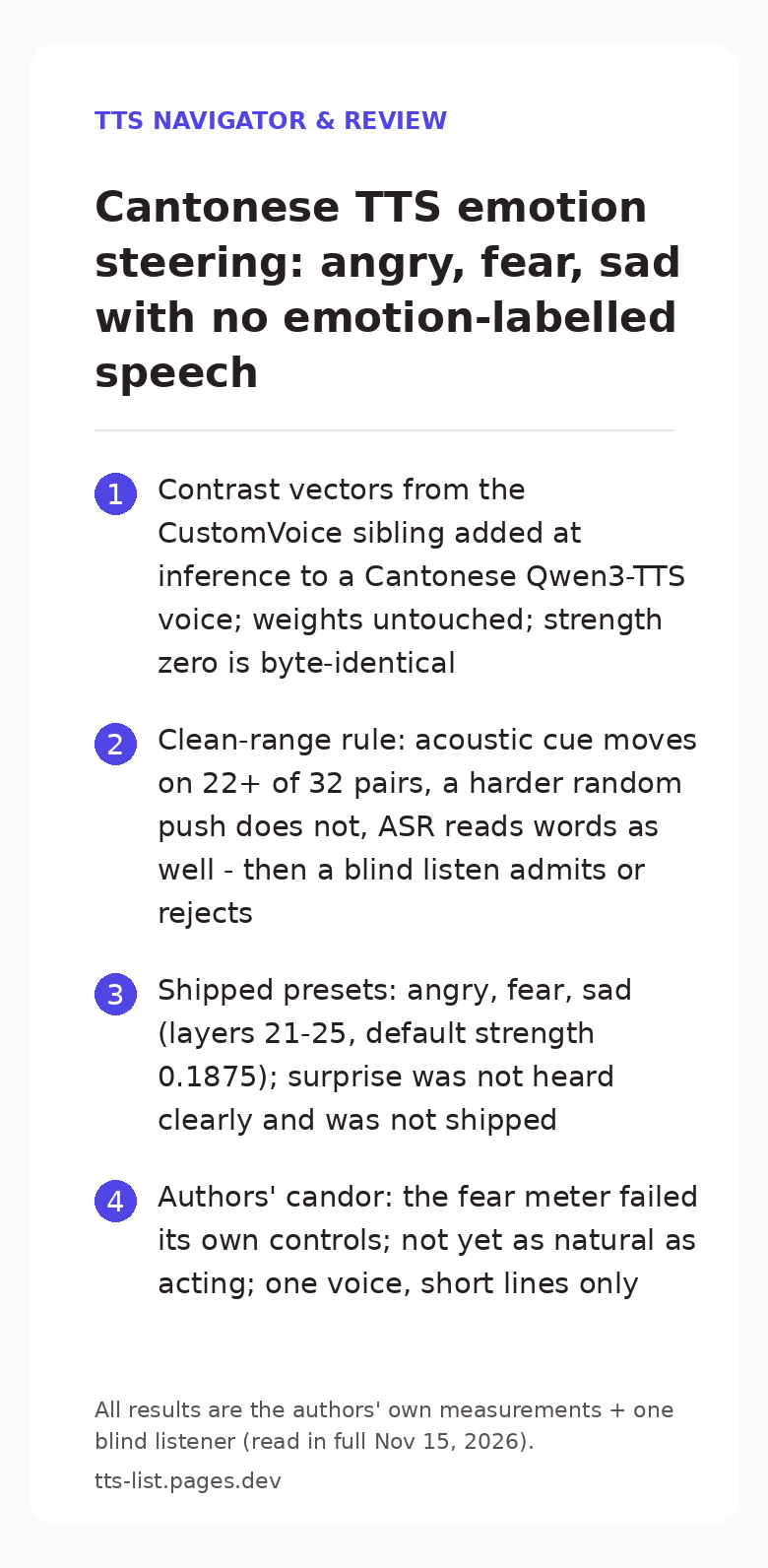
The Hong Kong Cantonese Qwen3-TTS voice (jmtl/hk-cantonese-cc0-qwen3-tts, v0.0.5) was fine-tuned from Qwen3-TTS Base, which cannot follow a style instruction - there is no way to ask it to sound angry. Its sibling, Qwen3-TTS CustomVoice, can. A new pack, hk-cantonese-cc0-qwen3-tts-emotion-steering (v0.1.0, November 15, Apache-2.0), transfers a slice of that ability without training on anything: for each emotion, the authors read Cantonese lines through CustomVoice with and without the emotion instruction, averaged the hidden-state difference at each talker layer into one direction per layer (a contrast vector, in the Representation Engineering sense), and now add that direction to the Cantonese model while it speaks. The weights are never changed; a strength of zero reproduces the plain model byte for byte. Three presets ship - angry, fear, sad - each a small safetensors file with per-layer vectors for layers 21-25.
Why no emotion-labelled data was needed
The usual route to emotional TTS is recordings labelled by emotion, and the authors know of no emotion-labelled Cantonese corpus whose licence allows commercial use. This pack uses none: the emotion direction comes from the sibling model's instruction contrast, the Cantonese model contributes the language and the voice, so the release keeps its commercial-friendly stack (Apache-2.0 code and weights, CC-0 training data). The check protocol borrows from interpretability hygiene: a strength only counts as clean when the emotion's acoustic cue moves the right way on at least 22 of 32 line pairs, a random direction pushed harder does not produce the effect, no render runs away, and an ASR reads the words as well as on the plain model. Then, and only then, a listener heard the candidate blind against the plain model - in the authors' framing, a meter can rule a preset out, but only the listen can let one in.
The dose maps, and the honest parts
Every preset ships with a full dose map: layers x strength x runtime (PyTorch and the ggtts GGUF runtime) x sentence type, with the outcome spelled out per cell - clean, moved-at-a-cost-to-intelligibility, or broke-the-render (past the clean range the model can run on and never stop; greedy decoding does not terminate on this model at all). Defaults are layers 21-25 at strength 0.1875; the push is 3-4% of the hidden state's magnitude at each layer. The candor goes further than most papers: the automatic emotion meters are mostly trained on English and Mandarin and untested on Cantonese, and where a meter failed its own control (it could not recognise even CustomVoice's instructed fear), the card prints the reading and marks it uninformative - the fear preset's automatic evidence is explicitly weak, and its case rests on the blind listen. Speaker-similarity meters register the push (0.68-0.79 ECAPA against the plain render, where a second draw of the plain model reads 0.841), but the blind listener never heard a different person at default strength (0 of 20 pairs) - read it as a change in delivery within the same voice. Surprise was tried and not shipped (not heard clearly); disgust and happy are pending the blind listen.
The stated limits
A fixed menu of three emotions, never a free-text instruction. The clean strength range is narrow and past it you are on untested ground - the authors point to SteerSpeech's learned correction (arXiv 2610.10415) as the known fix this pack lacks. One voice, short lines only (up to 45 characters); other voices and long passages untested. The borrowed directions were made with Mandarin instruction text, and part of an emotion may be speed or loudness rather than feeling. Text that already carries emotion is read with some of that emotion by the plain model - the blind listen used such lines, so pushing an emotion against the text's meaning is untested by ear. And the first-cut caveat up front: the steered render is not yet as natural as a speaker acting the emotion.
Our analysis
Activation steering has been the LLM alignment community's party trick for two years; this is the cleanest application to TTS we have seen, and the first we know of that ships as an end-user pack with presets, dose maps and a runtime flag. The licensing insight is the strategic part: if steering vectors really transfer emotion control from an instruction-following sibling, then low-resource voices can borrow expressivity from well-resourced ones without touching the one dataset type that is hardest to license - emotion-labelled speech. Hold the caveats the authors themselves insist on: the evidence is one blind listener plus meters of admitted mixed value, the fear direction is the shakiest, and naturalness is not yet actor-grade. But as a method - contrast vectors from a sibling, clean-range dose maps, "the listen admits, the meter rejects" as the release rule - this is a template every community voice project can reuse, and it costs one GPU afternoon instead of a labelled corpus.
Sources
- Emotion steering pack (card, METHOD.md, MODEL_CARD.md - read in full, November 15, 2026)
- The Cantonese voice it steers (v0.0.5)