The EmoTra-TTS authors cannot release their weights - so RetentionLabs reproduced the paper and verified it bitwise
November 24, 2026 - TTS Navi. We read the reproduction's model card in full, including its training, precision and verification sections. All figures are the reproducers' own measurements, not our tests.
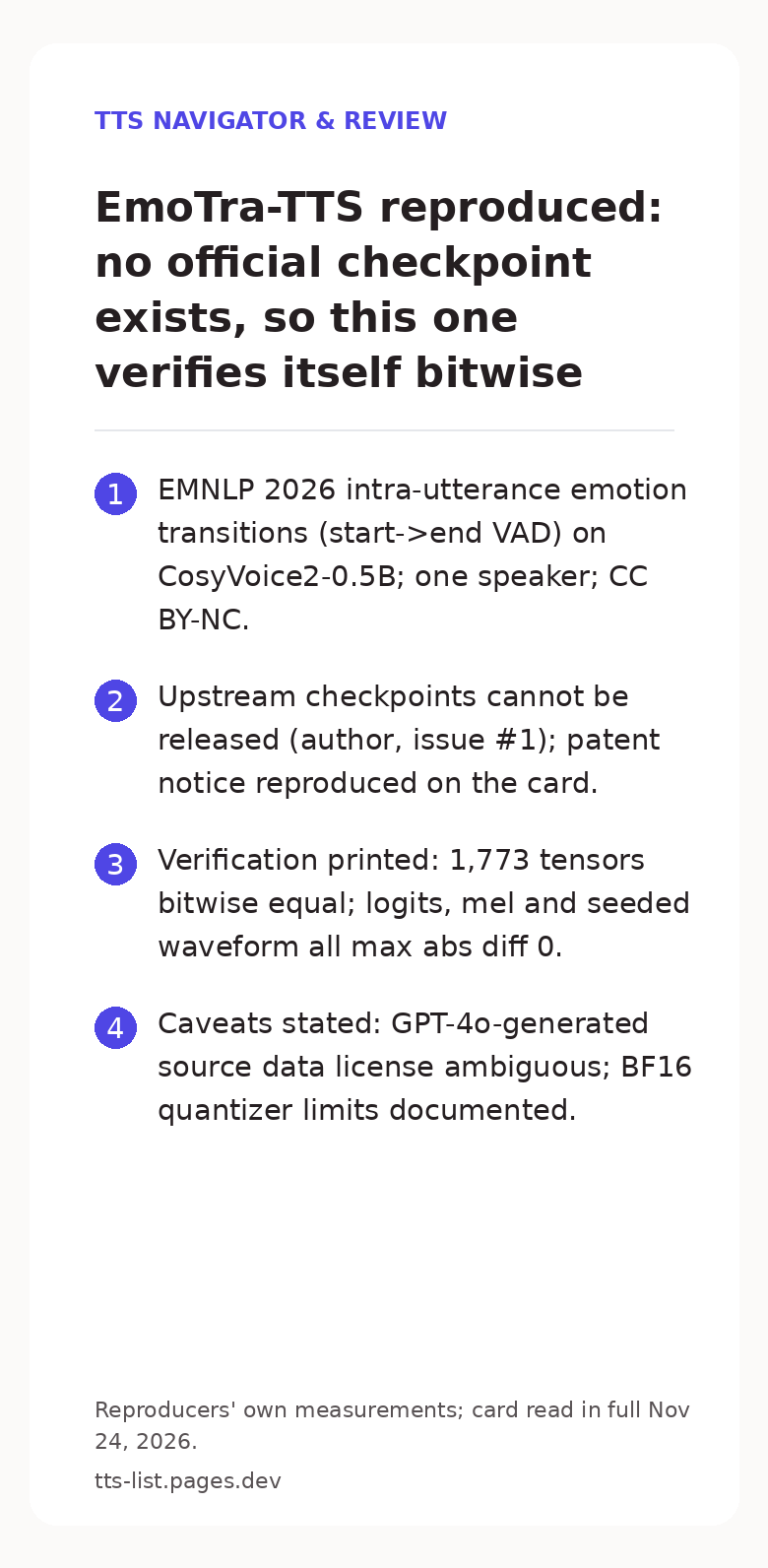
EmoTra-TTS (Liu et al., EMNLP 2026) fine-tunes CosyVoice2 so the emotion inside a single utterance moves from a start VAD (arousal, valence, dominance) to an end VAD - a sentence that begins calm and ends angry, controlled by two vectors. No official checkpoint exists: the reproducers searched the Hub, the upstream repo, Zenodo and the demo page on October 12, 2026, and quote the first author writing in upstream issue #1 (September 8) that the paper's checkpoints cannot be released; the upstream README carries a patent notice on the core method. RetentionLabs' EmoTra-TTS (released November 23, 2026) is an independent reproduction of the upstream recipe at a traced commit, on CosyVoice2-0.5B, one fixed English speaker (ash of EmoVoice-DB), in transformers format with self-contained remote code. Weights CC BY-NC 4.0, code Apache-2.0, the patent notice reproduced on the card rather than buried.
How the transition is built
Stage I: the start and end VAD are interpolated into five points, each projected to one input embedding and placed between the sequence start and the text, so token k carries (1-alpha) x start + alpha x end; an auxiliary perceptron maps the first and last VAD tokens to pooled hidden states of audEERING's w2v2 VAD regressor on the two reference utterances. Stage II adds a per-frame emotion embedding to the flow-matching estimator's speaker input, holding the start VAD for the first 40% of mel frames, moving linearly to the end VAD by 70%, holding after. The card notes one place where paper and code differ - the paper text says only the VAD modules train, the upstream code trains the whole language model - and follows the code. Stage II trains exactly 283,120 parameters (flow.vad_downsample, flow.emo_layer_norm).
Verification as the headline
The released folder, loaded in a fresh process with trust_remote_code and no training code installed, was compared against the model the training code assembles from the raw stage checkpoints on one held-out record: 1,773 tensors bitwise equal; teacher-forced logits over 139 positions x 6,564 classes at max abs diff 0; flow-matching mel at fixed noise, diff 0; a seeded 120,960-sample waveform, diff 0. Reproductions usually ask for trust; this one prints a table that makes the released artifact auditable against its own pipeline. Held-out losses are printed too (Stage I 2.7353, Stage II 0.8509) - on a split the runs did not train on.
The caveats are part of the release
The training data is 50k synthetic transitions built with the upstream scripts from EmoVoice-DB - itself a corpus generated with GPT-4o - and the card states plainly that the license status of weights trained on GPT-4o-generated speech may be ambiguous. Precision is documented to the buffer: everything BF16 except the HiFT spectral transforms and the FSQ quantizer (BF16 cannot represent token ids above 256 exactly), with the measured cost of that choice - the BF16 speech tokenizer reproduces 114 of 116 reference tokens where FP32 reproduces all 116. Single speaker, not zero-shot, English only, generation is seed-dependent, no text normalization. This is what a research-artifact release looks like when the people writing the card assume you will check.
Sources
- https://huggingface.co/RetentionLabs/EmoTra-TTS
- https://arxiv.org/abs/2608.23791
- https://github.com/Liu-Tianchi/EmoTra-TTS