tujia-tts v0.3: a TTS for an endangered language, trained on 6.4 hours, honest about everything it cannot do
November 20, 2026 - TTS Navi. We read the tujia-tts v0.3 model card and its license NOTICE in full. Evaluation figures are the author's own probe results, not our tests.
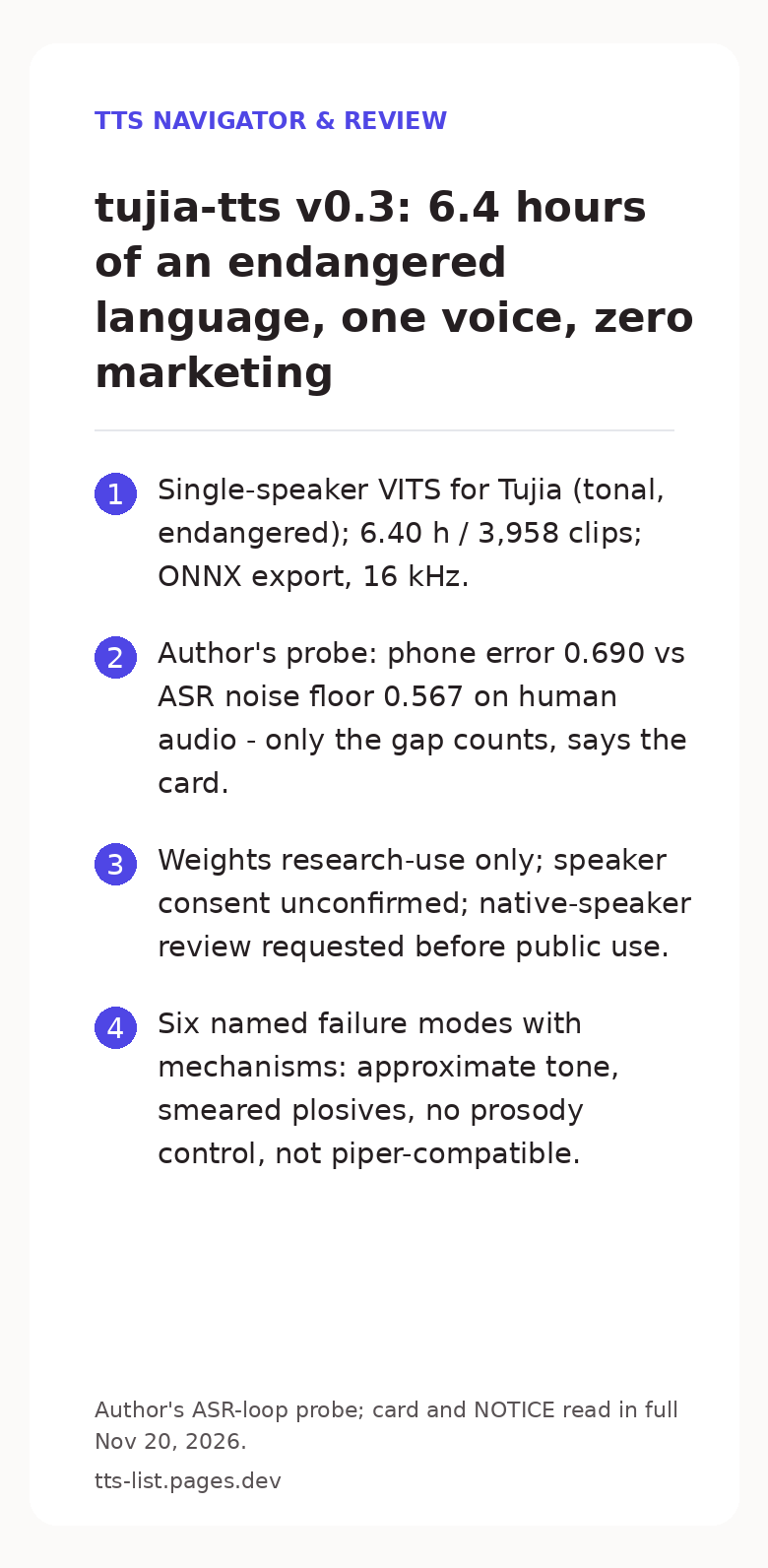
Tujia is a tonal language spoken by a small community in China and classified as endangered. On November 20, 2026, TujiaNLP released tujia-tts v0.3, a single-speaker VITS model trained on 6.40 hours (3,958 clips) unified to one voice, exported as ONNX with a piper-style config. It takes Ye pinyin with Ye De-shu tone letters or toned IPA as input - Chinese characters are not supported - and produces 16 kHz mono speech. This is a research release, and the card never pretends otherwise.
How the evaluation is framed, and why it is the right way
The card reports a phone error rate of 0.690 (median, lower is better) on 40 synthesized sentence probes, scored by running the output back through a Tujia ASR and comparing against the expected phone string. Next to it, the card prints the ASR's own error rate on the original human recordings of the same probes: 0.567. That second row is the noise floor - only the gap between the two rows means anything, and the card says exactly that. Validation mel loss improved from 0.5108 (v0.2) to 0.4523. There is no MOS and no claim of naturalness.
The limitations list is the useful part
Six named failure modes, each explained mechanistically: tone is approximate (sandhi and emphatic lengthening not modelled); short single-syllable words are the weakest (most sensitive to the coarse 16 ms frame rate); no prosody control beyond length_scale; one speaker only, no cloning or conversion; plosive bursts are smeared because the 16 kHz / 256-hop configuration gives 16 ms frames, coarser than a stop burst, with synthetic audio measurably brighter than real recordings (high-band energy share 0.177 vs 0.104); and it is not a piper voice - the standard piper espeak-ng front-end cannot drive it, you use the bundled front-end.
Licensing: read the NOTICE before anything else
Code is MIT, but the weights are research-use only under the repo's NOTICE. No rights are granted to the training recordings, transcripts, or the speaker's voice; speaker consent per recording is unconfirmed. Synthesized audio must not be presented as a real person's recording, and any commercial use or redistribution requires a rights review. Because Tujia is endangered, the card asks that outputs be reviewed by native speakers before community or educational use - an unusually direct statement of responsibility for a language-technology artifact.
Why this release matters beyond its size
Low-resource language TTS usually appears either as a glossy demo or as a corpus paper. This is neither: it is a runnable ONNX model plus an honest account of what 6.4 hours and one speaker can and cannot buy you, with version history that includes a failed v0.1 (1.87 h, failed the intelligibility probe, never released). For anyone building speech tools for minority or endangered languages, the card itself is a template: define your probe, print your noise floor, name your failure modes, scope your license.