tujia-tts v0.4, three days after v0.3: what a disciplined iteration on an endangered-language TTS looks like
November 23, 2026 - TTS Navi. We read the v0.4 model card in full and compared it line by line with the v0.3 card we covered on November 20. All figures are the author's own measurements, not our tests.
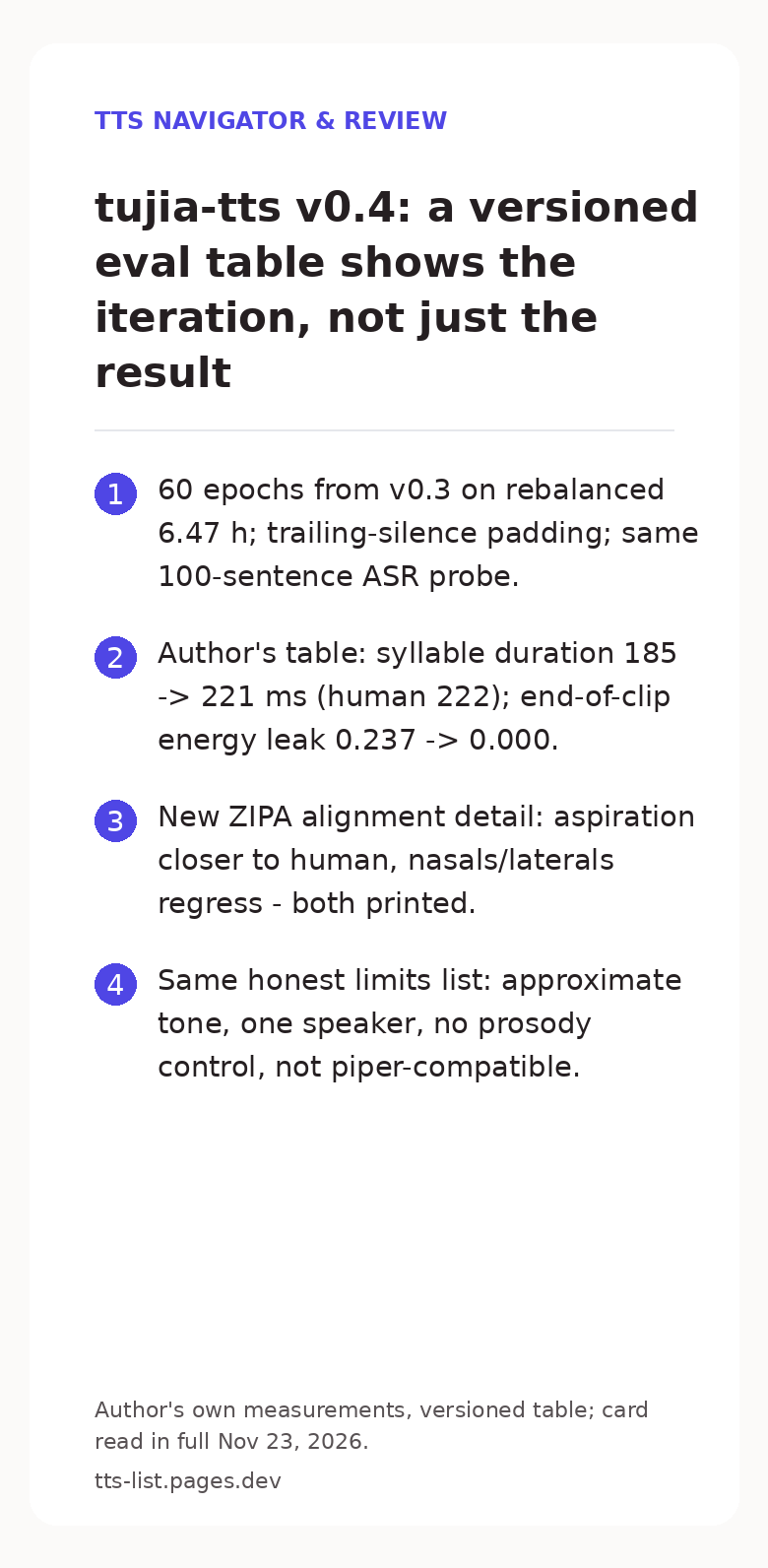
On November 20 we covered tujia-tts v0.3, a single-speaker VITS model for Tujia, an endangered tonal language of China, notable for printing its ASR noise floor next to its own error rate. Three days later, TujiaNLP released v0.4: fine-tuned 60 epochs from the v0.3 checkpoint on a slightly rebalanced corpus (3,881 clips, 6.47 h, voice unified to "badou", clips now padded with 150 ms of trailing silence). Same license posture (research-preview NOTICE), same input (Ye pinyin or toned IPA, no Chinese characters), same 16 kHz single-speaker ONNX export. What makes it worth a second look is that the evaluation table is versioned - you can watch the iteration happen.
The versioned table, row by row
The author reruns the same 100 held-out sentences through the Tujia ASR loop and prints v0.3 next to v0.4, with the human-recording noise floor in its own row: ASR error 0.973 to 0.972 synthesized, 0.805 to 0.804 human - intelligibility unchanged, and the card still says only the gap matters. Validation mel loss improves 0.4523 to 0.4195. The two defects v0.3 named get their own rows: median syllable duration moves from 185 ms to 221 ms, against a human 222 ms - v0.3's rushed timing is essentially fixed - and the energy leaking into the last 100 ms of clips drops from 0.237 to 0.000, the trailing-silence padding doing exactly what it was meant to do.
A finer instrument appears
New in v0.4: ZIPA forced alignment on the same sentences, tracking phoneme-level detail. Aspiration onset presence moves toward the human value (0.556 to 0.634, human 0.802), while nasals and laterals regress slightly (0.765 to 0.658; 0.741 to 0.706), leaving overall onset presence unchanged (0.676 to 0.679, human 0.805). The card prints the regressions next to the wins. The known-limitations list is unchanged - approximate tone, weak short syllables, no prosody control, one speaker, smeared plosives, not piper-compatible - which is itself information: v0.4 was a prosody-timing iteration, not an attempt at the harder phonetic problems.
Why follow a point release
Most model coverage treats releases as events. This pair shows the alternative: a research line where each version states what it changed, measures it on the same probe, and leaves the unfixed items on the list. For anyone iterating on low-resource TTS, v0.3 to v0.4 is a template: pad your silence, rerun the same sentences, print the floor, and do not claim what the table does not show.