Khmer VITS from scratch: 36.6 hours of read speech, ten voices, no phonemizer - and no formal evaluation yet
November 13, 2026 - by TTS Navi. We read the model card and repository documentation in full; everything below is the author's own reporting.
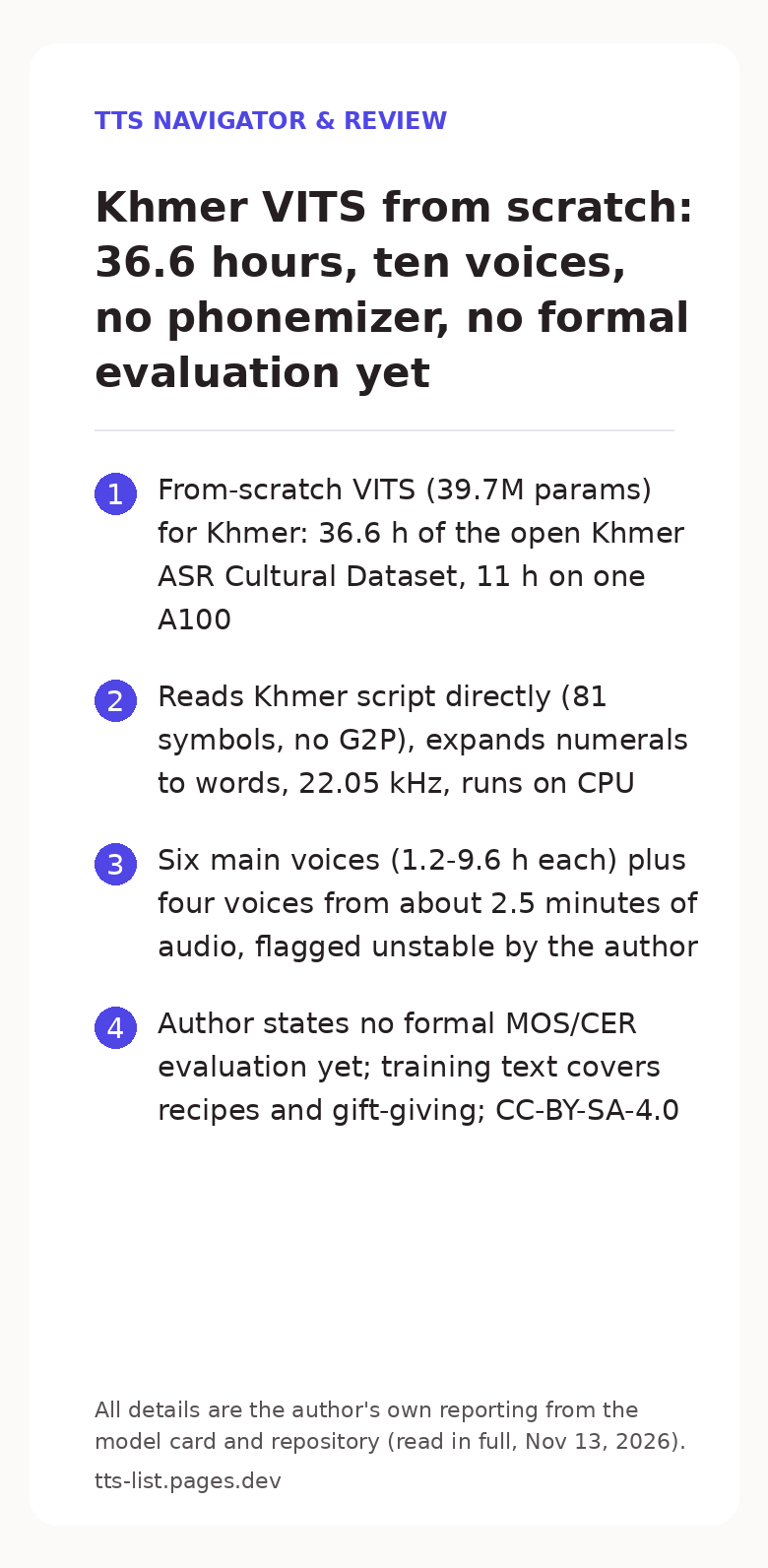
A developer publishing as Lykheang has released khmer_vits_tts_v1, an end-to-end Khmer text-to-speech model trained from scratch - a VITS generator of 39.7M parameters trained on 36.6 hours (16,145 utterances) of the Khmer ASR Cultural Dataset from Digital Divide Data, in 11 hours on a single A100. Khmer is spoken by more than 16 million people and has almost no open TTS tooling; this release ships 10 speaker voices, reads Khmer script directly with no phonemizer or G2P, expands Khmer and Arabic numerals into words, and outputs 22.05 kHz audio. The checkpoint is about 160 MB and runs on CPU, including free Colab tiers. Model and samples are CC-BY-SA-4.0 with attribution to Digital Divide Data; the code is MIT.
What the author built
The pipeline is deliberately simple: 81 symbols covering Khmer consonants, vowels, diacritics, the coeng subscript marker and punctuation (characters seen fewer than three times are excluded), monotonic alignment search via numba dynamic programming instead of an external aligner, AdamW at lr 2e-4 for 107,336 steps (212 epochs at batch 32), final mel loss 19.7. Sentence splitting for long text uses Khmer punctuation. The ten voices are not equal: six main voices trained on 1.2 to 9.6 hours each, and four more - clearly flagged with a warning on the card - learned from about 2.5 minutes of audio apiece and "are less stable." The samples on the card are single unprocessed renders at step 107,336, one per voice, of a sentence chosen to show numeral reading ("Cambodia has a population of more than 16 million people," with ១៦ read as words).
The stated limits
The card is more candid than most: "No formal evaluation (MOS or CER) has been done yet." Beyond that, the training text covers recipes and gift-giving, so the author expects more mistakes on other topics, rare words and names; Latin script (English words) is skipped entirely; decimals, dates and times are not read correctly; and because pronunciation is learned from spelling, irregular spellings and loanwords may be misread. The intended-use section bars impersonating the speakers or passing the audio off as real recordings, and bars trying to identify the speakers, per the dataset's terms.
Our analysis
This is what a healthy low-resource release looks like in 2026: an ASR dataset repurposed as supervised TTS data, a stock architecture (VITS, 2021) trained from scratch for the price of a lunch on one GPU, and a card that tells you exactly which four voices to avoid and which evaluations have not been run. The 2.5-minute voices are the instructive detail - VITS will learn a recognizable voice from minutes of audio, just not a stable one, and labeling that honestly is more useful than hiding it. The practical ceiling is clear: a single-domain corpus (recipes and gift-giving) means the model is a reading voice for simple Khmer prose, not a general assistant voice, and the lack of any CER against a recognizer means even intelligibility is unverified beyond the author's samples. But the floor matters more than the ceiling here: Khmer developers now have weights, a training pipeline, and a documented recipe (dataset, symbol table, hyperparameters, hardware budget) they can rerun and extend - which is exactly the author's stated goal of helping the next generation of Khmer AI developers. The obvious next step for anyone picking this up is a Whisper-style CER pass on held-out utterances, which the pipeline makes a weekend project.
Sources
- khmer_vits_tts_v1 model card (Hugging Face) (read in full, November 13, 2026)
- Training pipeline, methodology and logs (GitHub) (read in full)
- Khmer ASR Cultural Dataset (Digital Divide Data, Mozilla Data Collective, CC-BY-SA-4.0)