TTSonic: ByteDance's recipe for one model that clones, converts, designs and follows instructions
November 8, 2026 - by TTS Navi. We read the full paper; all experiments and numbers below are the paper authors' (arXiv 2611.04282), not ours.
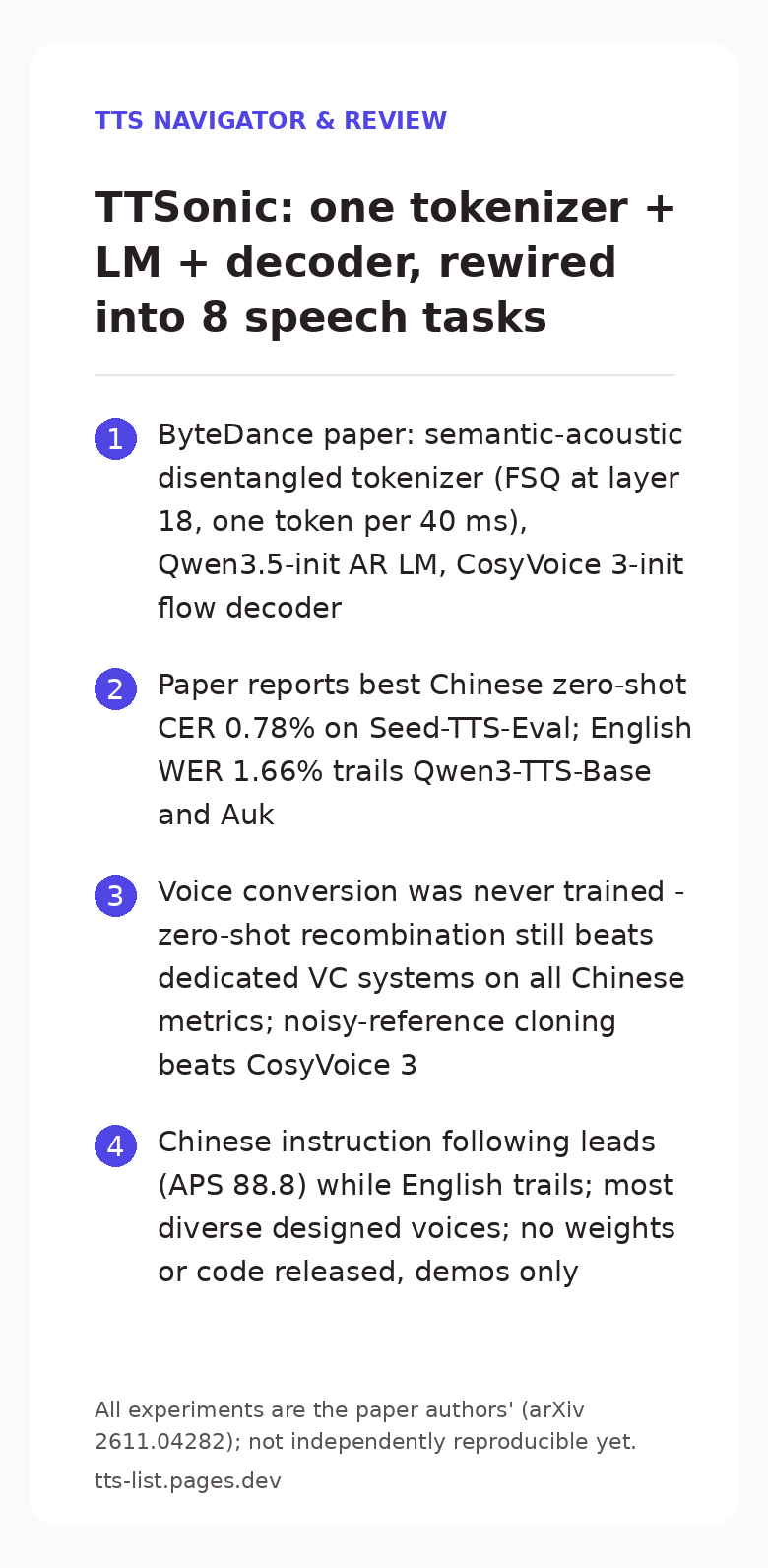
Most speech models do one trick well and need a sibling model for every additional trick. TTSonic, a technical report from ByteDance's Douyin Content Group (arXiv, November 3), takes the composable route instead: three shared modules - a semantic-acoustic disentangled speech tokenizer, a text-to-semantic autoregressive LM, and an acoustic flow-matching decoder - that are rewired per task to produce eight generation modes, from zero-shot cloning to voice conversion to instruction following, without training task-specific end-to-end models. A separate Text2Timbre module designs voices from text descriptions and plugs into the same decoder.
How the pieces compose
The tokenizer is the paper's foundation: a 32-block E-Branchformer encoder with a finite-scalar-quantization bottleneck inserted after block 19, trained in two stages - first ASR-supervised semantic learning with CTC and consistency regularisation, then a frozen-encoder refinement of the quantisation mapping guided by speech reconstruction plus a speech-understanding objective. It emits one discrete token every 40 ms. The AR language model (initialised from Qwen3.5) extends the text vocabulary with the full set of speech tokens, so text, instructions and speech units share one autoregressive space; a chain-of-thought style plan inside <think> tags sits between the user's instruction and the speech tokens. The flow-matching decoder (initialised from CosyVoice 3) renders 24 kHz audio conditioned on a CAM++ speaker embedding, a generated Text2Timbre embedding, or a prompt mel. Voice conversion and enhancement skip the LM entirely - tokens in, re-rendered audio out.
What the authors' experiments report
On Seed-TTS-Eval zero-shot synthesis, TTSonic (2B) posts the best Chinese CER among the listed systems (0.78% on test-zh, versus 0.96% for dots.tts and 1.12% for CosyVoice 3) and 5.64% on the hard Chinese subset; on English it trails Qwen3-TTS-Base and Auk (1.66% WER versus 1.23% and 1.02%). On CV3-Eval multilingual and cross-lingual tests it takes the highest speaker similarity on five of six subsets and the lowest English-to-Chinese WER (3.44%). Instruction following on InstructTTSEval is strong in Chinese (best APS 88.8, second-best role-play 69.4) but behind the strongest baselines in English, which the authors flag as future work. Its designed voices are also more diverse: the lowest high-similarity speaker collision rates at every threshold versus Qwen3-TTS-VD and VoxCPM2. The most interesting result is voice conversion - a task TTSonic was never trained on, with no cross-speaker token-speaker pairs in training: it still beats dedicated VC systems on all three Chinese metrics (1.85% WER, 0.78 SIM, 3.42 UTMOS) and leads English similarity, which the authors read as functional evidence that the tokenizer really does separate content from speaker. Noisy-reference cloning beats CosyVoice 3 (1.45% versus 1.90% WER).
What the paper does not give you
No weights and no code: as of November 8 the project page offers audio demos only, so every number is the authors' own and none of it is independently reproducible yet. Baseline values are a mix of cited publications, official releases and the authors' own reproductions. The English instruction-following gap is stated plainly. And the tokenizer ablation is honestly two-sided: the Stage-II refinement buys naturalness (NMOS 3.94 to 4.08 on reconstruction, 3.64 to 3.91 on conversion) at a small cost in objective content accuracy, which the tables show rather than hide.
Our analysis
The contribution is less any single number than the accounting: one tokenizer, one LM, one decoder, and a table showing which conditions to swap for eight tasks. The unseen voice-conversion result is the load-bearing evidence - cross-speaker recombination working without a single VC training pair is exactly what "disentangled representation" should predict, and it is a stronger argument for the tokenizer than another decimal of CER. Two things temper the headline: the Chinese-English asymmetry runs through every table (English trails on zero-shot WER, instruction following and VC accuracy), and until weights or code appear, TTSonic is a recipe to learn from rather than a model to run. Teams already on the CosyVoice line will recognise the initialisation choices - this reads as ByteDance's consolidation of that recipe into a generalist, and the collision-rate metric for voice-design diversity is worth stealing for anyone evaluating Text2Timbre-style features.
Sources
- arXiv 2611.04282: TTSonic: A Unified Framework for Composable and Controllable Speech Generation (read in full)
- TTSonic demo page (audio demos; no weights or code as of November 8, 2026)