Rime Prism: speech-to-speech with an inspectable text checkpoint - guardrails before the words become audio
Published October 31, 2026 · Built from Rime's launch post (CEO Lily Clifford, October 28, 2026) and product page, read in full on October 31, 2026. Benchmark figures are Rime running Artificial Analysis's harness itself - not the leaderboard's own runs - and are labeled as such. We did not test the model.
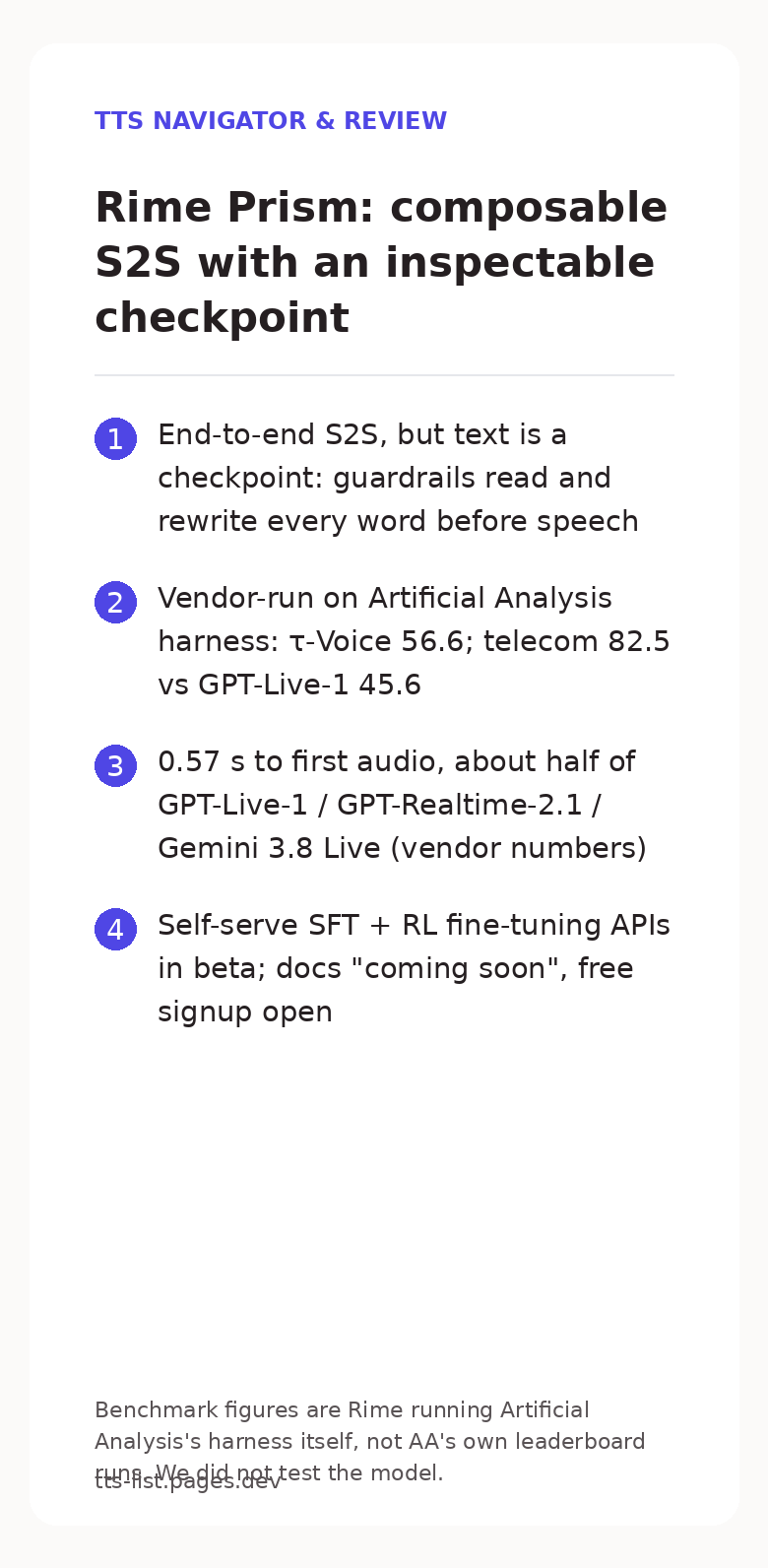
Rime - the TTS provider whose voices sit behind a number of large brand phone lines - has launched Prism, a speech-to-speech model built around one architectural decision: the model is trained end-to-end on audio, but its internal text plan is exposed as a checkpoint. Your rules can read every word, rewrite tokens, inject phonemic conditioning for names and account identifiers, and fire tool calls in parallel - all before the sentence becomes speech, while the audio stream still carries the caller's hesitation, frustration, or the dog barking in the background.
The argument it is making
Clifford frames Prism against both existing paradigms: the cascade (ASR → LLM → TTS) gives you control but destroys the audio information that carries intent; the big labs' fused-runtime S2S keeps the audio but lets you neither inspect nor own what the model is about to say - "a classic Faustian bargain." Prism's pitch is to keep both: one end-to-end model that listens, writes what it is going to say, and keeps hearing you while it speaks. She also owns a public reversal: eighteen months ago she called production S2S "a decade out."
The numbers - and who ran them
- τ-Voice 56.6 - Rime says it put Prism "on the same harness Artificial Analysis uses" for its speech-to-speech leaderboard and ran it itself, configured as on a live call (no pre-speech reasoning step). On that self-run it claims a 17-30 point lead over non-reasoning realtime models from OpenAI and Google, and a lead over GPT-Realtime-2.1 even with reasoning turned up. The two models that score above Prism get there by reasoning before speaking, at 1.24-1.35 s to first audio.
- Telecom: 82.5 vs 45.6 for GPT-Live-1 - the domain chosen because it is dense with account and phone numbers that must be captured exactly.
- Latency: the launch post claims Prism responds "in about 300 ms," and in the benchmark section specifies 0.57 seconds to first audio, "about half the wait" of GPT-Live-1, GPT-Realtime-2.1 and Gemini 3.8 Live.
Labeling matters here: these are vendor-executed runs on a third-party harness, not Artificial Analysis leaderboard entries we can cross-check today, and Rime controls the configuration it reports. A Revmo deployment figure circulating in a Rime announcement carried by AiTech365 (94% explicit order confirmations vs 57% on a baseline OpenAI engine, after fine-tuning on 10 hours of calls) is a customer case number from that announcement, not an independent measurement.
"Own your intelligence" - the fine-tuning bet
Rime's strategic claim: on a live call there is no latency budget for chain-of-thought, so "the intelligence in the weights is the intelligence you get" - and the only way to get better in your domain is to own those weights. Prism is pitched as the first speech-to-speech model anyone can fine-tune (vendor claim), with self-serve SFT and RL APIs being built with beta customers for training on your own production call audio and transcripts.
What is not there yet
- Docs are "coming soon" per the product page; access today is a free signup at app.rime.ai. There is no public self-serve evaluation path, so every number above stays vendor-run until docs and the fine-tuning APIs ship.
- No pricing on the launch materials for Prism specifically, and no public benchmark artifacts (prompts, audio, transcripts) attached to the τ-Voice run.
- Closed hosted model - this is the enterprise end of the market, opposite of this week's open-weights releases.
Why it matters
- The inspectable checkpoint is a genuinely different design point. If enterprises must satisfy compliance review on what an agent says, "read the words before they become audio" is a cleaner answer than either cascades or black-box S2S - and it is the first shipped S2S architecture built around it.
- Composable vs fused is becoming the S2S fault line. Phonic-1 (yesterday) bets on acting mid-speech; Prism bets on mid-flight inspectability; both attack the latency-control trade from different sides.
- Fine-tunable S2S changes procurement math. If the RL/SFT APIs land, voice-agent quality stops being a vendor roadmap item and becomes a training-data question - which favors companies sitting on years of call recordings.
Sources (read in full; links verified October 31, 2026)
- Introducing Prism: the first composable speech-to-speech model - Rime (October 28, 2026) - primary source: architecture, τ-Voice and latency figures, fine-tuning plans, Clifford quotes.
- Prism product page - availability ("docs coming soon", free signup) and positioning. The Revmo deployment figures come from Rime's announcement as carried by AiTech365 (October 29, 2026) - a secondary report, labeled as such.