VoxPocket v5: a 0.89B Khmer TTS that leads its teacher in a 40-sentence dev test
November 9, 2026 - by TTS Navi. We read the full model card; all measurements below are the developer's (Ing Muyleang), not ours.
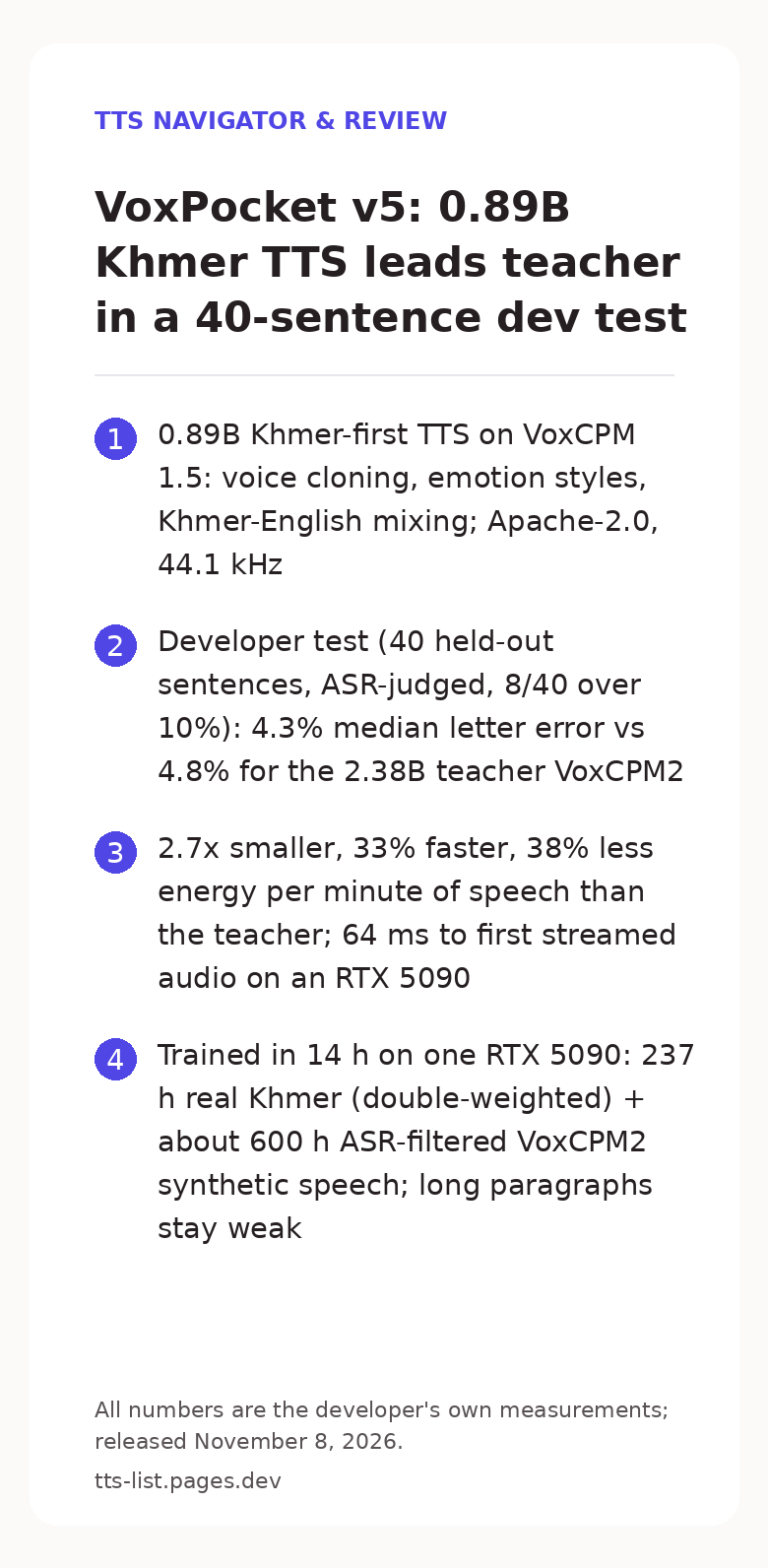
Khmer has almost no open TTS options, and the general-purpose multilingual models that do speak it tend to stumble over its 74-letter alphabet and no-spaces script. VoxPocket v5, released on Hugging Face on November 8 by solo developer Ing Muyleang, is a 0.89-billion-parameter Khmer-first model built on OpenBMB's VoxCPM 1.5 - and in the developer's own 40-sentence dev benchmark it reads held-out Khmer sentences slightly more accurately than VoxCPM2, the 2.38B model whose synthetic speech helped train it, while being 2.7x smaller, 33% faster and using 38% less energy per minute of speech. Apache-2.0, 44.1 kHz output, with voice cloning, emotion styles, and Khmer-English code-mixing.
The developer's numbers
Evaluation is a 40-sentence held-out set read with one fixed voice clip, cfg 2.0, 10 sampling steps, seed 0, transcribed back by a Khmer ASR model (seanghay/Qwen3-ASR-0.6B-Khmer), counting letter errors on Khmer letters. On that setup: VoxPocket v5 scores a 4.3% median letter error (mean 6.1%, 8 of 40 sentences over 10%), versus 4.8% median for VoxCPM2 and 6.6% for the previous VoxPocket release. A second machine measured the main checkpoint (step 30,000 of 43,200) at 3.7% - the card shows both figures rather than picking one. Speed on one RTX 5090: 3.6x real time (VoxCPM2: 2.7x), 64 ms to first streamed audio, 3.8-6.3 GB peak GPU memory, 0.80 Wh per minute of speech against the teacher's 1.29 Wh. Training was one full pass over roughly 1,010 hours in about 14 hours on that single card.
How it got there
The recipe is mostly data: 778,028 clips - 237 hours of real Khmer speech double-weighted so voices stay natural, about 600 hours of VoxCPM2-synthesized speech filtered by ASR (kept only at 15% letter error or better), including 340 new hours of styled and emotional speech, long multi-sentence reading, and Khmer sentences with English words mixed in, plus 157 hours of voice-clip-plus-style pairs so a cloned voice can change tone. Starting point was the previous VoxPocket checkpoint, trained one more pass at learning rate 2e-5. Styles are requested in brackets before the text ("(angry and upset tone)..."), and a voice can be designed from a description alone, no reference clip.
Limits, as stated
Very long paragraphs (450+ characters) in one go still produce many errors - VoxCPM2 is better there, so split into sentences. Styles move cloned voices less than designed ones. The big emotional styles with English-only text can be read aloud as words instead of applied as tone. Rare words and names can be swapped for common ones, and English support is basic by design. The evaluation is one 40-sentence set with one ASR judge - no listening test, no human raters.
Our analysis
The student-beats-teacher headline deserves its caveats - 40 sentences, one recogniser as judge, the developer running every leg - but the mechanism behind it is the genuinely instructive part: this is a distillation pipeline where the synthetic data was ASR-filtered and the real data double-weighted, and the result is a small model that is both cheaper and, on its target language, better than the generalist that taught it. For the long tail of languages that big multilingual models cover badly, "one motivated person, one consumer GPU, one filtered distillation loop" is an increasingly repeatable template - and VoxPocket's card, with its checkpoint table, energy accounting and named weaknesses, is one of the more honest records of it. If you need Khmer today, this is the first open model where the answer is not "use a big multilingual one and hope."
Sources
- Hugging Face model card: INGMUYLEANG/VoxPocket-v5 (read in full, November 9, 2026)
- OpenBMB VoxCPM 1.5 (base model) and VoxCPM2 (synthetic-data teacher)
- Browser demo (v4 demo space)