Visteon MIO TTS: an automotive supplier open-sources its Jetson voice
November 9, 2026 - by TTS Navi. We read the full model card; all measurements below are Visteon's own, not ours.
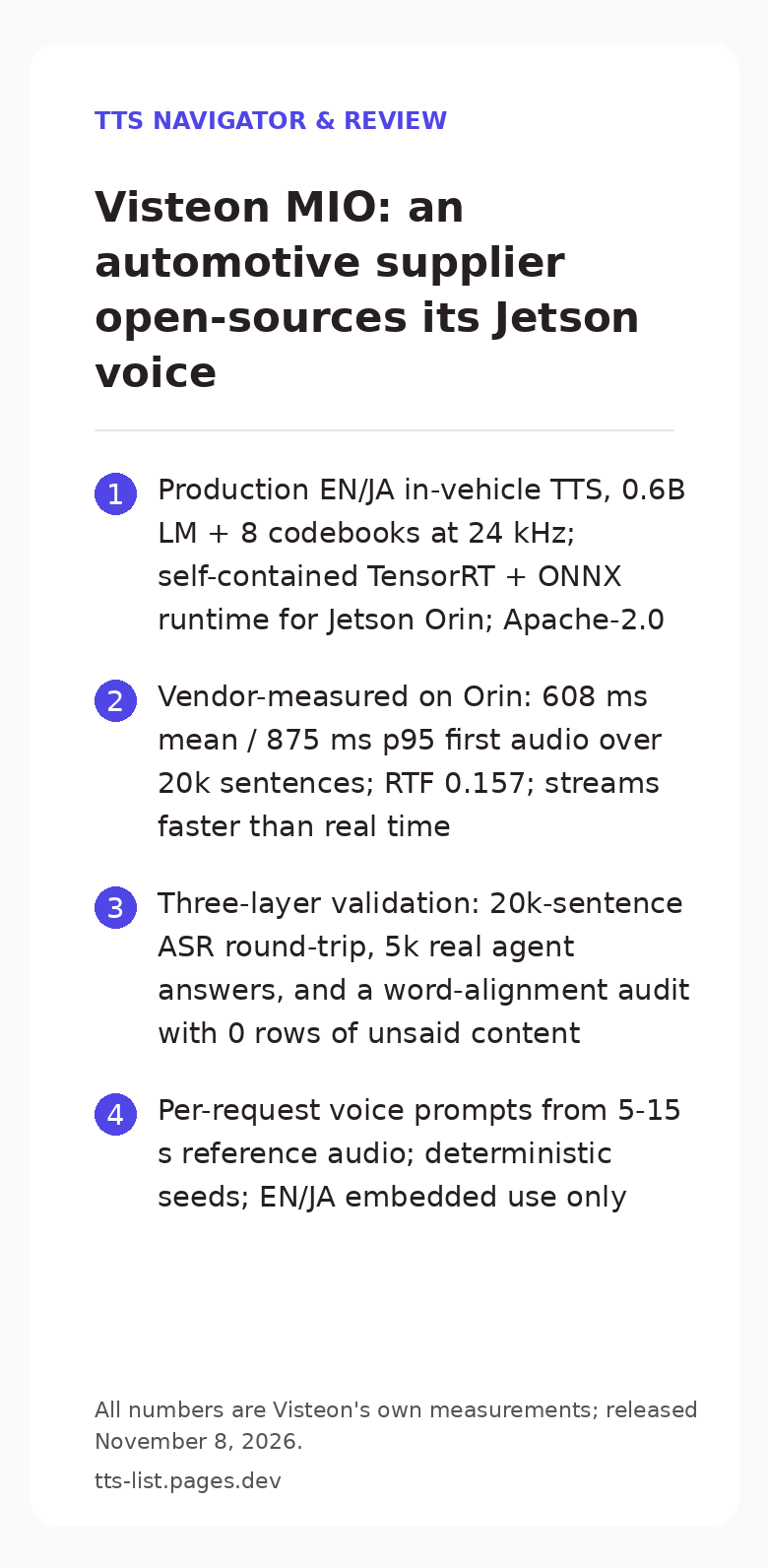
Most embedded TTS releases are research models with an ONNX export bolted on. Visteon MIO TTS en-jp 0.6B, published on Hugging Face on November 8 by the automotive Tier-1 supplier Visteon, is the opposite shape: a production in-vehicle voice for English and Japanese that ships as a self-contained runtime for NVIDIA Jetson Orin - a C++/CUDA server binary, a TensorRT fp16 engine, an ONNX vocoder, bundled TensorRT libraries, and a one-command launcher that starts streaming audio on a TCP port. Apache-2.0.
What ships and how it performs
The architecture is a 0.6B decoder-only language model producing eight parallel acoustic codebooks at 24 kHz, followed by an iterative denoiser (24 steps, TensorRT fp16) and a neural vocoder (ONNX fp32). A language-detecting text frontend handles number, unit and URL normalization plus G2P and mixed EN-JA script. On a Jetson Orin 64 GB, Visteon measures time-to-first-audio at 608 ms mean / 875 ms p95 across a 20,000-sentence validation corpus, and RTF 0.157 mean - short utterances stream first audio in about 0.4-0.6 s, and long multi-sentence assistant answers still start in under about a second (p50 692 ms on 5,000 real agent answers), then stream faster than real time. Voices are swapped per request through reference-audio prompt files (a compact token bundle from 5-15 s of reference speech), and a per-request seed keeps output deterministic across restarts.
The validation story is the interesting part
Three layers, all described on the card. A corpus round-trip: 20,000 sentences (10k EN/JA mixed + 10k more) synthesized and transcribed back by a forced-language ASR ensemble, with deletions and insertions reviewed row by row. An agent-answer benchmark: 5,000 realistic in-car assistant answers through the same pipeline. And a ground-truth audit: every row the ASR flagged was re-synthesized and checked against the model's own LIPSYNC word alignment - finding zero rows where the model failed to speak the input content. Stability testing covered sustained multi-instance serving, mid-stream cancel, and scrubbing of emoji, URLs and control characters. The wire protocol emits LIPSYNC word events for avatar and lip-sync consumers, which tells you what the in-car product around this model looks like.
Limits, as stated
English and Japanese only, aimed at in-vehicle and embedded assistant responses, notifications and prompts. Reference prompts need 5-15 s of clean speech with a verbatim transcript. The runtime targets Linux aarch64 on Jetson; this is not a laptop-pip-install model. The card's own caveat applies to everything above: not a medical or safety device, and output should be labeled as synthetic speech.
Our analysis
Two things make this release unusual. First, the publisher: a Tier-1 automotive supplier putting its production voice stack on Hugging Face under Apache-2.0 is a different signal than another lab demo - embedded TTS is where the automotive industry actually ships, and they just showed their homework. Second, the honesty of the validation design: the "zero failed rows" claim is carefully scoped (ASR-flagged rows, re-checked against the model's own alignment), the p95 numbers are shown next to the means, and contention RTF is admitted to roughly triple under multi-instance load. If you are benchmarking on-device voices for embedded assistants, MIO's card is a useful reference for what production-grade disclosure looks like - and the self-contained Orin runtime makes it one of the few releases you can benchmark on real edge hardware the same day.
Sources
- Hugging Face model card: visteon/mio-tts-en-jp-0.6b (link unavailable) (read in full, November 9, 2026)