VIPBench: Clones Heard as a Different Person in 41% of Judgments
November 5, 2026 - by TTS Navi. We read the full paper; all experiments and numbers below are the paper authors' (arXiv 2611.05638), not ours.
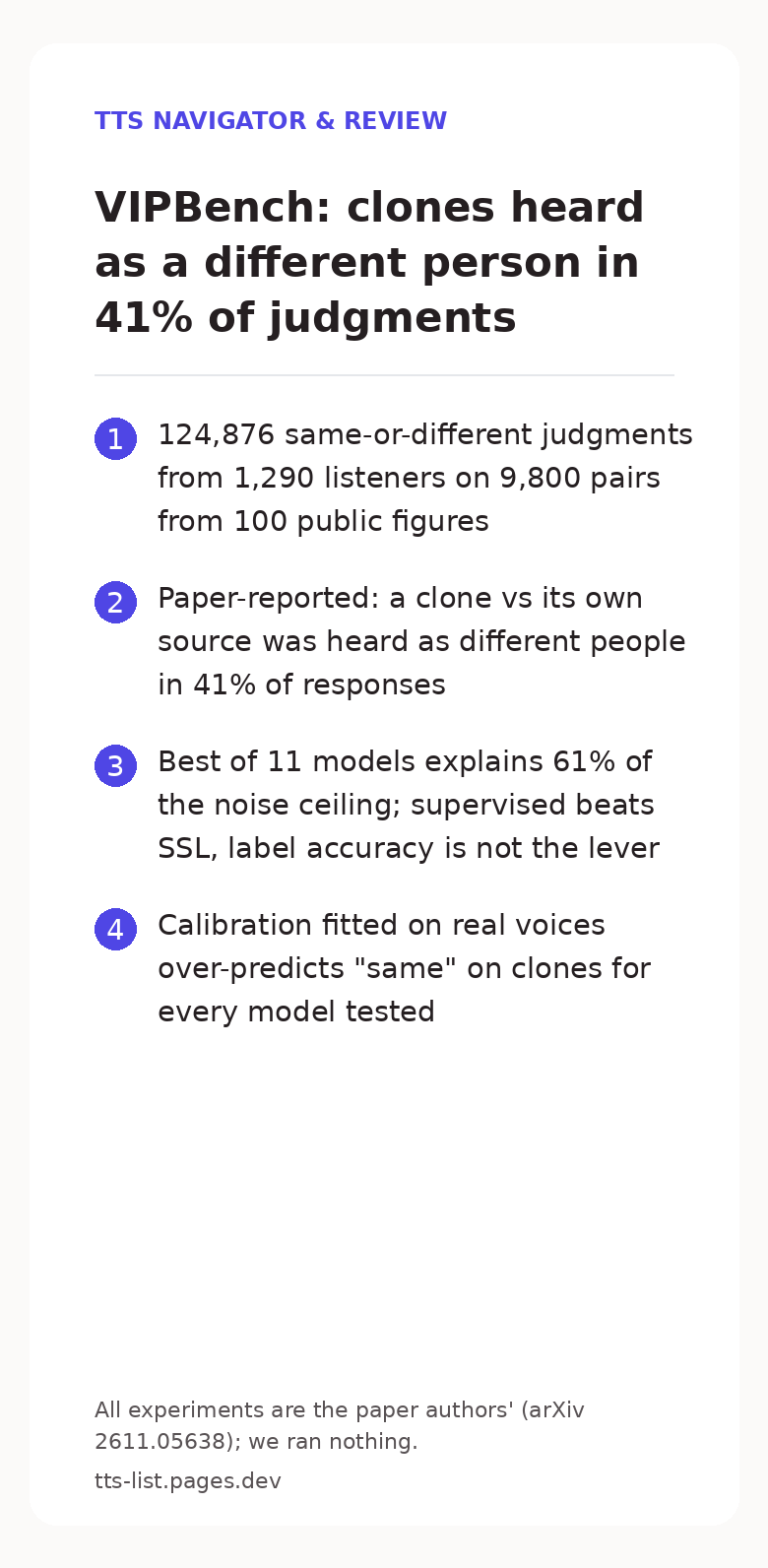
Speaker-verification benchmarks test whether a model recovers the metadata label of a recording - who actually spoke. They do not test who a listener hears. VIPBench (Voice Identity Perception benchmark, Tang and Groh, Northwestern University) closes that gap at scale: 124,876 same-or-different judgments from 1,290 listeners on 9,800 recording pairs spanning 100 public figures. The pairs mix real interview audio, voice clones generated by Cartesia Sonic 3, and continuous morphs between two speakers. A small held-out extension (152 new listeners, 60 pairs, 10 speakers) uses clones from a second system, CosyVoice 2. The speakers are stratified across five sociophonetic groups of American English, two genders, and two age brackets, with IRB approval for cloning public figures' voices.
The headline finding
The paper's central number is uncomfortable for the cloning industry: in 41% of responses, listeners judged a clone and a real recording of its source speaker to be different people - even though the metadata label says "same speaker". The mean fraction of "same" responses tells the gradient: same-recording pairs score 0.91, two real recordings of one speaker 0.69, a real recording versus its clone 0.59, and different-speaker pairs 0.26-0.27. In other words, a state-of-the-art commercial clone sits about halfway between "obviously the same person" and "obviously someone else" for human listeners. The authors frame the security corollary directly: a voice-authentication system trained on metadata alone would likely accept clones the listener community hears as someone else, so perception-aligned models are a defense layer metadata training cannot provide.
Four tasks, eleven models, one ceiling nobody reaches
The benchmark defines four tasks over model embeddings: predicting the continuous proportion of "same" judgments (Task 1), calibrated same/different verification (Task 2), matching listener-level speaker similarity structure (Task 3), and whether calibration fitted on real recordings transfers to synthetic ones (Task 4). Eleven public models were evaluated without fine-tuning: six supervised speaker models (x-vector, ECAPA-TDNN, RawNet3, TitaNet, resemblyzer, WeSpeaker), four self-supervised models (wav2vec 2.0, HuBERT, WavLM, XLS-R), and Whisper. The paper reports:
- No model reaches the noise ceiling. The best, resemblyzer, explains 61% of the explainable variance in listener judgments.
- Supervised beats self-supervised, but label accuracy is not the lever. Every supervised model beat every SSL model in all 1,000 speaker-resampling tests - yet a model with a 12% speaker-label error rate aligns with listeners about as well as models below 2%. Better verification accuracy does not buy perceptual alignment.
- Calibration does not transfer to clones. For every model, a regression fitted on real pairs over-predicts "same" responses on synthetic pairs (slope ratio above 1, up to 2.1 for Whisper): when a model is confident, listeners are less convinced than the model.
- Machines already beat the median listener at agreeing with the crowd. Resemblyzer agrees with the listener majority on 79% of pairs - more than 72% of individual listeners manage.
- SSL layer choice matters. The best alignment comes from the first or second layer, not the last (last-layer scores drop from ~0.46-0.51 to 0.03-0.27), a detail most off-the-shelf usage gets wrong.
Limitations the authors state
The paper is careful about scope: all 100 speakers are US public figures speaking American English, recorded in interviews and podcasts - no other languages, no private individuals, no other recording conditions. All main-set clones and morphs come from a single commercial system, so the Task 4 transfer gap may be partly system-specific; the CosyVoice 2 extension is too small to settle that. No listener judged the same pair twice, so individual test-retest reliability is unknown.
Our analysis
For TTS builders, VIPBench reframes what "a good clone" means. The field optimizes speaker-similarity scores against embeddings trained on metadata labels; this paper shows both halves of that loop are misaligned with the actual product question - will a human hear this as the same person? The 41% figure also hands the safety debate a concrete measurement: even flagship commercial cloning fails the human identity test nearly half the time, which cuts both ways (clones are less perfect than feared, and voice-biometric defenses are weaker than assumed). The most actionable findings are practical: calibrate before thresholding, pick SSL layers by validation rather than default, and never assume real-voice calibration holds on synthetic audio. The authors' suggestion to train speaker models directly on listener judgments is the obvious next step - and this dataset is exactly the fuel for it. The benchmark is released on Hugging Face (sendfuze/vipbench) with Croissant metadata.
Sources
- VIPBench: A Human-Aligned Benchmark for Voice Identity Perception in the Age of Voice Cloning (arXiv 2611.05638, read in full)
- sendfuze/vipbench dataset on Hugging Face