Underdog Woof: 40.6 MB of English TTS that runs on numpy alone
November 8, 2026 - by TTS Navi. We read the full model card; benchmark numbers below are Underdog's own measurements except where we note the independent check.
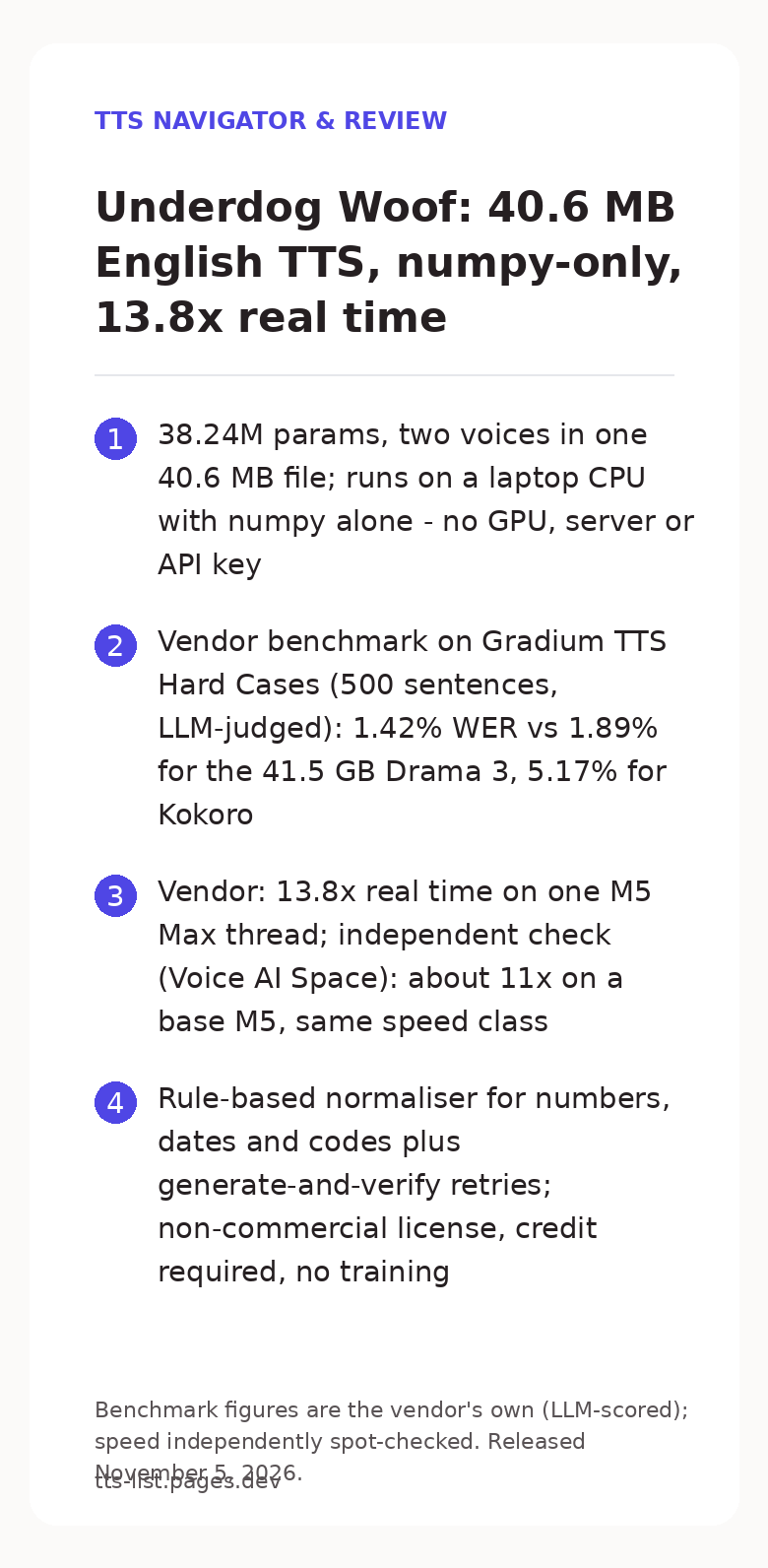
Underdog - the invite-only personal AI assistant built by Conway - has put its English text-to-speech model on Hugging Face. Woof ships as a single 40.6 MB file holding two voices (Juno and Mira), 38.24M parameters in total, and it runs on a laptop CPU with nothing but numpy: no GPU, no server, no API key, no PyTorch. The downloadable two-voice weights went up on November 5; a smaller one-voice build (30.7M parameters, 31.7 MB) exists only as the in-browser demo on underdog.ai. It is built to read the things assistants actually say - phone numbers, dates, prices, tracking codes - and a rule-based normaliser rewrites them the way people say them before a single audio frame is generated.
The vendor's numbers
Underdog ran every comparison itself on Gradium's TTS Hard Cases (500 English sentences), each model in its best-scoring voice, transcripts by qwen3.8-omni-flash and word errors counted by gemma-4-31b-it. On that setup, Woof's Mira voice scores a 1.42% word error rate (Juno 1.53%), ahead of every entry in its own table: Fish Audio Drama 3 at 1.89% (a 41.5 GB download), Phonon 31m at 2.16%, Deepgram Aura-2 at 2.43%, Kokoro 82M at 5.17%, Pocket TTS at 8.07%. Kitten Nano 0.8, the only smaller download at 27.6 MB, scores 9.81%. Speed: 13.8x real time for Juno on one Apple M5 Max CPU thread, 7.2x for Mira, with 402 MB peak memory. One caution the card volunteers itself: Liquid AI's LFM3-Audio-2B scored 20.1% under a different transcriber, and a Kokoro cross-check suggests its true number on the main setup is somewhat better.
An independent spot check
Voice AI Space ran the two-voice model on one thread of a base Apple M5 and measured about 11x real time on the numpy runtime - same speed class as the vendor's 13.8x claim on a faster M5 Max. In their local test, Gradium's Phonon 31M ran at about 30x real time on its own Rust runtime, also on one thread: Phonon is roughly 3x faster per thread, Woof is the smaller download and the dependency-free runtime.
The engineering around the model
Two details do more work than the architecture (a compact speech model plus an audio decoder adapted from Kyutai's Mimi codec, trained on LibriTTS-R and Emilia-YODAS). First, the normaliser: "020 7946 0018" becomes "zero two zero, seven nine four six, zero zero one eight", "14/03" becomes "the fourteenth of March", "XK-4471" becomes "X K four four seven one", with a lexicon for hard names - all standard library, no model. Second, self-checking: each sentence piece is verified as it is generated, and if it runs far too long for its text or contains a second of mid-sentence silence, Woof redraws it, up to three retries, and keeps the best take. All benchmark numbers were measured with this retry loop active, one seed per sentence.
The license
Woof ships under the Underdog Non-Commercial License 1.0 (the launch page says CC BY-NC 4.0, but the repository's own license file governs). Free for personal projects, research, teaching and non-profits - with mandatory credit ("Underdog Woof" or "underdog.ai" in anything published, "Voice by Underdog Woof" inside any app that uses it). Commercial use needs a paid license from Underdog, and training, fine-tuning or distilling another speech model on Woof or its audio is prohibited.
Our analysis
Read the 1.42% as a vendor-run benchmark with an LLM judge chain - Underdog ran and scored every model in its table itself, and LLM-counted word errors are only as consistent as the counting model. The independent speed check roughly corroborates the throughput class, which is the more load-bearing claim for a CPU runtime anyway. The durable idea here is that a small model plus serious text normalisation plus generate-and-verify retries beats a bigger model fed raw text: none of Woof's three tricks is new, but shipping all three in 40.6 MB with a numpy-only runtime is a genuinely useful bundle for on-device assistants. The no-training clause and mandatory credit make it a poor fit for commercial pipelines; for prototypes and personal tools, it is the most practical tiny English TTS download this week.
Sources
- Hugging Face model card: ConwayResearch/Underdog-Woof (read in full, November 8, 2026)
- Voice AI Space: independent speed check and license analysis
- Underdog Woof browser demo (one-voice model); benchmark set: Gradium TTS Hard Cases