Trelis Egyptian Arabic TTS: a VoxCPM2 fine-tune that measures Cairene pronunciation word by word - 1.9% wrong vs Cartesia's 2.3%
November 27, 2026 - TTS Navi. We read the model card in full. All figures are the authors' own measurements, not our tests.
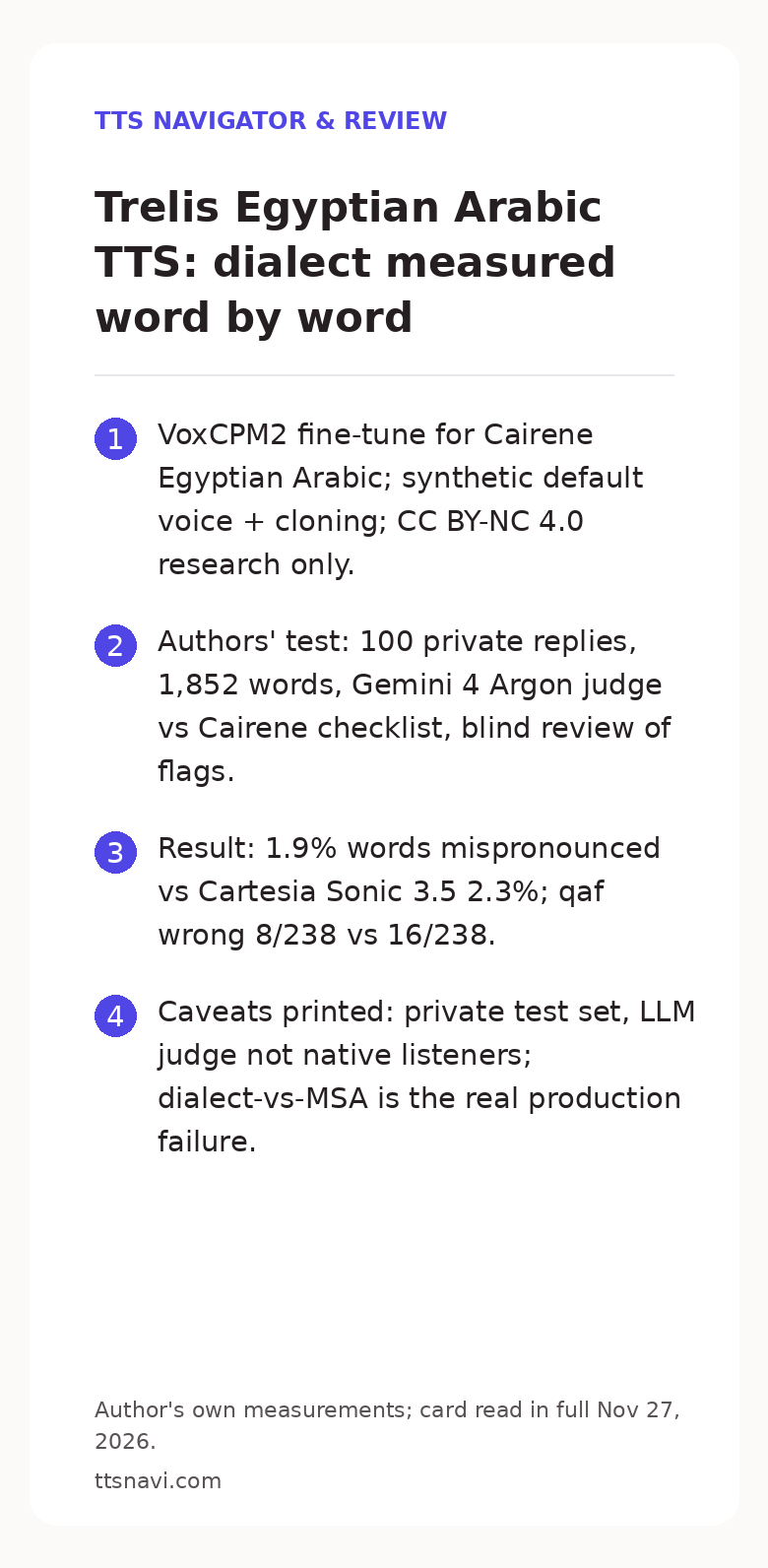
Trelis Research's egyptian-arabic-tts-research (released late November 2026) targets a specific failure: many Arabic TTS models read Egyptian text as Modern Standard Arabic - ق pronounced as q in everyday words, MSA case endings, MSA vowels. This VoxCPM2 fine-tune (2B class, CC BY-NC 4.0, research only) speaks Cairene Egyptian Arabic with a synthetic default voice (no reference clip needed) and can also clone from a short reference. Usage is the standard VoxCPM package pinned to a commit.
The benchmark, with its caveats attached
The authors' measurement: 100 private Egyptian Arabic test replies, 1,852 checked words, judged by Gemini 4 Argon against a Cairene pronunciation checklist with blind review of every flag. Result: 1.9% of words wrongly pronounced vs 2.3% for Cartesia Sonic 3.5; ق wrong 8 of 238 vs 16 of 238; text errors 4 vs 3. Two caveats travel with the numbers: the test set is private (not independently reproducible), and the judge is an LLM, not native listeners - blind review of flags softens but does not remove that. Read it as evidence the dialect gap is measurable and that this fine-tune closes much of it on its authors' test, not as a settled ranking.
Why it matters beyond the numbers
For Arabic voice agents, dialect-versus-MSA is a production complaint, not an academic one - a Cairene customer hears MSA endings as wrong. This card is one of the few that word-level quantifies the gap against a named commercial baseline. The non-commercial license means it is a research signal and a fine-tuning recipe reference, not something you ship; the cloning capability carries the card's own reminder to clone only permitted voices and disclose AI-generated speech.