StyleStream 2.0: Streaming Voice Style Conversion at 520 ms, Now Steerable by Text (October 2026)
Published October 22, 2026 · Built from the full paper arXiv:2610.28940 (v1, including appendices), the official GitHub repo, and the demo page, all read end to end on October 22, 2026. Every result number below is the authors' own measurement, not independently reproduced - we say so each time it matters. No inference code or weights are public as of today.
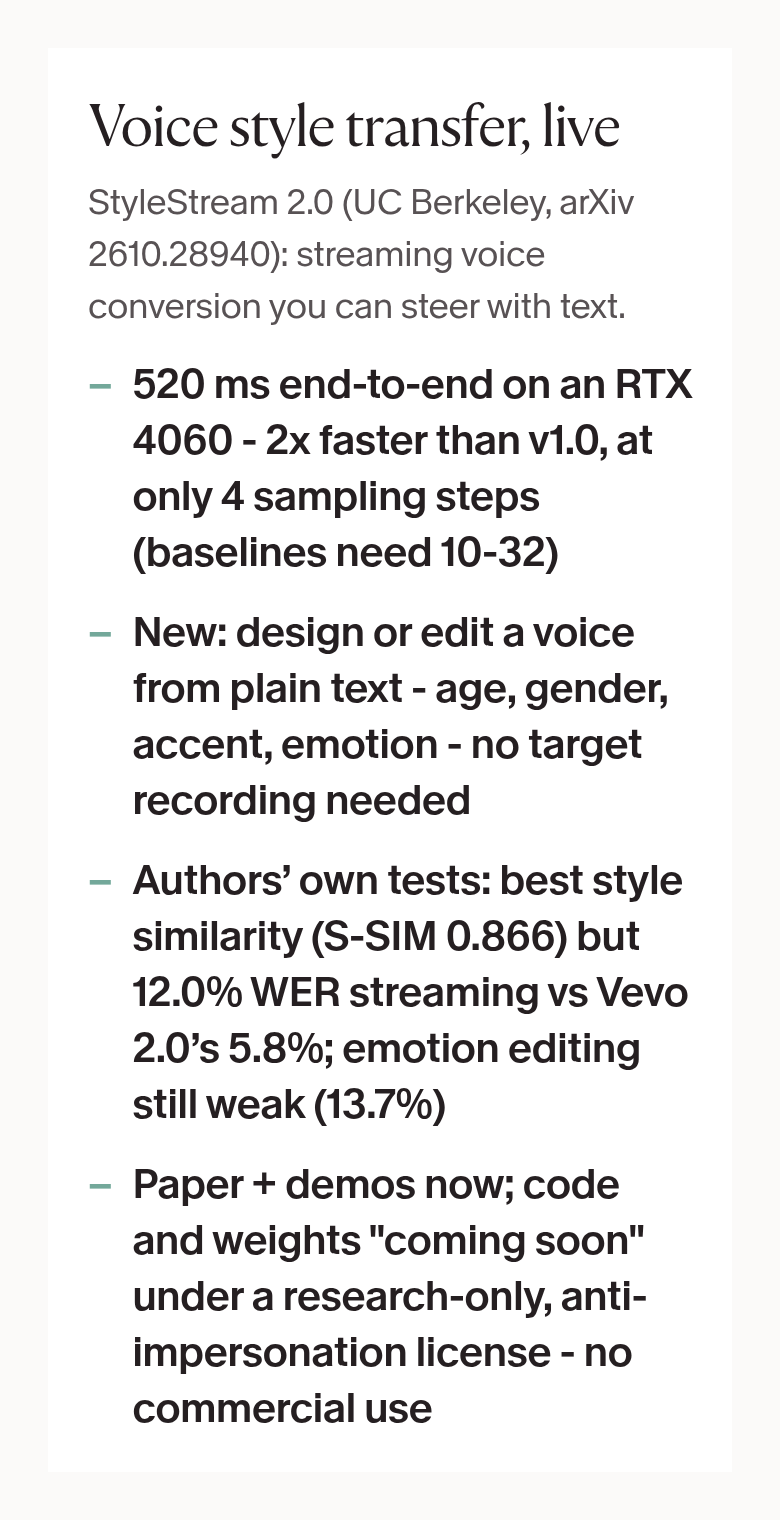
Voice style conversion (VSC) takes a recording of your voice and re-renders it with a different timbre, accent, or emotion while keeping the words intact. StyleStream 2.0, a UC Berkeley paper (Yisi Liu, Nicholas Lee, Gopala K. Anumanchipalli; arXiv:2610.28940, October 20, 2026; the project README states it was accepted to NeurIPS 2026), pushes on both of the field's pain points at once: latency, and the need for a target reference recording. In the authors' own measurements it runs streaming conversion at 520.7 ms end-to-end on a consumer GPU - roughly twice as fast as StyleStream 1.0 - and it can be steered with plain text prompts instead of a reference utterance. The trade-off, also in the authors' own numbers, is intelligibility: 12.0% word error rate in streaming mode versus 5.8% for the best baseline.
What it actually is
StyleStream 2.0 keeps the two-stage design of StyleStream 1.0: a Destylizer strips the source audio down to linguistic content, and a Stylizer re-renders that content in the target style. Two changes matter for 2.0:
- Speed. The Stylizer is a few-step MeanFlow model needing only 4 function evaluations per chunk (NFE 4), versus 16 for StyleStream 1.0, 10 for CosyVoice 2.0/3.0, and 32 for Vevo and Vevo 2.0. It is then fine-tuned with autoregressive feedback (inspired by Self Forcing) so quality holds up under chunk-by-chunk streaming inference.
- Control. The mel-spectrogram style context is replaced by a compact style embedding. On top of that embedding sits a text-conditioned model (the architecture borrows from FLUX Kontext in images) that supports two modes: voice design - describe a voice in natural language ("an elderly woman with a British accent, speaking calmly") - and voice editing - change one attribute of an existing voice ("make it older") while keeping the rest.
To the authors' knowledge, no prior system offers text-based design and editing for holistic voice style conversion - timbre, accent, and emotion together - let alone in streaming mode.
The 520 ms, broken down
The headline latency is arithmetic the paper states plainly: a 300 ms audio chunk, a fixed 80 ms lookahead, plus a measured 140.7 ms of per-chunk processing on an RTX 4060 (vocoder included) = 520.7 ms end-to-end. The authors call it a 2× speedup over StyleStream 1.0, whose per-chunk processing at the same 300 ms chunk size was 559.3 ms on the same hardware. The chunk-size table is honest about the lever: larger chunks improve word error rate and similarity (WER falls from 14.0% at 160 ms chunks to 10.9% at 600 ms) at the cost of latency - so 520 ms is a chosen operating point, not a floor.
Conversion quality: the trade-off in the authors' own table
On the main conversion benchmark (3,000 source-target pairs from English, German, and Mandarin corpora, same protocol as StyleStream 1.0):
| System | NFE | WER ↓ | S-SIM ↑ | E-SIM ↑ | NMOS |
|---|---|---|---|---|---|
| Vevo 2.0 | 32 | 5.79% | 0.843 | 0.723 | 3.44 |
| SS 1.0 (offline) | 16 | 7.47% | 0.869 | 0.808 | 3.43 |
| SS 2.0 (streaming) | 4 | 12.02% | 0.866 | 0.765 | 3.40 |
| SS 2.0 (offline) | 4 | 7.00% | 0.879 | 0.774 | 3.45 |
Read it both ways. On speaker similarity (S-SIM) the streaming model is best in the table (0.866), and naturalness (NMOS) is statistically comparable across systems. On word error rate it is the worst of the recent systems shown: 12.02% streaming versus Vevo 2.0's 5.79% - the authors note Vevo 2.0's advantage is expected since it is effectively a cascaded ASR-plus-TTS pipeline, while their style similarity beats it across every metric. Ground-truth recordings themselves measure 4.42% WER under the same recognizer, which frames how much headroom the whole field has. The offline variant of SS 2.0 closes much of the gap (7.00% WER) at the cost of streaming.
An ablation worth knowing: removing the autoregressive fine-tuning (AR-ft) roughly doubles streaming WER from 12.03% to 19.54% - that training step is what makes few-step streaming usable.
Text control: where it is strong and where it is not
For voice design (generate a style from a prompt), measured with VoxProfile classifiers on the edited axis:
| System | WER ↓ | Age-acc | Gender-acc | Accent-acc | Emotion-acc | SC-MOS |
|---|---|---|---|---|---|---|
| CapTTS | 7.36% | 41.11% | 94.33% | 52.00% | 29.47% | 3.54 |
| Qwen3-TTS | 4.86% | 44.33% | 92.39% | 14.73% | 36.33% | 2.97 |
| SS 2.0 (streaming) | 10.42% | 67.94% | 98.94% | 46.73% | 30.13% | 3.78 |
StyleStream 2.0 leads clearly on age and gender control and on style-consistency MOS (3.78 vs 3.54 for CapTTS). It trails CapTTS on accent accuracy (46.7% vs 52.0%). The baseline caveat matters: CapTTS and Qwen3-TTS are cascaded TTS systems generating from text, not converting real audio, so this is the comparison the authors chose, not a like-for-like conversion contest.
For voice editing (change one attribute of a real recording), SS 2.0 streaming hits 99.67% gender accuracy and 67.17% age accuracy, with the best instruction-consistency MOS (3.64) - but only 13.67% emotion accuracy (14.67% offline). That is still ahead of every baseline (Vevo 6.56%, Vevo 2.0 7.11%) - emotion editing is weak across the entire field, and the authors say so: "emotion editing, while ahead of all baselines, still trails the corresponding timbre" control. Style preservation of non-edited attributes also drops versus Vevo (speaker-preservation similarity 0.764 vs 0.909), another explicit trade-off.
Availability: paper and demos now, code and weights later
As of October 22, 2026:
- The demo page hosts audio/video samples; the GitHub repo currently contains only the demo site, a README, and a license file.
- The README states "Inference code and pretrained checkpoints are coming soon," with a Hugging Face model badge marked coming soon as well. The paper says weights are planned for release under a license prohibiting impersonation and malicious use.
- The license already in the repo is UC Regents' Research/Educational/Not-for-Profit license: commercial use is not permitted without a separate agreement with UC Berkeley's Office of Technology Licensing. If that license also governs the coming weights, this is a research tool, not something you can ship in a product.
- The paper's broader-impacts section notes training used only existing public speech corpora, with a model card planned alongside release.
Caveats
- Every number above is the authors' own measurement on their chosen test sets; none are independently reproduced here. We did not run the model (no code or weights are public).
- The 520 ms figure is the 300 ms chunk operating point on an RTX 4060; lower latency (smaller chunks) degrades WER, and the paper itself says 520 ms "still leaves room for improvement in tightly interactive use cases."
- "Accepted to NeurIPS 2026" comes from the project README; the arXiv v1 header describes it as a submission to the conference.
- Text-control accuracies are classifier-based (VoxProfile) on a 300-source-utterance set; classifier accuracy is a proxy for human perception, not the same thing.
- The text-control interface covers age, gender, accent, and emotion only; finer qualities like breathiness or brightness are future work, per the authors.
Sources (read in full; links verified October 22, 2026)
- Liu, Lee, Anumanchipalli (UC Berkeley) - StyleStream 2.0: Fast and Controllable Streaming Voice Style Conversion, arXiv:2610.28940 v1 (October 20, 2026) - all method, latency, and result claims above.
- Berkeley-Speech-Group/StyleStream2.0 (GitHub) - release status ("inference code and pretrained checkpoints coming soon"), NeurIPS 2026 acceptance claim, license text.
- Official demo page - audio/video samples.