Phonon: Gradium's Open-Weight On-Device TTS Family - 31M Parameters, 7 ms to First Audio (October 2026)
Published October 21, 2026 · Built from Gradium's launch blog and Hugging Face model cards, read in full, plus the runtime and upstream repositories. Every benchmark and latency figure below is Gradium's or its partners' own measurement, not ours and not independently reproduced - we say so each time it matters.
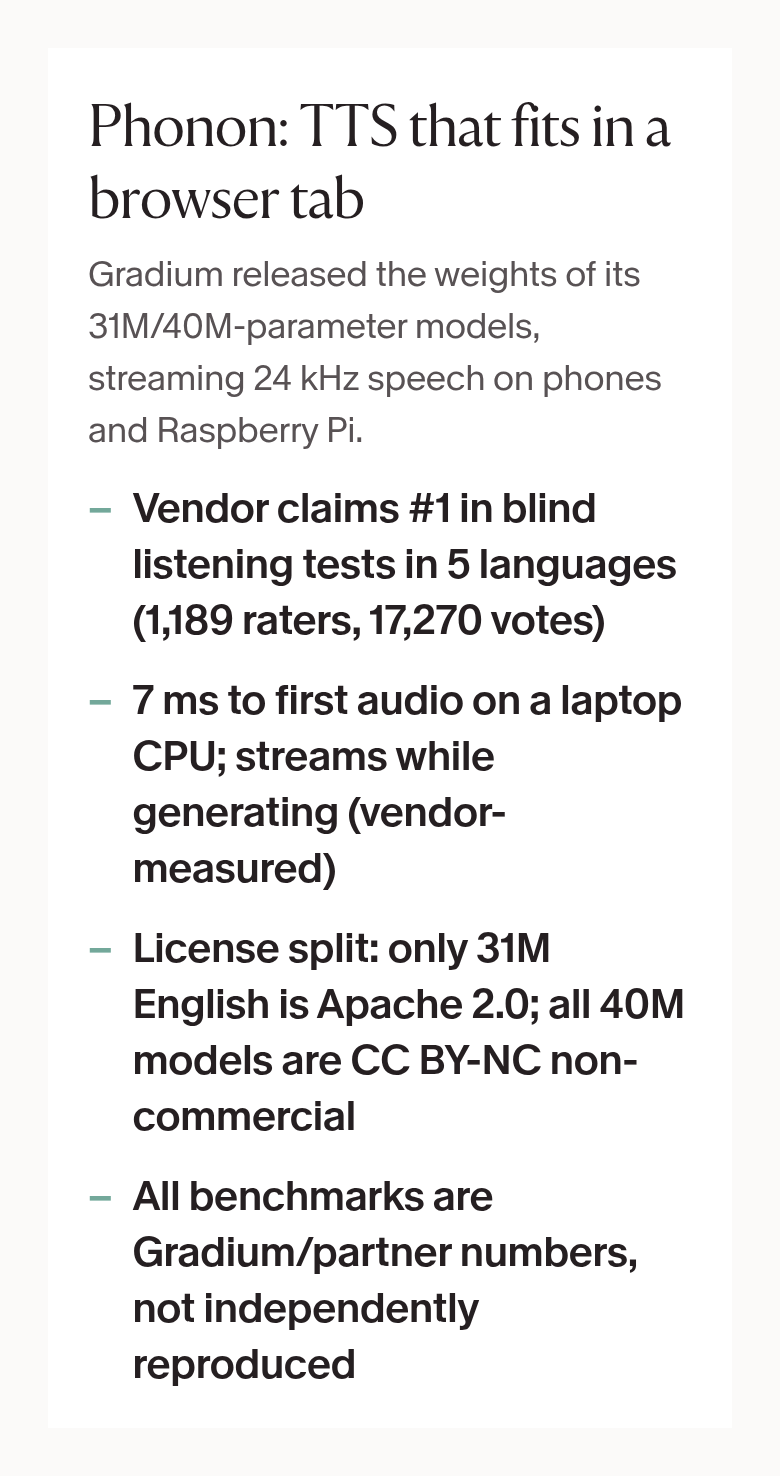
Yesterday, Paris-based voice AI company Gradium released the weights of Phonon, its on-device text-to-speech model, as a family of nine Hugging Face repos: a 31M-parameter English model, 40M models for English, French, German, Spanish and Portuguese plus a five-language multilingual variant, a 102-voice catalog, and the audio decoder the family shares. The models are small enough to synthesize 24 kHz speech inside a browser tab, on a phone, or on a Raspberry Pi, and they stream audio while still generating. The launch matters because the on-device TTS niche has been short on models that are both good and permissively licensed - and Phonon is only half of that, as the license section below explains.
Who Gradium is, and where Phonon comes from
Gradium is a Paris voice AI startup that sells a real-time voice API (TTS, speech-to-text, live translation, voice cloning and design). TechCrunch reported a $70M seed round in December 2025 and an extension to $100M with NVIDIA among the backers in July 2026. The launch blog describes Phonon as building on the team's earlier research at Kyutai - the French lab behind the MIT-licensed Pocket TTS (9,970 GitHub stars) and the Mimi audio codec - specifically their work on continuous audio language models. Gradium first announced Phonon in April 2026, ran it in private beta, and released the weights on October 20 with day-one integrations in MLX-Audio, Hugging Face Transformers, LM Studio (it powers "Read aloud" in Bionic), and Ollama.
What was released
| Repo | Size (q8) | Languages | License |
|---|---|---|---|
| phonon-31m-en | 64.5 MB | English | Apache 2.0 (commercial OK) |
| phonon-40m-en / -fr / -de / -es / -pt | 74.6 MB each | one per language | CC BY-NC 4.0 (non-commercial) |
| phonon-40m-multilingual | 74.6 MB | all five in one model | CC BY-NC 4.0 (non-commercial) |
| phonon-voices | embeddings | 102 voices, 5 languages + 12 characters | Apache 2.0 |
| phonon-mimi | decoder weights | shared audio decoder | Apache 2.0 |
The runtime is a separate project, xn-ptts on GitHub (142 stars, Apache-2.0), with bindings for Rust, Python (ptts on PyPI), JavaScript/WASM for the browser (phonon-tts on npm), Swift/Core ML for iPhone and Mac, Android (including a Snapdragon NPU preview), a WebSocket server, and an OpenAI-compatible server that also documents a Home Assistant setup. The 40M repos sit behind a click-through gate on Hugging Face; the 31M English repo downloads freely.
How it works
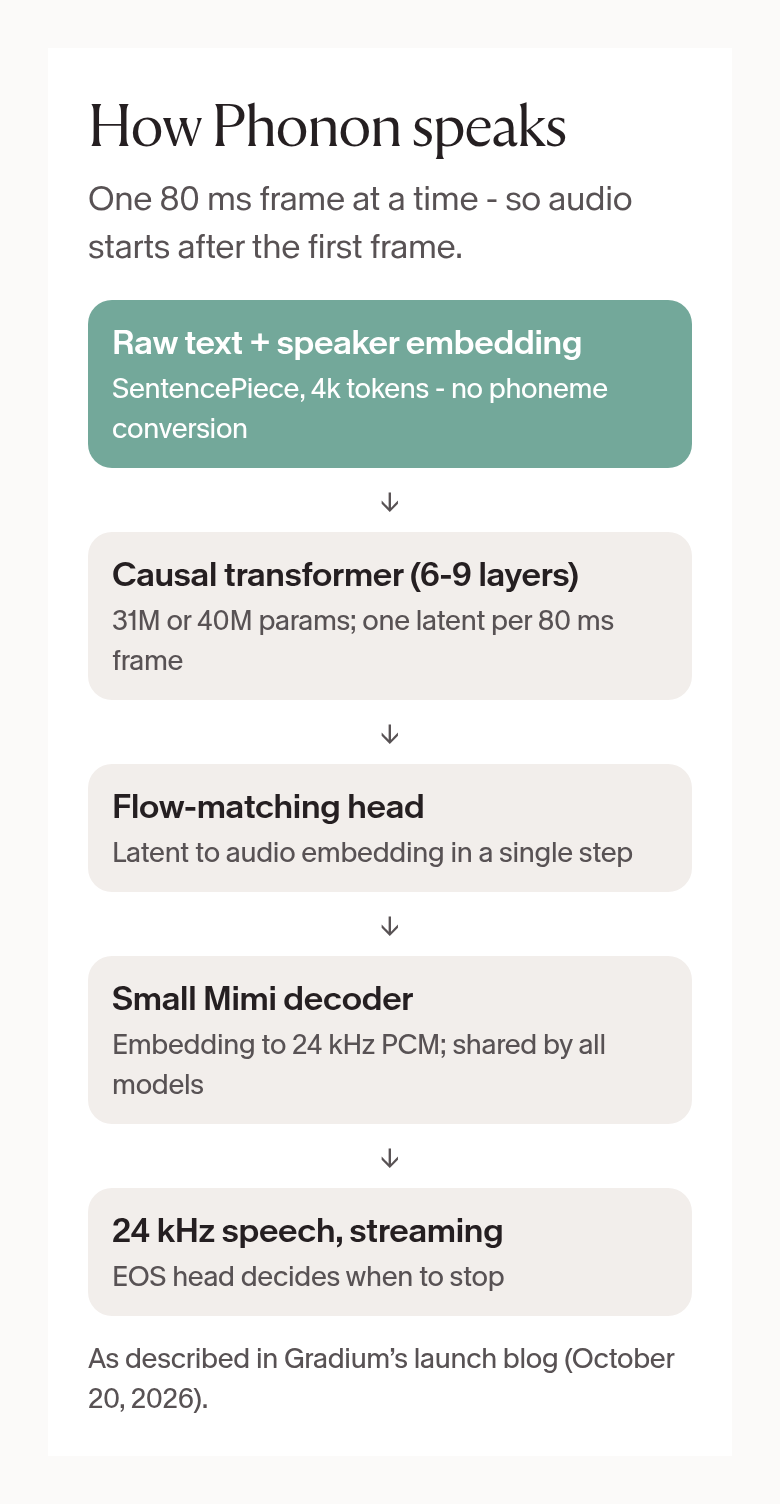
Phonon is a causal transformer that reads raw text - a SentencePiece tokenizer with a 4,000-token vocabulary, no phoneme conversion, which is what makes new languages cheap to add - concatenated with a speaker embedding as the prefix. It generates one latent vector per 80 ms frame; a flow-matching head turns each latent into continuous audio embeddings in a single step, and a smaller variant of Kyutai's Mimi decoder renders them into 24 kHz PCM. An end-of-speech head decides when to stop. The 31M model has 6 transformer layers at width 512; the 40M has 9. All variants are distilled from a larger Phonon teacher and share the same flow-matching head and Mimi decoder - which is why the decoder ships as its own Apache-2.0 repo. Because generation is frame-by-frame causal, audio streams out while the rest of the sentence is still being computed, and the first 80 ms frame is all that stands between text and sound.
The vendor's numbers
Gradium's quality claims rest on blind pairwise listening tests against Kokoro, Magpie, NeuTTS and Pocket TTS - 1,189 raters and 17,270 votes across the five languages, per the launch blog. In the English table on the model card (468 raters, 8,290 votes), phonon-40m-en leads at Elo 2117, phonon-31m-en scores 2098, Kokoro 2043, NeuTTS 2034, Magpie 1939. Gradium says a Phonon model ranks first on all three of its measures in every language. On accuracy, the company built a 500-sentences-per-language test set of hard structured text (phone numbers, dates, codes) and published it at gradium/tts-hard-sentences-202610; on the English hard set the card reports 1.5% LLM-scored WER for phonon-31m-en versus 3.5% for Kokoro and 28% for Magpie, with transcripts by qwen3.8-omni-flash and scoring by gemma-4-31b-it.
| Setup (all vendor- or partner-measured) | Time to first audio | Speed |
|---|---|---|
| MacBook Air M5, CPU 4 threads (Gradium) | 6.9 ms (31m) | 29.9x real time |
| MacBook Air M5, 1 core (Gradium) | 13.6 ms (31m) | 11.6x real time |
| Raspberry Pi 5 (Gradium) | 38 ms | 3.7x real time (Kokoro: ~7 s start, below real time) |
| Arm CPUs with KleidiAI (measured by Arm) | 28 ms | 15x real time |
| Snapdragon 8 Elite Gen 5 (measured with Qualcomm) | 7.5 ms | 24x real time |
The comparison that matters for voice assistants is time to first audio, and here Gradium's own table shows the structural difference: Kokoro's PyTorch package does not stream, so its "first audio" is the whole sentence (517 ms on the same MacBook), while Phonon's streaming design starts in milliseconds. That is a real architectural advantage, and also why the comparison is somewhat apples-to-oranges - streaming versus batch. These are launch-day numbers from the vendor and its chip partners; nobody independent has reproduced them yet.
The license split, read carefully
Only the 31M English model is Apache 2.0. Every 40M model - all five languages and the multilingual one - is CC BY-NC 4.0, which forbids commercial use; Gradium's blog invites companies to "reach out for commercial usage and custom models", including smaller footprints, other languages (Korean, Arabic and Japanese are named), and fine-tunes on your vocabulary. The voice catalog, the Mimi decoder and the runtime are Apache 2.0 (the model card says the runtime is MIT OR Apache-2.0). So the practical map is: hobbyists, researchers and prototypes can use everything; a commercial product ships the 31M English model today or talks to Gradium about licensing the 40M line. Voice cloning and voice design run through Gradium's cloud Studio (free and unlimited to create, per the blog); the resulting voice file then runs fully on-device. The model card's responsible-use section bars impersonation and non-consensual cloning.
Limitations the card itself lists
- Only the released languages are supported; other languages are read with wrong pronunciation.
- Text normalization (numbers, dates, currencies) depends on picking the right language setting.
- Long inputs are split into sentences spoken one after another, so prosody does not carry across a whole document.
- The smallest model "trades some accuracy for size" (Gradium's words) - the 31M is the footprint pick, the 40M the quality pick.
Our read
Judgment, not measurement: this is the most complete on-device TTS release of the year - weights, voices, decoder, a serious cross-platform runtime, and day-one integrations in the tools people already use, from a team with a real research lineage (Kyutai's Pocket TTS and Mimi). The architecture choices are the interesting part: raw-text SentencePiece instead of phonemes, single-step flow matching, and a shared small Mimi decoder are exactly what makes 64 MB and millisecond first-audio plausible, and the streaming design is what voice assistants actually need. The vendor's benchmark presentation is better than most (public test set, named scorer models, rater counts), but the numbers are still the vendor's, the Elo pools are small, and the streaming-versus-batch framing flatters the latency comparison. The CC BY-NC wall around the 40M family is the catch to check before you build a business on it: the best-quality models are a demo license, and only the 31M English weights are truly open.
Caveats
- We did not run Phonon; every Elo, WER, latency and speed figure is Gradium's or its partners' (Arm, Qualcomm) own measurement, quoted from the launch blog and model cards on October 21, 2026.
- The English Elo table is based on 468 raters; small pools move easily, and blind-pairwise Elo is not an absolute quality score.
- Kokoro's quoted time-to-first-audio reflects its non-streaming reference package, not a streaming fork; treat the latency gap as architectural, not a like-for-like engine benchmark.
- Only phonon-31m-en, phonon-voices and phonon-mimi are Apache 2.0; the 40M weights are CC BY-NC 4.0. Confirm the license on the exact repo you download.
- Star, download and voice counts are point-in-time (October 21, 2026); the release is one day old.
Sources (blog and cards read in full; links verified October 21, 2026)
- Launch blog: gradium.ai/blog/release-phonon-open-weight
- Model cards: huggingface.co/gradium/phonon-31m-en (family table and per-language benchmark tables), phonon-voices, phonon-mimi
- Runtime: github.com/gradium-ai/xn-ptts
- Public WER test set: huggingface.co/datasets/gradium/tts-hard-sentences-202610
- Upstream: github.com/kyutai-labs/pocket-tts (MIT)
- Company funding: TechCrunch, December 2025 and TechCrunch, July 2026
More TTS provider profiles: TTS Navi