AssemblyAI-TTS-1: the ASR company enters TTS - 47 ms first byte, $15 per million characters, unlimited concurrency
Published October 29, 2026 · Built from AssemblyAI's launch post and methodology section, read in full on October 29, 2026. The benchmark numbers are AssemblyAI's own evaluation (dated October 28) unless credited to a third-party board - we say so each time it matters. We did not run the model.
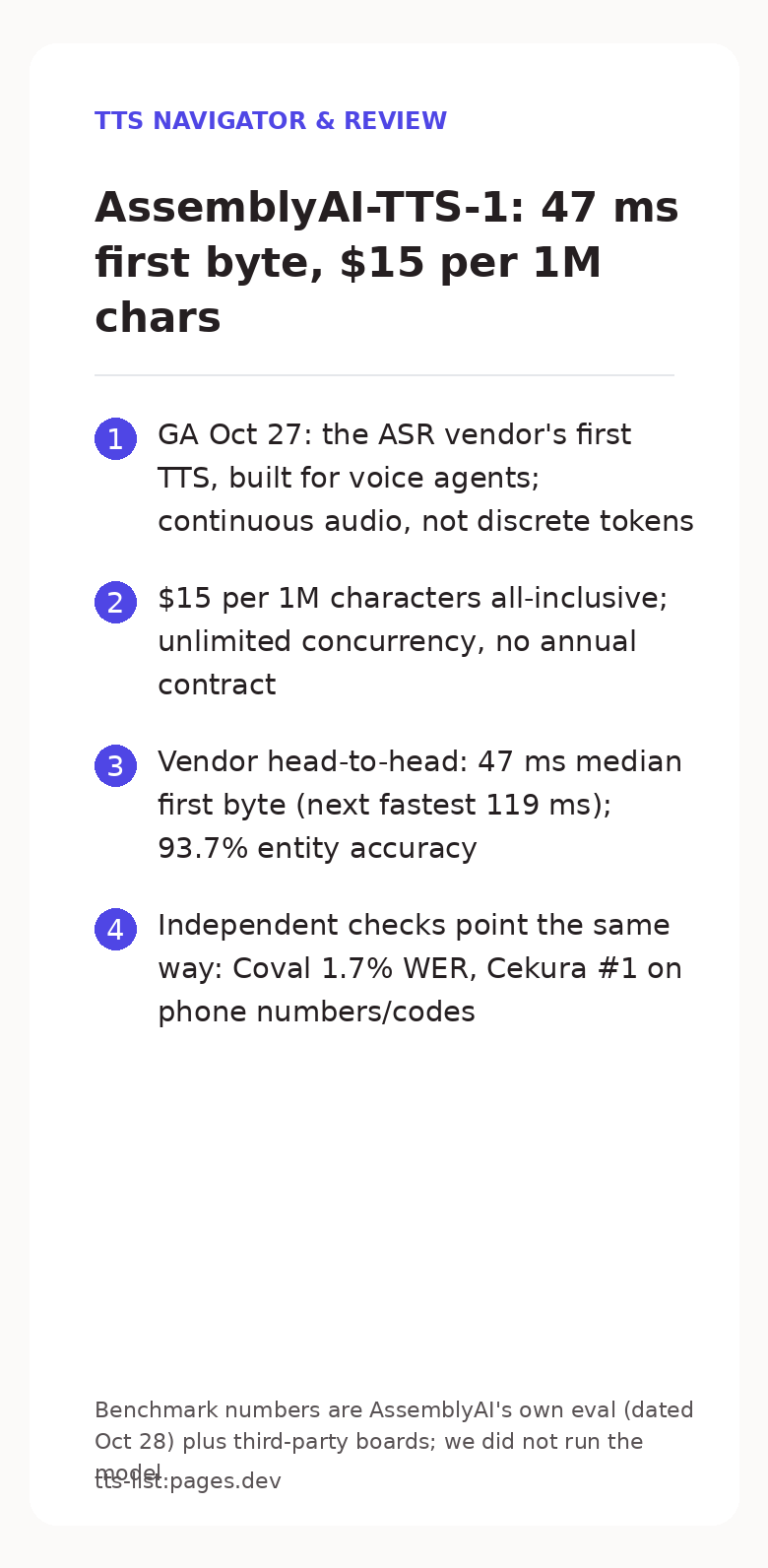
AssemblyAI - until now a speech-to-text company - has launched AssemblyAI-TTS-1, its first text-to-speech model, generally available since October 27 and aimed squarely at voice agents. The launch post argues on three axes at once: latency ("90 ms time to first audio in production"), price ($15 per 1M characters with everything included), and a commercial shape that removes the usual enterprise lever - unlimited concurrency on pay-as-you-go, with no annual contract. The pitch: a TTS bill that grows with every completed call "competes with the business case for the agent itself."
The vendor's own numbers - clearly labeled, with a real methodology
- Latency: 47 ms median time to first byte in AssemblyAI's single-client lab measurement (30 prompts, three rounds, four stock voices per model), the fastest of six - ElevenLabs Flash v2.5 at 119 ms, Cartesia Sonic 3.6 at 143 ms, Inworld TTS-2 Flash 244 ms, Inworld TTS-2 280 ms, ElevenLabs v4 612 ms. The "90 ms" headline is the production figure across real networks and both regions - the conservative number to plan around. That distinction (lab vs production quote) is more honest than most launch posts.
- Accuracy: 99.0% word accuracy on plain sentences (Seed-TTS + LibriSpeech); 93.7% entity accuracy on its 580-sentence pronunciation set (phone numbers, dates, URLs, confirmation codes) - ahead of ElevenLabs v4 at 93.6%, Cartesia Sonic 3.6 at 82.5%, ElevenLabs Flash v2.5 at 68.0%.
- Naturalness: predicted MOS 3.85 (averaged across preference predictors including UTMOSv2), TTSDS prosody 85.5/100, speaker similarity 0.64 for cloned voices.
- Methodology worth naming: every model spoke through the same fixed pool of 50 cloned voices; 95% bootstrap intervals; the eval is dated October 28. One caveat they don't flag: generated audio is transcribed for scoring by Universal-3.5 Pro - AssemblyAI's own ASR model. Standard practice, but the judge is family.
The independent cross-checks - and why they matter here
Unlike most vendor charts, three outside boards already carry the model:
- Cekura (104 agent sentences, 27 models): "Best Quadrant" of accuracy vs latency; #1 on phone numbers and codes at 91.7%, #4 on naturalness (4.50), reading accuracy 81.5% - above every ElevenLabs and Deepgram model there, at roughly half their per-character price.
- Coval (re-measures daily over a rolling 30 days): WER 1.7%, three-tenths of a point behind the leader, ahead of ElevenLabs v4 Turbo and Cartesia Sonic 3.6 (1.8%) and Deepgram Aura-2 (1.9%). Recall from yesterday's Deepdub piece: the rolling window is the harder test.
- Artificial Analysis controlled-voice arena (same eight cloned voices across models): top-ten debut, ahead of ElevenLabs v3.
None of these make the vendor's 47 ms or 93.7% independently true - but a launch that volunteers third-party boards on day one is playing a different game than a launch with only internal numbers.
Product shape
- 4,000+ voice library, instant cloning (the post's clone used 24 seconds of audio; you confirm you have the speaker's permission), cloned voices at the same per-character price.
- English, Spanish, French, German, Italian and Portuguese at launch, with accent variety in each; more languages "in the coming weeks."
- US or EU data residency at the same price; word timestamps; a cancel message for barge-in; reference agents for LiveKit and Pipecat.
- Trained on "millions of hours" including real conversational data; operates on continuous audio representations rather than discrete tokens - the same architectural direction as several 2026 low-latency models.
What it does not do yet
- No SSML, no speed parameter, no custom pronunciation dictionaries, no emotion tags - "coming soon." The post's advice: have your agent's LLM write the pause or "um" into the text and the model will speak it.
- No "Pro" (fine-tuned) voice cloning at launch - instant cloning only.
- All accuracy and latency figures above are the vendor's own eval; the independent boards cover WER, naturalness and arena preference, not the 47 ms claim.
Why it matters
- Price as the wedge. $15/1M all-in against $30-40 for comparable tiers, with no concurrency tier to negotiate, attacks the part of the voice-agent bill that scales with success. "Ten concurrent calls and ten thousand run on the same API at the same per-character price."
- The ASR-TTS stack consolidates. AssemblyAI joins Deepgram (Aura), Cartesia and ElevenLabs in offering both directions of the voice loop; its speech-to-text incumbency is the distribution channel.
- Evaluation culture is shifting. A dated eval, a named methodology, fixed cloned-voice pools, and day-one third-party boards - this is what launch benchmarks look like when buyers have started asking questions.
Source (read in full; link verified October 29, 2026)
- Introducing AssemblyAI-TTS-1: text-to-speech built for voice agents - AssemblyAI (October 27, 2026) - all product, pricing, latency and accuracy claims above, including its methodology section and the Cekura/Coval/Artificial Analysis figures it cites.