Deepdub Phantom Z 4.0: 50 ms to first audio on an independent benchmark - the claim, and the other page that reads 193 ms
Published October 28, 2026 · Built from Deepdub's launch post, read in full on October 28, 2026, with LLMs Blog's independent cross-check of Coval's public pages. Benchmark numbers are Coval measurements of Deepdub's service, cited by Deepdub - we did not run the model.
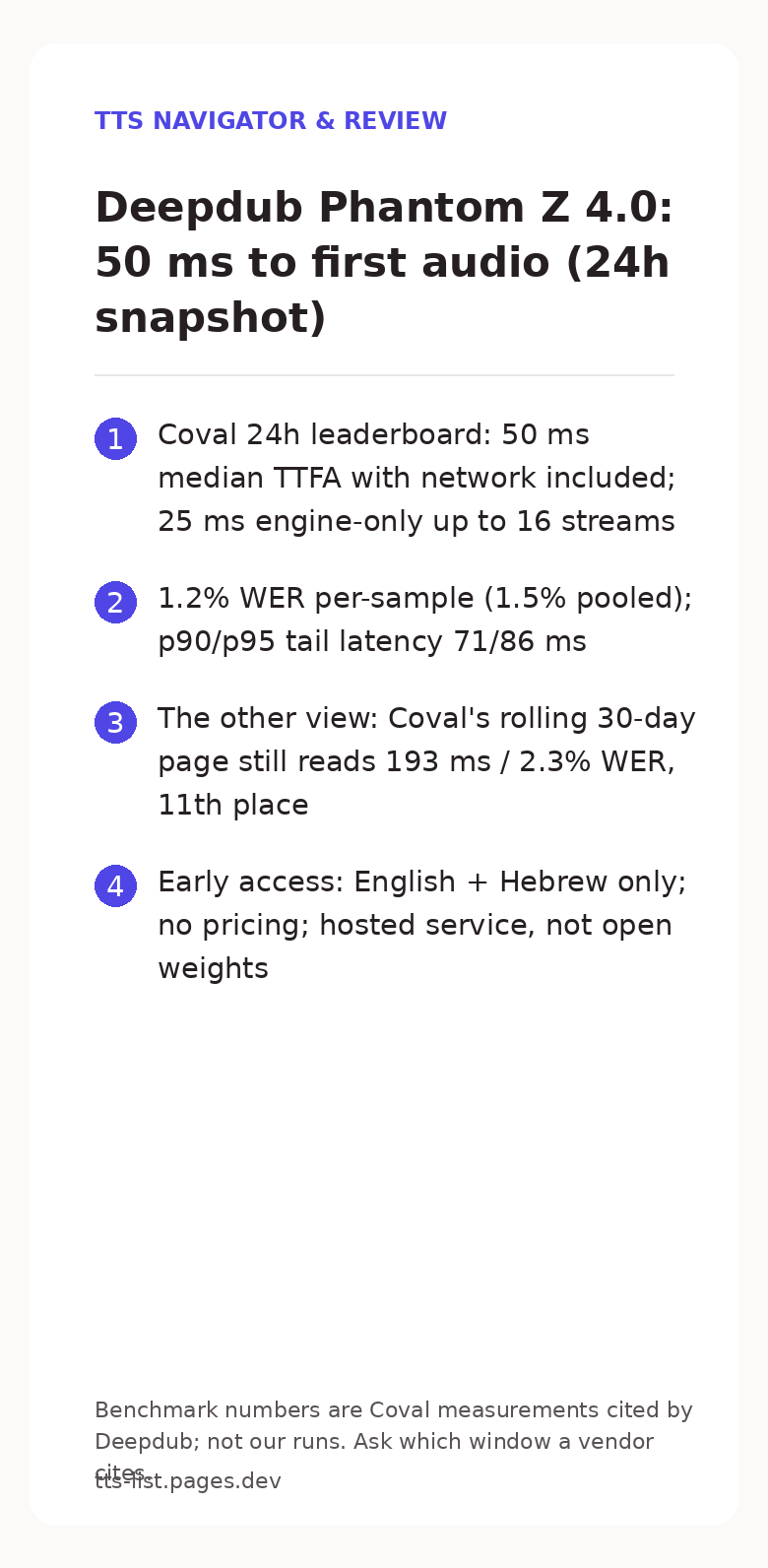
Deepdub - the AI dubbing company that says it has localized more than 5,000 titles - has released Phantom Z 4.0, a text-to-speech model aimed squarely at voice agents. The headline, from its October 26 launch post: a 50 ms median time to first audio (TTFA), network round trip included, with a 1.2% word error rate - both from Coval's independent voice AI benchmark, where a month earlier the same measurement read roughly 250 ms. Latency is the whole game for voice agents: the TTS link sits between the language model's reply and the caller's ear, and every 100 ms is audible dead air.
The claims, precisely
- 50 ms median TTFA, network included, on Coval's 24-hour leaderboard (96 samples per model), measured from Coval's workers in us-east-1; connection setup is excluded for every provider. p90 and p95 tail latency of 71 ms and 86 ms - Deepdub says that ranks second on tail latency.
- 1.2% WER is a per-sample average. Pooled across datasets - every word counted together - it is 1.5% (0.9% substitutions, 0.5% deletions, 0.1% insertions). Both figures are on the launch page, which is more transparency than launch posts usually give.
- 25 ms engine-only TTFA, which Deepdub says holds from a single request up to a burst of 16 concurrent streams. 2B parameters, 48 kHz output.
- Pareto framing. On Coval's WER-vs-latency chart, Deepdub says "no model on the leaderboard is both faster and more accurate than Phantom Z 4.0." Note whose sentence that is: Deepdub's reading of Coval's data, not a statement from Coval.
The second page: snapshot vs. rolling average
Here is the part worth your skepticism - and it holds up. Coval publishes two views. The launch post cites the 24-hour snapshot. Coval's public TTFA page shows a rolling 30-day average, and when LLMs Blog checked it on October 27 it listed the service - still named "Phantom Z 3.4 conversational" on the board - at 193 ms average TTFA and 2.3% WER, in 11th place of 31 models.
Both numbers can be true at once. Deepdub's own chart of daily medians (September 27 to October 26) shows latency falling across the month, so a 30-day window still carries the slower weeks; the 50 ms figure is the recent end of that curve. Two practical takeaways: first, when a vendor cites a benchmark, ask which window; second, the 30-day page is the one to watch over the next weeks - it will show whether the new numbers hold or were a good day. Coval's methodology is open source, and since a May 2026 change its TTFA includes any leading silence a provider streams, which makes pre-change numbers non-comparable.
What is new under the hood - vendor description, no measurements
Deepdub says "almost everything underneath is new": a new modeling approach "drawing on recent advances in language and vision modeling," a new inference engine (kernel fusion, quantization, dedicated Triton kernels, custom scheduling), trained on seven years of professional dubbing-production data and RL-tuned on "thousands of hours of human-rated audio." Chief scientist Chen's quote frames the approach: "Designing the model and the inference engine together, rather than optimizing one after the other, is what let us push latency down without giving up quality." The post promises expressive content-aware delivery, strong text normalization and fine-grained control - with no separate measurements for any of those. Roadmap: more kernel work, a 24 kHz telephony variant, and distilled "flash" models, which Deepdub says should take "roughly another 10 ms" off TTFA.
Who can use it today
- Early access in the Deepdub Playground, English and Hebrew only for now; other languages "soon."
- No pricing anywhere in the launch - no cost per character or minute.
- It is a hosted service, not open weights. If self-hosting is the requirement, this is not that.
Why it matters
- The latency bar moved. A 50 ms network-inclusive median - if it holds on the 30-day page - puts TTS comfortably inside the response-time budget of a natural phone turn.
- Third-party measurement is becoming table stakes. Launching against an independent, open-methodology leaderboard (rather than only internal numbers) is the right kind of claim - and, as the 193 ms page shows, one readers can verify from two angles.
- Media-grade pipelines are entering voice agents. Deepdub joins ElevenLabs (Eleven Realtime) and the open Hurston-1 in chasing the phone call; the dubbing data angle is a genuinely different training asset.
Caveats
- The 50 ms / 1.2% figures are a 24-hour snapshot cited by the vendor; the 30-day rolling page reads 193 ms / 2.3% today. Neither is our measurement.
- Ranking language ("Pareto frontier," "#2 on tail latency") is Deepdub's interpretation of Coval's board, which updates continuously and still labels the model "Phantom Z 3.4 conversational."
- English and Hebrew only at launch; no published pricing; expressiveness and normalization claims carry no measurements.
Sources (read in full; links verified October 28, 2026)
- Deepdub - Phantom Z 4.0: from 250 ms to 50 ms (launch post, October 26, 2026) - all product, latency and WER claims above.
- LLMs Blog - Deepdub Phantom Z 4.0 (October 27, 2026) - the Coval 30-day rolling-page cross-check (193 ms, 2.3% WER, 11th place) and TTFA methodology notes.