Where intonation lives in TTS: steering tunes inside CSM and Fish S2 (Northwestern, October 2026)
Published October 25, 2026 · Built from the paper arXiv:2610.27403, read in full on October 25, 2026 - method, findings, and limitations included. All results are the authors' own; we did not run their code. Our judgments are marked as such.
Ask a modern TTS system for a question and you get a rising tune - because of the question mark, not because the model understands what you want. A Northwestern University paper (Vigneaux and Cole, arXiv:2610.27403, October 19, 2026) asks the deeper question: inside today's residual-vector-quantization (RVQ) speech generators, where is intonation actually computed, and can you steer it directly? The answers are useful both scientifically and practically - including one very actionable finding about what prompting cannot do. This is a full read of the paper; all results are the authors'.
Why this matters: the two-stage architecture most new TTS uses
Many recent speech generators - CSM (Sesame) and Fish Audio S2 among them - are staged hierarchical generators: a transformer backbone runs along time and emits the first level of each audio frame's token stack, and a smaller depth model, conditioned on the backbone's hidden state, fills in the remaining levels. The split is an efficiency measure. What it does to control - specifically, to intonation - had not been measured.
The authors focus on the English nuclear tune: the pitch melody from the stressed syllable of the last accented word to the end of the phrase - the fall that marks an assertion ("It's Marilyn.") versus the rise that marks a question ("It's Marilyn?"). They work with two systems (CSM, on the Mimi codec; Fish Audio S2, on a DAC-based codec), three carrier sentences, ten speakers, and matched assertion/question pairs elicited by a final period or question mark - 540 utterances per system in the main set.
Finding 1: prompting barely works
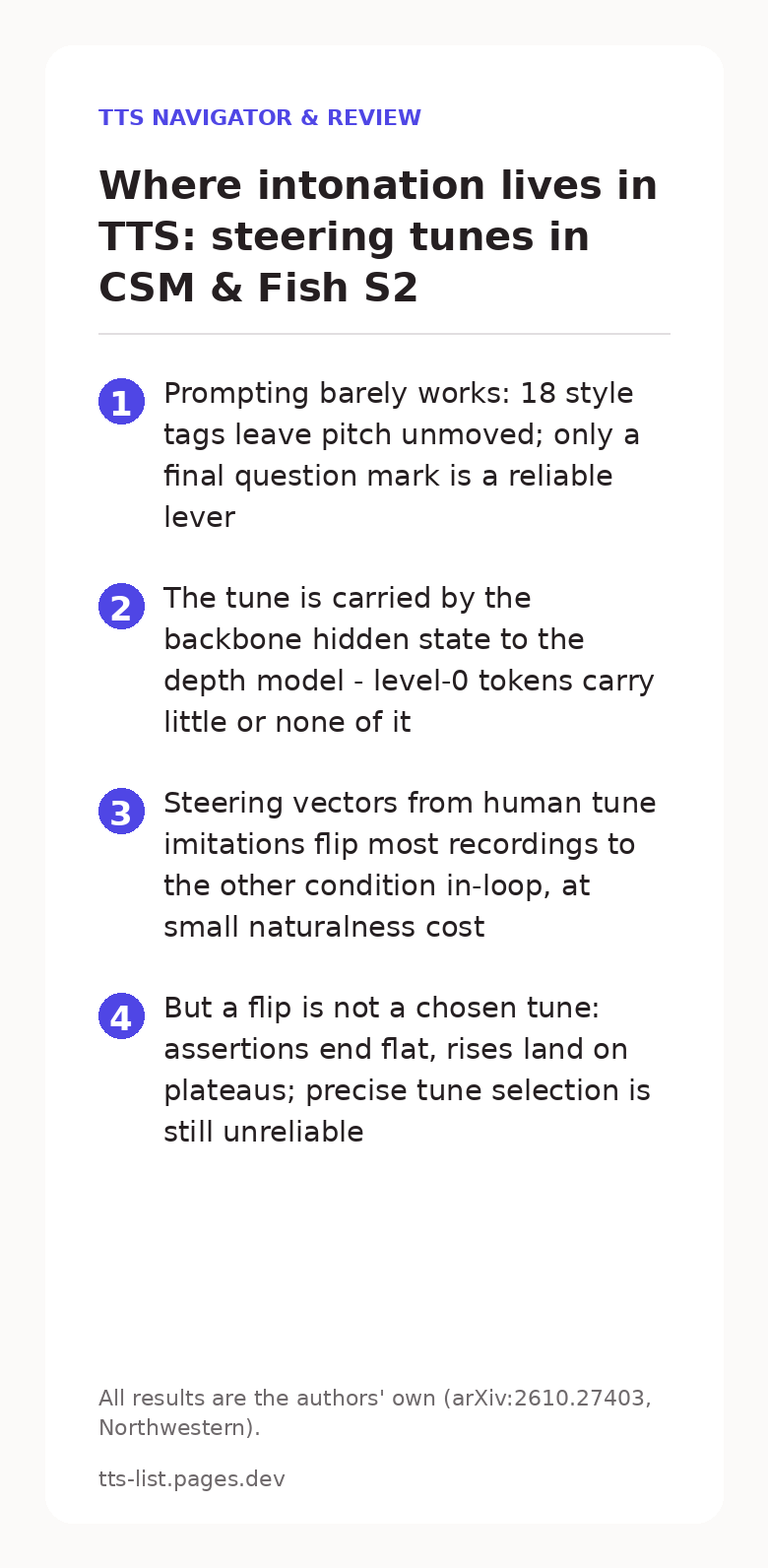
Before touching the models' internals, the authors tried three prompt-side strategies. Eighteen inline style tags naming uses of a rising tune ([questioning], [very uncertain], and so on) leave S2's pitch indistinguishable from the untagged baseline across ten voices - none moves the contour toward a rise. Lead-in text that would constrain a human's intonation does nothing. A recorded demonstration of the target tune, given as the voice prompt, moves the contour only partway. The only reliable orthographic lever is the final punctuation mark itself. If you need a specific tune in production today, punctuation is close to all you have - everything fancier fails quietly.
Finding 2: the tune lives in the backbone state, not the "semantic" tokens
Using interchange interventions between matched assertion/question pairs, the authors localize the computation. Swapping the depth-model-generated token levels (levels 1 and up) over the final word transfers the intonation between utterances. Swapping level 0 - the level the literature calls "semantic" - transfers neither the tune nor the words in CSM (in S2 it carries a small part of the tune). And re-running the depth model with the other utterance's backbone hidden state transfers the tune, while re-running it with the other's level-0 tokens does not. Conclusion: the backbone's hidden state already carries the tune, and the depth model writes it into the waveform. For anyone trying to control or fine-tune intonation in these systems, the lever is the backbone state, not the level-0 audio tokens.
Finding 3: steering the backbone state works - within limits
A difference-of-means vector computed on backbone states from punctuation-elicited material steers the tune offline, but asymmetrically: pushing a question toward an assertion degrades voicing and harmonicity. The more interesting result uses vectors computed differently - from the model's backbone states while it "reads" (as voice prompts) human imitations of theoretically specified tunes, whose transcripts carry no punctuation at all. Applied inside the generation loop, these imitation-derived vectors move most recordings to the other condition in both systems - even when fitted without the speaker being steered - at a small cost in predicted naturalness (UTMOS stays within about 0.1 of the target condition, speaker similarity unchanged, median word-error-rate change zero). The imitation-derived vectors are aligned with the punctuation-derived vector far beyond a shuffled-label null, which tells us the backbone state of a punctuated prompt already represents intonation: the orthographic cue has been translated into something the model also computes when it hears pitch.
The limits matter as much as the effect. Steering in the loop works because the model is free to choose timing and codewords; offline edits cost voice quality. Pushing toward a fall still costs harmonicity (about 1 dB below the model's own assertions in CSM, with steeper losses at higher strengths). And a "flip" to the other condition is not the same as reaching the intended tune: the models' own assertions are mostly flat (lll) rather than the falling hll a human would produce, so a question pushed toward "assertion" often ends flat, not falling. Pushed toward a rise, recordings mostly land on a high plateau rather than the paradigmatic question rise. The edge tone moves more coherently than the pitch accent; S2 appears to represent the two jointly even though they vary independently in human speech. A vector fitted for one specific tune (hlh) that no punctuation mark elicits reached its target in about a quarter of recordings at the right strength - promising, not production-ready.
What to take away
- For TTS users: style tags and prose instructions are not a reliable intonation API in current RVQ-based systems - the paper measured them failing. Use punctuation; test everything else against your ear.
- For builders of open stacks: the control point is the backbone hidden state applied inside the generation loop. The paper's code is public (github.com/jpvigneaux/steering-intonation-tts), and the localization results suggest where prosody-annotated fine-tuning data - relatively scarce - would do the most good.
- For the field (our judgment): the gap between "moves most recordings to the other condition" and "selects a tune precisely" is the real story. Broad rise/fall steering is close; choosing among the eight tunes of the autosegmental-metrical inventory is not.
Limitations the authors state
- Material is English imitated speech: three carrier sentences, ten speakers, the tunes of a single corpus (the Basic8 corpus). The voice prompt is maximally varied by design, but each tune occurs over a single word at the end of its recording.
- No listening test was run: voice quality is measured acoustically and by prediction (harmonicity, voicing, UTMOS, speaker similarity), and tune shapes are read from F0 contours - a word with too little voicing cannot be labeled at all.
Reproducibility is unusually strong for the field: code accompanies the paper, every reported number is produced by a script reading a committed CSV, split seeds and generation seeds are stored, and offline depth re-runs are verified against each generator's own computation before use.
Sources (paper read in full October 25, 2026)
- Vigneaux & Cole (Northwestern University) - "Steering intonational tunes in text-to-speech synthesis," arXiv:2610.27403v1, October 19, 2026 - all methods, findings, and limitations above.
- github.com/jpvigneaux/steering-intonation-tts - authors' code, linked from the paper; we did not run it.