LoCA: Teaching TTS Models Where Their Mistakes Are (arXiv 2610.28035, October 2026)
Published October 21, 2026 · Built from the full paper (v1, submitted October 20, 2026, CC BY 4.0), read end to end including appendices. Every result number below is the paper's own experiment, not ours and not independently reproduced - we say so each time it matters.
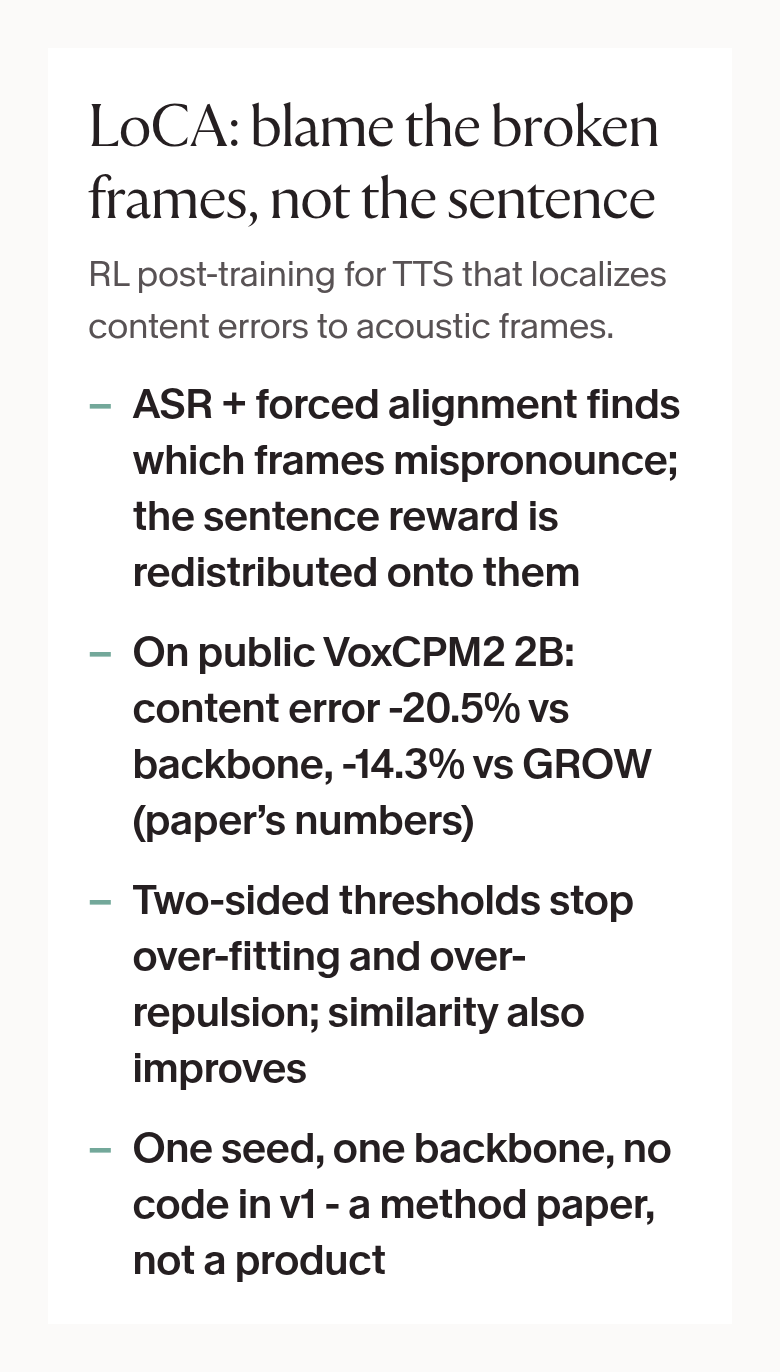
Reinforcement learning is how TTS models get post-trained from "mostly right" to production-grade: generate several candidates, score the audio, and push the model toward the good ones. But a sentence-level score has a known blind spot - if one word in a ten-second line is mispronounced, the reward cannot say where the problem is, so every acoustic frame gets the same praise or blame. LoCA (Local Credit Assignment), from Lingguang Zhaxian Technology in Shanghai, attacks exactly that, and pairs it with a stability mechanism that stops RL regression from over-fitting good samples or over-repelling bad ones. The paper was submitted to arXiv on October 20 and reports experiments on OpenBMB's public 2B-parameter VoxCPM2 checkpoint - a model anyone can download, which makes the claims unusually checkable in principle.
The two problems LoCA targets
Where should a sentence reward act? Broadcasting one advantage coefficient across an utterance treats the mispronounced span and its flawless surroundings identically. When should a regression update stop? In the direct-regression RL style this paper builds on (GROW, Yang et al. 2026), a positive advantage keeps pulling the model toward a sampled trajectory with no built-in stopping point, and a negative advantage pushes it away without bound - the authors call the failure modes excessive fitting and excessive repulsion. LoCA keeps GROW's frozen-reference anchor and changes two things: the credit becomes per-frame, and both update directions get explicit stopping thresholds.
How local credit is built
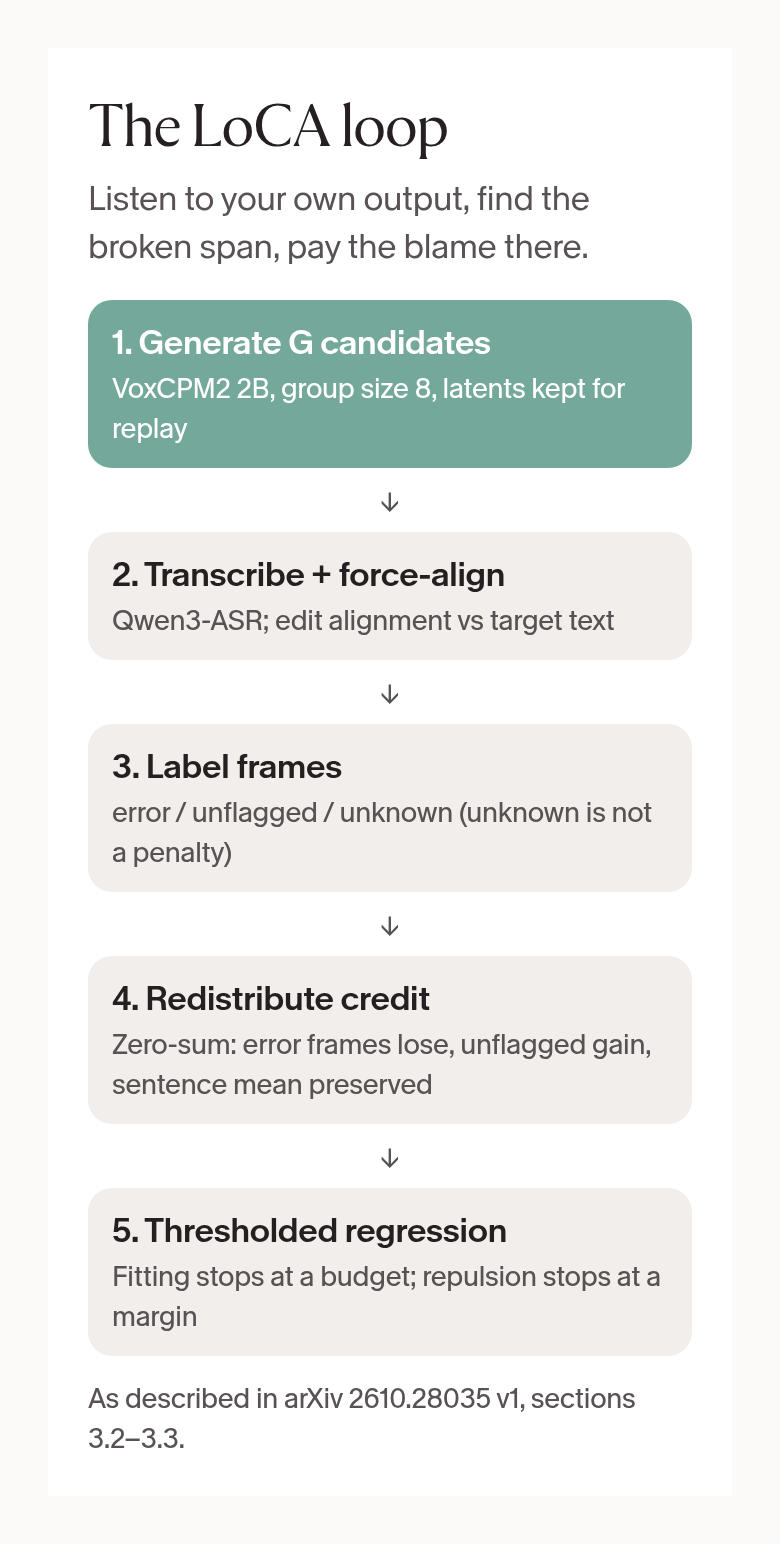
The pipeline is refreshingly concrete. Each generated utterance is transcribed with Qwen3-ASR and force-aligned to its own waveform; an edit alignment against the target text marks substitutions and insertions with timestamps, while deletions inherit neighboring-word boundaries. Those intervals are projected onto the generated latent frames, giving each frame one of three labels: detected error, unflagged, or unknown (unreliable timing, unmeasured tail - explicitly not a negative reward). A per-utterance, zero-sum redistribution then moves part of the sentence advantage (local weight alpha = 0.2) from unflagged frames to error frames: the sentence-level coefficient is preserved on average, but the broken span gets the punishment. The authors note the final frame coefficient can even flip sign when local evidence outweighs the sentence advantage.
The second mechanism is simpler: positive fitting stops once the frame's regression error improves past a budget relative to the frozen reference model's error, and negative repulsion stops at a fixed margin above it. That removes the incentive for unbounded negative regression - the failure mode where a model pushed away from bad samples drifts into worse behavior elsewhere.
What they measured
All systems start from the public BF16 VoxCPM2 2B checkpoint. RL samples a 50,000-example Emilia pool across six languages (Chinese, English, German, French, Japanese, Korean), group size 8, AdamW at lr 2e-6, a single training seed (42). Evaluation covers seven CV3 language splits (500 items each) plus Chinese/English hard sets, 3,624 items total, and Seed-TTS-Eval. The headline table, quoted from the paper:
| Method | CV3 content error | Severe proxy cases | Speaker similarity (x100) |
|---|---|---|---|
| VoxCPM2 base (no RL) | 5.986% | 61 | 67.168 |
| GROW (sentence-level) | 5.553% | 60 | 67.562 |
| LoCA | 4.758% | 51 | 69.137 |
That is a 20.5% relative error reduction over the backbone and 14.3% over GROW, matching the abstract. On the Seed-TTS-Eval hard Chinese subset, LoCA's 6.884% CER beats the base's 8.193% - and note GROW lands at 9.575%, worse than no RL at all on that set, which is exactly the instability story the thresholds are meant to fix. A Russian split (500 items), deliberately excluded from the RL pool, still improves: WER 6.219% to 4.723% (-24.1% relative) with higher similarity, though the authors caution this says nothing about whether Russian was in the backbone's pretraining.
The ablation table is the honest part
Removing local credit degrades CV3 error to 5.508%; removing the thresholds degrades it to 5.488%. Both components matter for content accuracy. But the no-threshold variant records 44 severe proxy cases - fewer than full LoCA's 51. The paper reports this trade-off plainly instead of hiding it, and its "severe failure" metric is itself an automatic proxy (WER over 0.5, all-silent output, generation-cap hits, or long silences). Single-seed, single-backbone results with mixed trade-offs are what one honest lab run looks like; treat the effect sizes as indicative, not settled.
The paper's own limitations
- One training seed and one backbone; results describe the evaluated language and task subsets only.
- Local labels inherit ASR recognition and timing errors; phonetic matching is a text-side proxy.
- The severe-failure metric is an automatic diagnostic, not human judgment; the paper reports no listening study.
- The fixed-replay threshold properties "do not guarantee optimizer convergence or absence of parameter drift".
- Ethics: voice cloning can enable impersonation; the study does not establish redistribution rights for every source recording.
Our read
Judgment, not measurement: LoCA is a clean, well-motivated idea - if you can transcribe your own model's output, you can localize blame, and zero-sum redistribution is a cheap way to do it without inventing a new reward model. The two-sided thresholds address a real and under-discussed instability in advantage-weighted regression (GROW going below base on Seed-hard is the kind of evidence that usually stays internal). The evaluation is more rigorous than most arXiv TTS-RL papers: public backbone, public benchmarks, per-checkpoint trajectories in the appendix, and ablations that include an unfavorable number. What it is not: a product result, a human-rated quality claim, or a guarantee the gains survive other backbones - there is no code release with v1, and the single-seed caveat is real. If you run RL post-training on flow-matching TTS, the method section is worth your afternoon; if you buy TTS, file this under "why next year's models should mispronounce less", not under anything to act on today.
Caveats
- We did not run LoCA; every number is from the paper's own tables (v1, October 20, 2026), not independently reproduced.
- Relative reductions (20.5%, 14.3%) are computed on the paper's 3,624-item CV3 selection; absolute error rates remain in the 4.7-6% band on ordinary splits and 7.2% on the hard set.
- The no-threshold ablation beats full LoCA on the severe-case count (44 vs 51); the paper's framing is a metric-dependent trade-off, not a uniform win.
- No listening study: speaker similarity and content error are automatic metrics, and similarity backends differ between CV3 and Seed per the appendix.
- v1 ships without code; reproducibility rests on the public VoxCPM2 checkpoint, named datasets (Emilia, CV3, Seed-TTS-Eval), and the hyperparameters in Appendix A.
Sources (paper read in full, including appendices; links verified October 21, 2026)
- Paper: arxiv.org/abs/2610.28035 (HTML: arxiv.org/html/2610.28035), CC BY 4.0
- Backbone: huggingface.co/openbmb/VoxCPM2 (public 2B checkpoint)
- Baseline method: GROW (Yang et al., 2026), cited within the paper
- Eval sets referenced: CV3 (QwenAudio, 2026), Seed-TTS-Eval (ByteDance Speech, 2024), Emilia dataset
More TTS provider profiles: TTS Navi