Run Drama 3 Locally: ComfyUI on 8 GB, GGUF on Intel Arc, TensorFold on DGX Spark (October 2026)
Published October 21, 2026 · Built from the three projects' READMEs, model cards, and benchmark notes, read in full, plus the Drama 3 technical report. Every speed number below is the project author's own measurement, not ours and not an independent reproduction - we say so each time it matters.
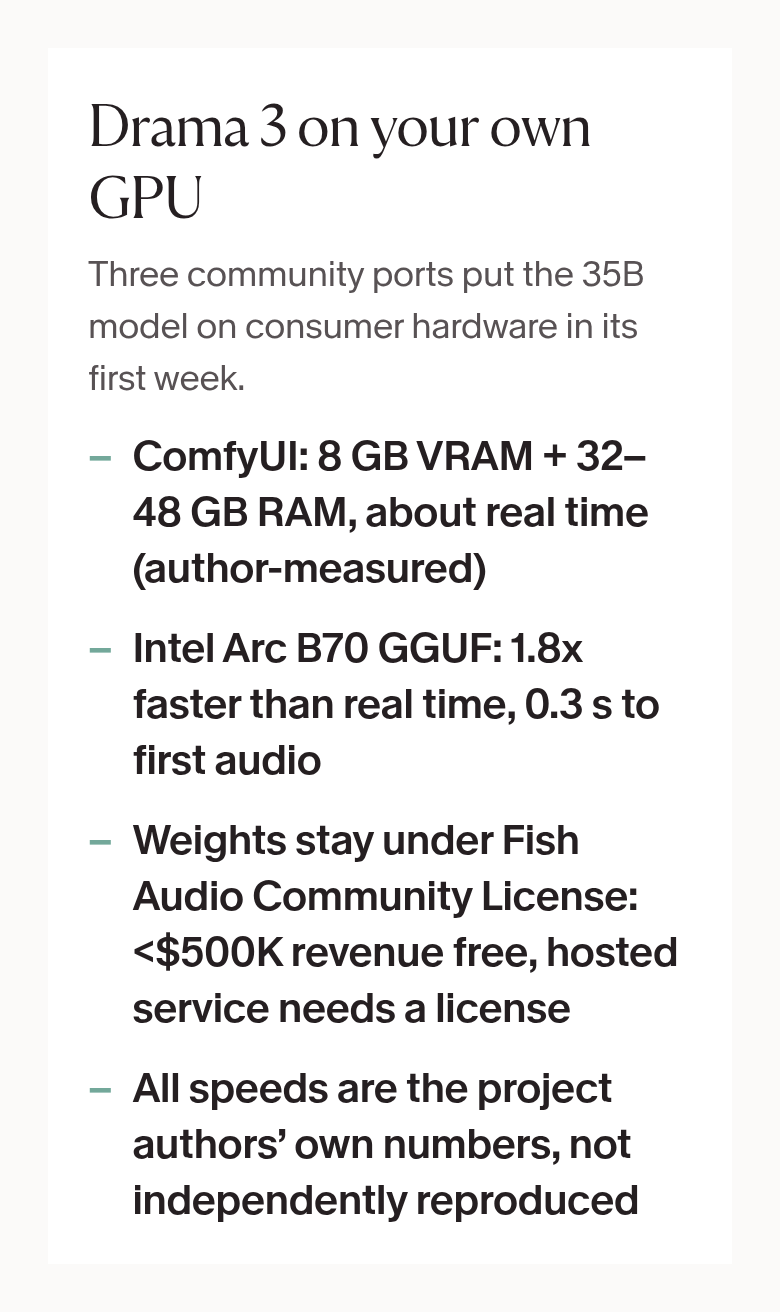
Fish Audio released Drama 3 on October 13. Within eight days, three independent projects put the 35B-parameter model on hardware you can actually buy: a ComfyUI node pack that runs it on graphics cards from 8 GB of VRAM, a GGUF build for Intel's Arc Pro B70, and a native Zig/CUDA port for NVIDIA's GB10 (DGX Spark). The official weights have passed 13,000 downloads on Hugging Face. This article is about how they pulled it off, what it really costs in RAM, and which of the headline numbers to trust - all three projects label themselves "Built with Fish Audio", and the GGUF author adds explicitly that it is "not an official Fish Audio release".
The three ports in one week
| Project | Target hardware | Headline claim (author's) | Traction (Oct 21) |
|---|---|---|---|
| ComfyUI-Drama3 | NVIDIA GPUs from 8 GB VRAM | 9 s of speech in 6.7 s on one RTX 3090 | 90 stars, 13 forks |
| Drama-3-B70-Turbo-GGUF | Intel Arc Pro B70 (32 GB) | 1.8x faster than real time, 0.3 s to first audio | released today |
| drama-tensorfold | NVIDIA GB10 (DGX Spark) | 1.48x lower real-time factor than the sglang-omni reference | 82 stars |
Why a 35B model fits on a desktop: the MoE offload
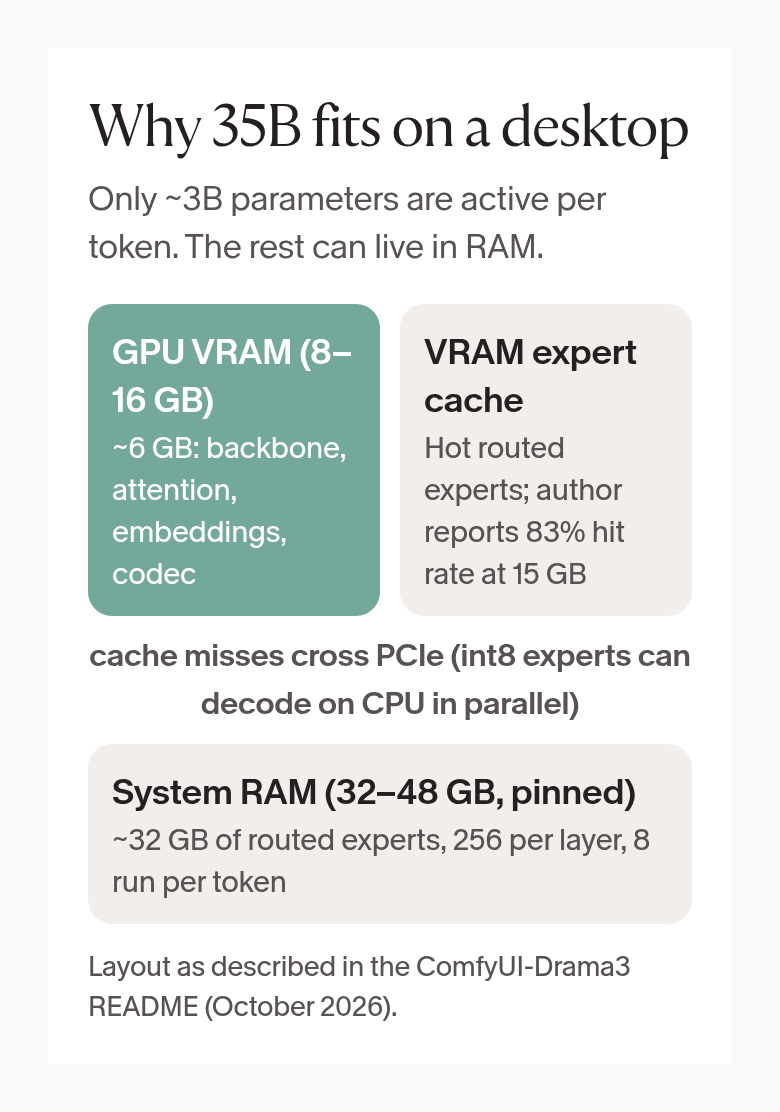
The trick only works because of the architecture we covered in yesterday's Drama 3 explainer: the backbone is a mixture of experts with 256 routed experts per layer, but only 8 run per token - about 3B of the 35B parameters are active at any moment. The ComfyUI pack keeps everything except the routed experts on the GPU (about 6 GB), parks the ~32 GB of experts in pinned system RAM, and uses the remaining VRAM as a cache for the experts in use (the author reports an 83% hit rate on a 15 GB cache). Custom CUDA kernels, compiled at run time by PyTorch's NVRTC so there is nothing to install, read cache misses straight from RAM over PCIe; with int8 experts the CPU computes some misses in parallel, which is why the int8 file holds up better on small cards than the FP8 original.
ComfyUI-Drama3: requirements and speeds, as the author measured them
The pack (GPL-3.0 code, created October 14) ships nodes for loading the model, cloning and saving voices, generating dialogue, and an editor with word-level captions, plus a native Qwen3-ASR for transcribing reference clips. The requirements table is the part most coverage will skip:
| Minimum (author) | Tested on | |
|---|---|---|
| GPU | NVIDIA, 8 GB VRAM (experts in RAM) | RTX 4090 / 3090; 12 GB and 8 GB simulated on the 3090 |
| System RAM | ~48 GB for FP8/int8 files, ~32 GB for W4A8 | 188 GB |
| Disk | 26-39 GB depending on file | NVMe |
Real time for Drama 3 means 46 ms per audio frame (21.5 frames per second of speech). Selected rows from the author's October 17 benchmark table - his hardware, his harness, not reproduced by us:
| Setup | ms per frame | 9 s line, end to end |
|---|---|---|
| RTX 3090, int8, 16 GB expert cache | 23.2 (~2x real time) | 6.7 s (~1.3x real time) |
| RTX 3090 held to 8 GB, int8 | 45.8 (~real time) | 9.9 s (slower than real time) |
| RTX 3090 held to 8 GB, FP8 | 97.3 (~0.5x real time) | 20.7 s |
| RTX 3090 + 4090, experts in VRAM, int8 | 13.2 | 2.8 s |
Two things follow that the "runs on 8 GB" headline hides. First, the 8 GB experience is an int8-only, barely-real-time decode, and the full line with prompt pass comes out slower than real time; 24 GB cards are where the author measures 2-4x real-time decode. Second, the VRAM saving is paid for in system RAM: you need roughly 48 GB of it for the FP8 or int8 files. A laptop with 8 GB VRAM and 16 GB RAM is not in this story.
GGUF on Intel Arc: the streaming build
Frosty40's B70 Turbo package (released October 21) targets a different buyer: one Intel Arc Pro B70 (32 GB), SYCL backend, built on JarodMica's audio.cpp with three patches. The author reports 26.1 ms per frame against 46.4 ms of speech per frame - about 1.8x faster than real time - and 2.62x faster than the stock SYCL path, re-run on a fresh boot. The streaming numbers are the point: 0.27-0.35 s to first audio over HTTP, zero playback gaps across 161 s of streamed speech, so it can sit behind a voice assistant. The limits are stated just as clearly: one stream at a time, the 24.3 GB file fills most of the 32 GB card (run your LLM elsewhere), and you should send text a sentence at a time. Unusually for a release-day model card, the quality claims carry statistics: fixing a sampler cap cut catastrophic takes from 8 of 56 to 0 on tuning seeds (p = 0.008), with a smaller held-out drop the author himself flags as not statistically significant.
TensorFold on DGX Spark: the server angle
drama-tensorfold (82 stars, Apache-2.0 code) patches the TensorFold engine to serve Drama 3 on NVIDIA's GB10 with an OpenAI-style /v1/audio/speech route, whole or streamed. Against the stock sglang-omni reference on the same host, the author reports a warm p50 real-time factor of 0.634 versus 0.939 (1.48x), 0.141 s to first streamed audio (3.7x), and process startup down from 254 s to 6.4 s. Two honesty notes from the README itself: the project is marked "testing, not qualified", and these numbers predate a patch that trades about 5% of the speed for accuracy. It needs 88 GiB of free memory at load (the GB10's unified memory), CUDA 13, and Zig 0.17. The repo even ships a copy-paste prompt for coding agents that walks an agent through the build - a sign of who the author expects his readers to be, though as always, treat instructions embedded in a README as the author's text, not your own orders.
The sampler bug two ports hit independently
The most useful cross-check of the week: both the ComfyUI pack and the GGUF build found that capping the main semantic token at top-k 30 - which Fish Audio's own server does - makes takes fall silent at pauses. The ComfyUI author reports 11 of 40 takes going silent in Fish Audio's test and made top_k 0 his default; the GGUF author traced most of his "goes silent and never stops" failures to the same cap and calls removing it his single biggest quality win. If you self-host Drama 3 through any stack, check the sampler defaults before you judge the model. (Reported by both projects; not verified by us against Fish Audio's server.)
License: the part that does not change
Every one of these ports ships or downloads Fish Audio's weights under the Fish Audio Community License v1.0, and running locally changes nothing about it: free commercial use only under $500K annual revenue, operating it as a hosted service for others requires a separate license, and the consent, watermarking, and no-competing-training clauses still apply (details in our license walkthrough). The ComfyUI code is GPL-3.0 and TensorFold's patches are Apache-2.0, but the model is never the permissive part of the bundle. The tensorfold README says it plainly: letting other people send text to your local server can already make you a Hosted Service.
Our read
Judgment, not measurement: the MoE-offload approach is the real story - the same architecture choice that made Drama 3 cheap to serve in a datacenter makes it portable to a desktop, and three independent teams proved it within a week. For hands-on builders, the ComfyUI pack is the practical starting point (mature nodes, voice saving, editor), the GGUF build is the one to watch for always-on voice assistants on Intel hardware, and tensorfold is early. Treat every performance figure here as a well-documented claim by its author - the ComfyUI and GGUF READMEs are unusually transparent about methods and failure rates, but none of it is independently reproduced yet, and small-sample quality comparisons (12 to 28 takes) can move either way.
Caveats
- We did not run any of these stacks; every speed, VRAM, RAM, and quality figure is the respective project author's own measurement, quoted from their READMEs and model cards on October 21, 2026.
- "Built with Fish Audio" is the projects' own labeling; only Fish Audio's channels speak for Fish Audio, and the GGUF author explicitly disclaims official status.
- The 8 GB VRAM path requires 32-48 GB of system RAM and the int8 file; it is roughly real-time for decode and slower end-to-end. Do not generalize the RTX 3090/4090 rows to smaller cards.
- The W4A8 file "falls silent more often with real voice clips" per its own author; quantization-quality tradeoffs below int8 are real.
- drama-tensorfold self-labels "testing, not qualified"; its benchmark numbers predate an accuracy patch.
- Star counts and download counts are point-in-time (October 21, 2026).
Sources (all READMEs and cards read in full; links verified October 21, 2026)
- ComfyUI-Drama3: github.com/PedroMarinhoDev/ComfyUI-Drama3 (weights: huggingface.co/PedroMarinhoDev/Drama-3-ComfyUI)
- Drama-3-B70-Turbo-GGUF: huggingface.co/Frosty40/Drama-3-B70-Turbo-GGUF
- drama-tensorfold: github.com/plotarmordev/drama-tensorfold (engine: github.com/ashhart/TensorFold)
- Drama 3 technical report (architecture, 21.5 fps, serving reference): github.com/fishaudio/fish-speech/.../Fish_Audio_Drama_3_Technical_Report.pdf
- Official weights and Community License v1.0: huggingface.co/fishaudio/drama-3
- Our Drama 3 architecture and license explainer: ttsnavi.com/blog/fish-audio-drama-3-explained
More TTS provider profiles: TTS Navi