Fish Audio Drama 3 Explained: Directable TTS with Open Weights (October 2026)
Published October 20, 2026 · Based on the full Drama 3 technical report plus Fish Audio's blog, docs, license text, and Artificial Analysis leaderboard data, verified on the same day (sources at the end).
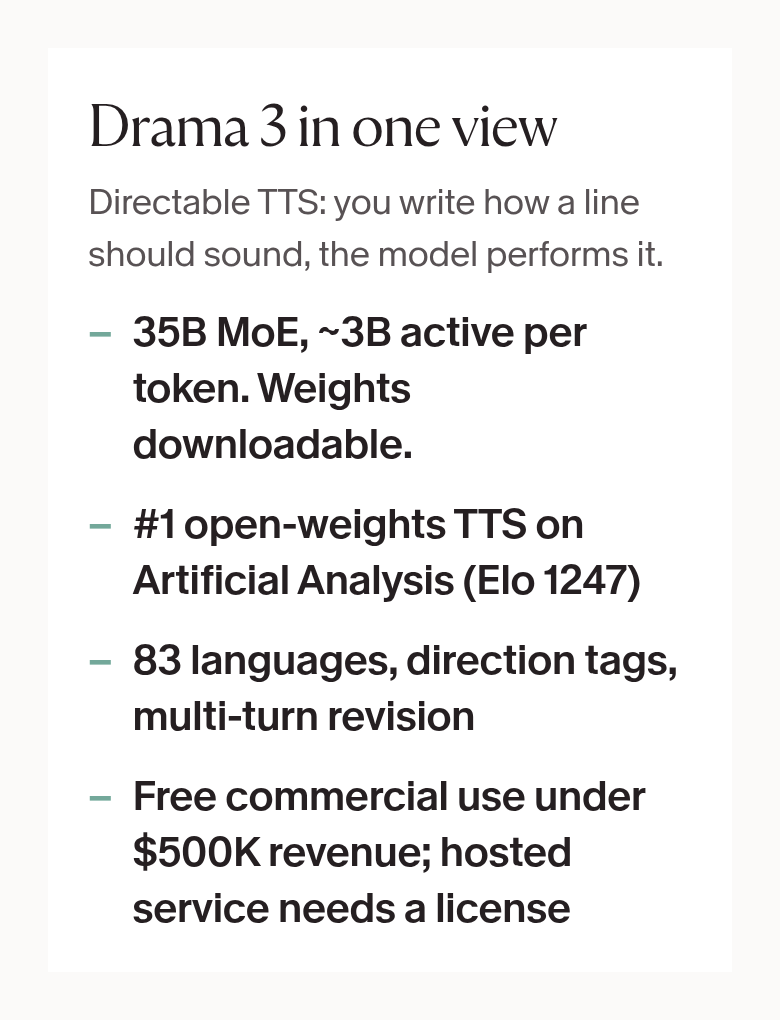
Fish Audio released Drama 3 on October 13, 2026, calling it their most emotive text-to-speech model. The pitch: instead of hoping the model guesses the right delivery, you direct it like an actor - bracketed notes such as [through gritted teeth, keeping his voice down] shape each line, and word-level tags like <emphasis> scope the effect. It is out now on fish.audio, the iOS/Android app, and the API, and the weights are downloadable under a new license. This article is built from the 18-page technical report, the license text, and third-party leaderboard data.
What directing looks like
Direction goes in square brackets, written the way you would say it to an actor, and it can change mid-line: [breathless, speaking fast] ... [voice drops to a terrified whisper]. Paired tags scope an effect to specific words. The model speaks 83 languages, and the direction language does not have to match the line's language (the docs show English lines directed from Chinese, Spanish, and Japanese). Switching the spoken language mid-line works but is flagged experimental in the docs. Multi-speaker dialogue uses speaker tags (<|speaker:0|> up to <|speaker:15|>), so one script can carry 16 characters. New in this generation, per the report: multi-turn revision (give a note on a take, get a redo that remembers earlier takes), multi-character scene dubbing, editing existing speech by infilling a word, and streaming text input. The first two editing tools are in invite-only testing, with an editing API announced as coming soon.
How it works (from the technical report)
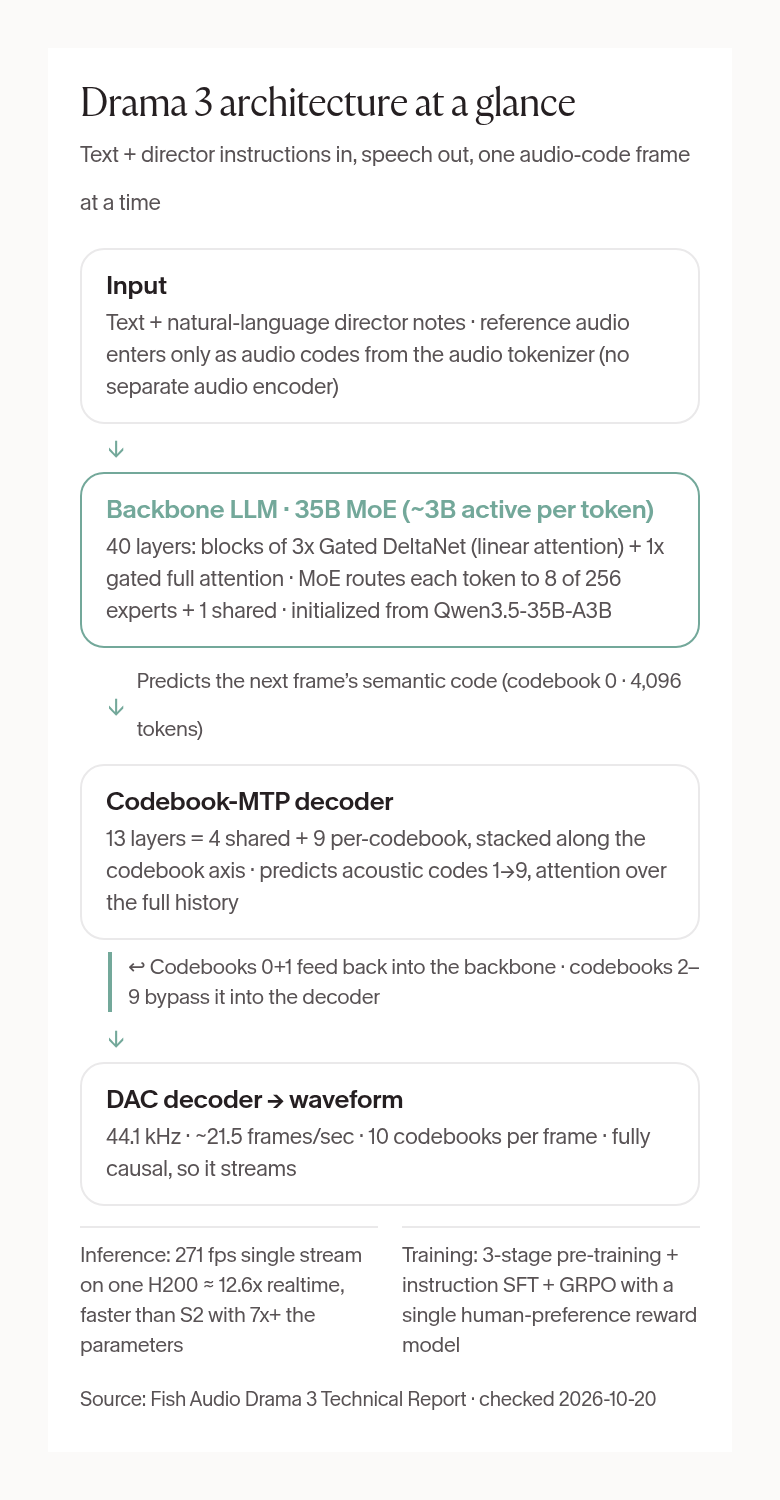
Drama 3 is a 35B-parameter mixture-of-experts model with about 3B parameters active per token (8 of 256 routed experts plus one shared), initialized from the language model of Qwen3.5-35B-A3B. The backbone uses hybrid attention: 40 layers in blocks of three Gated DeltaNet layers (constant-size state) and one gated full-attention layer (the only layer keeping a KV cache), which is what makes long directed sessions with multiple reference clips practical. On top sits a new codebook-MTP audio decoder: four shared layers feed nine full-width layers, one per acoustic codebook, and every layer attends causally over the whole sequence including the reference audio. Only codebooks 0 and 1 feed back into the backbone, to limit exposure bias. The tokenizer is unchanged from S2: a Descript Audio Codec variant at 44.1 kHz, ten codebooks, about 21.5 frames per second. Experts run in FP8, the rest in bf16, and the report's inference engine decodes a single stream at 271 frames per second on one H200, against 177 for S2. Inference works through SGLang-Omni and vLLM-Omni from launch day.
The training detail that explains the product: the RL stage optimizes a single learned model of human preference, with no rule-based rewards (GRPO without a KL penalty, 1,536 prompts x 8 takes per step). The report shows why the usual rewards fail here: on the Expresso dataset, styled human readings score lower on speaker similarity than default readings (whispering drops SIM by 0.310) and laughing raises WER by 0.79 points, so similarity- and WER-based rewards literally punish a laugh you asked for. With the style written as a direction, Fish Audio's reward model prefers the styled reading in 62-64% of whisper/laugh pairs, against 11-27% without the direction.
Benchmarks, with the fine print
The headline number is independent: on Artificial Analysis' Pronunciation Robustness benchmark (hard words - numbers, codes, brand names, context-dependent readings - checked by human listeners), Drama 3 (listed as "Drama 3 Preview") reads 93.2% correctly, the top score, against 88.1% for Fish Audio's own S2.1 Pro. Artificial Analysis separately ranks Drama 3 Preview #1 on its open-weights TTS arena leaderboard (Elo 1247 +/- 15, about 2,000 votes, checked October 20) and #9 on the overall provider-voice arena. The breakdown from Fish Audio's blog:
| Pronunciation Robustness category | Drama 3 | S2.1 Pro |
|---|---|---|
| Names of brands, places, technical terms | 95.9% | 87.3% |
| Context-dependent readings | 95.3% | 86.1% |
| Shorthand: numbers, dates, units, notation | 93.6% | 92.7% |
| Exact sequences: codes, paths, emails | 86.3% | 79.4% |
| Overall | 93.2% | 88.1% |
The technical report also evaluates multilingual voice cloning on the MiniMax Multilingual Testset (24 languages): Drama 3 posts a lower error rate than ElevenLabs v4 in 9 languages (Chinese, Dutch, English, German, Korean, Russian, Spanish, Thai, Turkish) and the lowest of every compared system in Chinese, Dutch, English, German, and Turkish. Read the setup before quoting that: ElevenLabs v4, Inworld TTS-2, and Soniox TTS RT v2 were run by Fish Audio themselves through the public APIs, while OmniVoice, FireRedTTS3-Base, and S2 numbers are quoted from their own papers with their own scoring; error rates follow each benchmark's protocol (CER for Chinese/Japanese/Korean, WER otherwise; Whisper-large-v3 and Paraformer-zh transcription; WavLM-based speaker similarity). Competitor numbers measured by the vendor are not the same as independent benchmarks.
Open weights and the Community License
The weights are on Hugging Face (fishaudio/drama-3) and the code on GitHub (fishaudio/fish-speech). Drama 3 ships under a new Fish Audio Community License v1.0 - we read the actual LICENSE file in the weights repo, dated October 13, 2026 (note: the Hugging Face card's metadata tag still says "fish-audio-research-license"; the license file itself is the Community License, and its versioning clause makes the file authoritative). The practical terms:
- Free for research and non-commercial use.
- Free for commercial use only while your annual revenue (you plus affiliates, all sources) stays under US$500,000; cross it and you must notify Fish Audio within 30 days, with a 90-day transition period.
- Offering Drama 3 to others as a TTS, voice-cloning, or inference service or API (a "Hosted Service") always requires a separate license, regardless of revenue - with carve-outs for speech inside your own product, production services that deliver finished audio, and free non-commercial research demos.
- Use restrictions: no cloning an identifiable person's voice without consent, no impersonation or fraud, no removing the watermark/provenance signals, and no using the model or its outputs to train a competing speech or foundation model.
- Redistributions must carry the license and a "Built with Fish Audio" attribution.
The older S2-Pro weights stay under the more restrictive Fish Audio Research License. This is "open weights with conditions", not OSI-style open source - closer to Meta's Llama license model.
API, pricing, and the launch offer
The API uses the same endpoint as S2.1 Pro with one header change (model: drama-3), and tags go inline in the text. Launch offer, October 13 to November 12, 2026: the API is $10 per million characters, 80% off the $50 list price; new Plus/Pro/Max creator plans are 50% off the first month (monthly) or first year (annual), and on creator plans Drama 3 costs the same credits as S2.1 Pro. Note that Artificial Analysis' leaderboard currently displays $15.0 per 1M characters for Drama 3 Preview under its own pricing methodology - for what you will actually pay, Fish Audio's pricing pages are authoritative.
Caveats
- We did not run Drama 3 ourselves; this article reflects the technical report, official pages, license text, and Artificial Analysis' public leaderboard, not a hands-on test.
- The Pronunciation Robustness and arena results are Artificial Analysis' independent measurements; the multilingual comparison in the technical report is Fish Audio's own evaluation, with competitor systems run by the vendor.
- The model is labeled "Preview" on Artificial Analysis; pricing and the promotional discounts are time-limited (verify on the official pages before building on them).
- The Community License is not a permissive open-source license: the revenue cap, hosted-service clause, attribution, and training restrictions matter for commercial projects.
- Fish Audio's launch marketing features an AI clone of Uncle Roger's voice - made and used with his permission, per the blog.
Sources (technical report read in full; all links verified October 20, 2026)
- Drama 3 technical report (PDF): github.com/fishaudio/fish-speech/.../Fish_Audio_Drama_3_Technical_Report.pdf
- Launch blog: fish.audio/blog/fish-audio-drama-3
- Product page: fish.audio/drama-3
- Docs: docs.fish.audio/features/text-to-speech/drama-3
- Weights + Community License v1.0: huggingface.co/fishaudio/drama-3
- Code and release notes: github.com/fishaudio/fish-speech/releases
- Artificial Analysis open-weights TTS leaderboard: artificialanalysis.ai/text-to-speech/leaderboard/provider-voice/open-weights
More TTS provider profiles: TTS Navi