Clone a French Voice Into English With Less French Accent: Closed-Loop Dual-Reference Guidance (arXiv, October 2026)
Published October 22, 2026 · Built from the full paper arXiv:2610.29351 (v1, including appendices), read end to end. Every result number below is the authors' own measurement, not independently reproduced - we say so each time it matters. No code or weights accompany the paper.
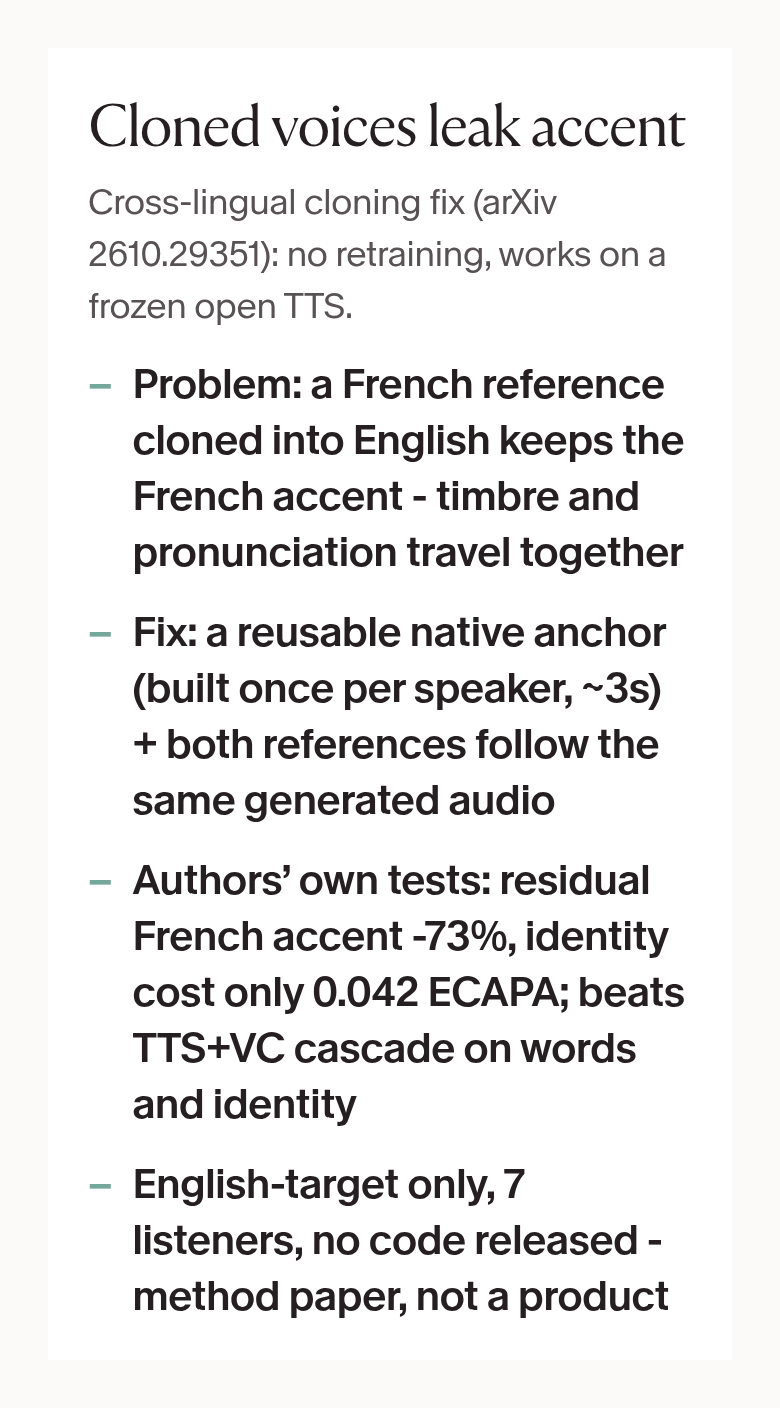
Zero-shot cross-lingual voice cloning has a persistent flaw: clone a French speaker into English and the English comes out with a French accent. The reference recording carries both who the speaker is (timbre) and how they pronounce (accent), and the model cannot tell which part you wanted to keep. A new paper from VoxNexus (Singapore) - "Closed-Loop Dual-Reference Guidance for Accent Control in Cross-Lingual Voice Cloning" (arXiv:2610.29351, October 21, 2026) - offers an inference-time fix that needs no retraining: give the frozen TTS model two references instead of one, and keep both on the same generated history. In the authors' own held-out tests, residual French accent drops 73% while speaker similarity falls by only 0.042 ECAPA cosine versus direct cloning.
The problem, precisely
Training-time fixes exist (disentanglement objectives, accent vectors), and so do post-hoc ones (run a voice converter over every output utterance). But if you have a frozen open TTS model - the paper uses VoxCPM2, the same backbone family we covered in the LoCA article - your options at inference time have been limited: classifier-free guidance variants mix conditional and unconditional fields, but there is no "pronounce like a native" condition to mix in. The paper's idea is to manufacture that condition.
The method in plain English
Two components:
- A synthetic native anchor, built once per speaker. At enrollment, a zero-shot voice converter (Seed-VC) converts a native-English donor's speech toward the source speaker's timbre. Four donors are tried; the candidate with the best speaker-similarity score is kept. This takes about 3.1 seconds per speaker, happens once, and the anchor is reused for all later utterances - no per-utterance conversion.
- Closed-loop dual-reference guidance. During generation, both references condition the same flow-matching decoder: the original (accented) reference anchors speaker identity, the native anchor anchors pronunciation. The generated patch is fed back into both reference states, so each branch always conditions on the audio actually produced. A weight λ controls the anchor's contribution; the authors select λ* = 0.33 on development data and freeze it.
The "closed loop" is the load-bearing piece. The naive version - letting each reference branch advance on its own predicted history - desynchronizes the two contexts, and the paper's open-KV ablation shows it collapsing: WER 0.139 versus 0.004 with shared feedback (development set, authors' numbers). A conditioning-space variant that fuses the two decoder conditions cuts the diffusion evaluations per patch from 27 to 18 at essentially the same quality (real-time factor 0.572 vs 0.589).
The results, as the authors measured them
Held-out test: 20 MLS French speakers (disjoint from development, donors, and tuning) × 20 English texts × 3 seeds, n = 1,200 per arm. Four arms: A = direct cloning, B = anchor-only cloning, C = proposed guidance, and a TTS→VC cascade (unconditioned English TTS, then Seed-VC transfers the timbre onto every utterance).
| Arm | WER ↓ | Residual French LID ↓ | ECAPA sim ↑ | GOP ↑ | DNSMOS ↑ |
|---|---|---|---|---|---|
| A (direct clone) | 0.016 | 0.093 | 0.601 | 4.663 | 2.900 |
| B (anchor only) | 0.013 | 0.000 | 0.404 | 4.733 | 2.934 |
| C (proposed) | 0.009 | 0.025 | 0.559 | 4.750 | 2.887 |
| Cascade | 0.047 | 0.001 | 0.468 | 4.378 | 3.026 |
Read against the trade-off the method is solving: anchor-only cloning (B) removes the accent entirely (residual LID 0.000) but destroys the speaker (ECAPA 0.404 vs 0.601). The proposed arm (C) cuts residual French LID mass by 73% versus direct cloning (0.093 → 0.025) while recovering 0.155 ECAPA over B - most of the speaker, most of the accent removal. It also posts the best WER (0.009) and best GOP pronunciation score (4.750) of all four arms. All of these are the paper's own runs.
The cascade comparison is where the paper gets honest. The cascade wins raw audio quality (DNSMOS 3.026 vs 2.887) and accent removal (0.001), and blinded listeners preferred it on pronunciation naturalness (32 vs 13 sessions, p = 0.026). But it mangles words - repetition or insertion errors in 3.2% of outputs versus under 0.5% for the other arms - and loses speaker identity badly: listeners preferred C on speaker identity 38 vs 5 (p < 0.0001). C is also cheaper online: RTF 0.59 vs ~0.80 on an H100 (authors' benchmark, 9-word text), because the cascade pays a full voice-conversion pass per utterance while C's anchor is built once and amortized after about six utterances.
What transfers, what does not
The French-tuned operating point transfers to Spanish→English without re-tuning: residual Spanish LID mass falls 0.032 → 0.014 (-56%), with speaker similarity recovering from 0.323 to 0.474 (15 VoxPopuli speakers, authors' numbers). That is one additional source language, one target language - evidence of some robustness, not of universality. Nothing in the paper tests a Chinese, German, or Arabic source, and the entire evaluation targets English.
Where the evidence is thin
- Seven listeners, low agreement. The human study uses 7 native-English evaluators over 60 sessions, with Fleiss' κ of 0.167-0.256 (slight-to-fair agreement); 87-89% of majority-disagreement judgments were ties. The significant results are directionally consistent with the automatic metrics, but this is a small study.
- Speaker-similarity vs direct cloning is NOT established. In the follow-up comparison of C against direct cloning on speaker identity, 51.7% of sessions were ties and the rest split against C (p = 0.723). The method's claim is "small measured identity cost," not "indistinguishable identity."
- Identity metrics depend on the verifier. A third speaker encoder (CAM++-CN, the one inside Seed-VC itself) reverses some rankings - the estimated identity cost of accent control depends on which verification model you believe. The authors disclose this rather than hiding it, which is to their credit, but it means the ECAPA numbers are not the whole story.
- English targets only; fixed λ; anchor quality bounded by Seed-VC; no code. The paper's own limitation list. As of v1 there is no released code or anchor pipeline, so reproduction means re-implementing from the method section.
Why it matters
For products cloning voices across languages - dubbing, localization, multilingual agents - accent leakage is the complaint users actually file. This paper shows a training-free knob that works on a frozen open model (VoxCPM2) with a one-time 3-second enrollment cost, and it isolates the mechanism that makes it work (shared generated history) from the one that does not matter much (where you mix the branches). If the technique replicates, it slots directly into the open-weight TTS stack this site tracks. That "if" is currently untested by anyone outside the authors.
Sources (read in full; links verified October 22, 2026)
- Zheng, Huang, Ma, Jin, Jiang (VoxNexus) - Closed-Loop Dual-Reference Guidance for Accent Control in Cross-Lingual Voice Cloning, arXiv:2610.29351 v1 (October 21, 2026) - all method and result claims above.
- Referenced systems: Seed-VC (anchor construction and cascade baseline), VoxCPM2 (frozen TTS backbone), LibriTTS-R / VoxPopuli / MLS (donor and evaluation speakers), faster-whisper-large-v3 (WER), DNSMOS P.835 (quality).