Paper: one reusable anchor voice cuts cross-lingual accent leakage 73% - closed-loop dual-reference guidance, no retraining
Published October 27, 2026 · Built from arXiv:2610.29351v2, read in full on October 27, 2026. Every number below is the paper's own experiment - we say so each time it matters. We did not run the method.
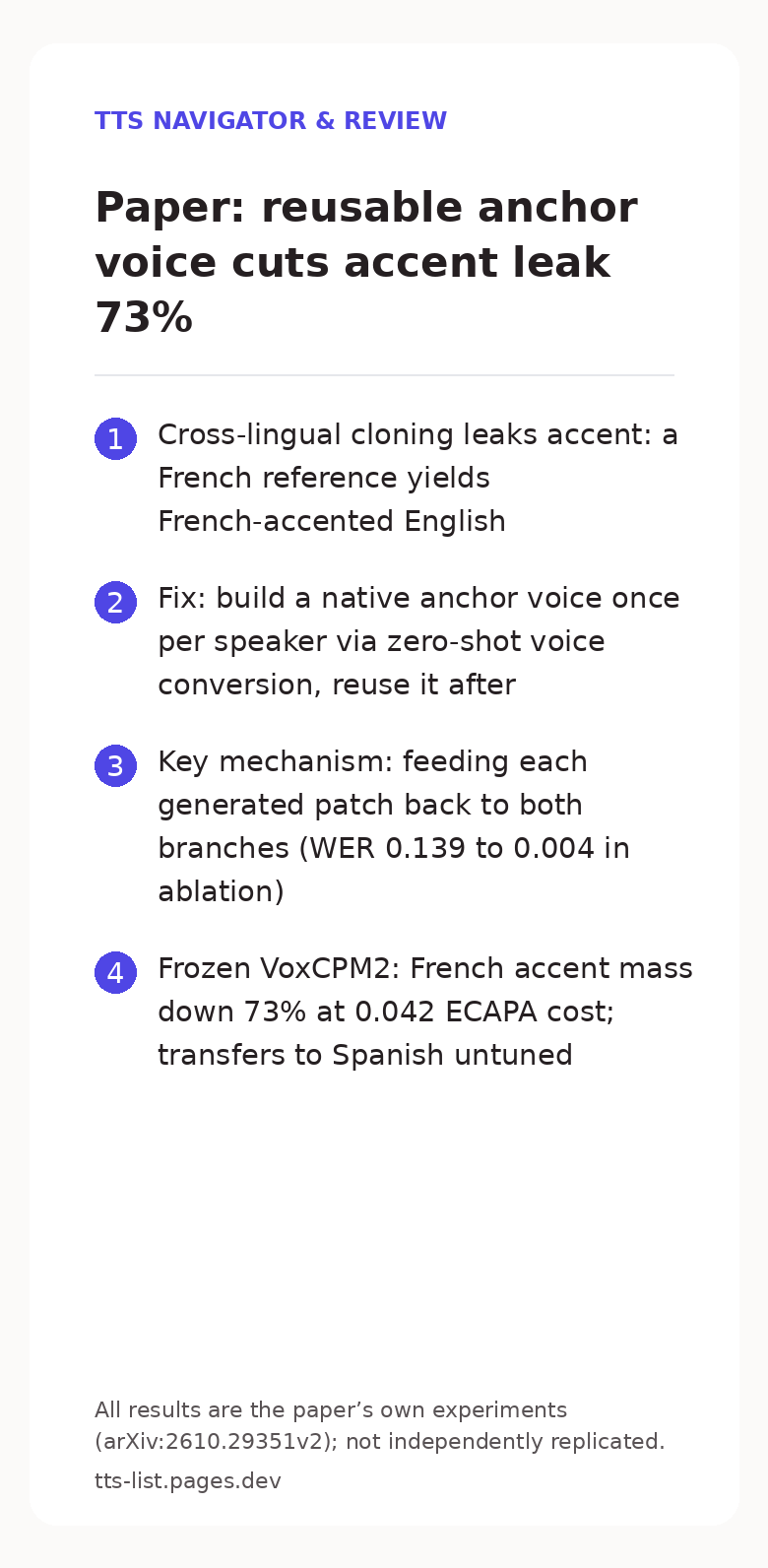
Clone a French speaker's voice and ask for English, and zero-shot TTS usually hands you English with a French accent: the reference clip carries both who is speaking and how they pronounce. A new paper from VoxNexus (Singapore) - the group whose VoxCPM2 speaker-control analysis we covered yesterday - proposes closed-loop dual-reference guidance: pair the original reference with a synthetic native-accented "anchor" voice built once per speaker, and steer generation between the two on a frozen TTS model. No fine-tuning, no per-utterance voice conversion.
The method in two moves
- Enrollment-time anchor. At setup, a zero-shot voice converter (Seed-VC) converts native-English donor speech toward the source speaker's timbre; the best of four candidates by speaker similarity becomes a reusable native anchor. This runs once per speaker (about 3.1 seconds) - online synthesis never calls the converter again, unlike a TTS-then-convert cascade that pays conversion cost on every utterance.
- Closed-loop shared history. Both references initialize separate language-model states that guide the same acoustic patch, mixed with CFG-Zero* velocity combination at weight λ. The key move: each emitted patch is fed back to both states, so the two branches always condition on the speech actually produced. In ablation, replacing this shared feedback with independent branch rollouts ("open-KV") degrades WER from 0.004 to 0.139 and GOP from 4.791 to 3.524 - the common-history constraint, not the mixing math, is where most of the quality comes from.
Results - the paper's own experiments
Evaluation used a frozen VoxCPM2 (2B), 20 held-out French speakers reading English, 20 texts, 3 seeds (1,200 items per arm), with λ*=0.33 fixed on development data before testing:
- Accent reduction. Residual French LID mass drops 73% versus direct cloning (0.093 to 0.025) at an ECAPA speaker-similarity cost of 0.042. Versus anchor-only cloning (which nearly zeroes the accent but loses the speaker), it recovers 0.155 ECAPA similarity.
- Best transcription and pronunciation scores. Mean WER 0.009 and GOP 4.750 - the best of all test arms. The TTS-to-VC cascade trails at WER 0.047, with word repetitions or insertions in 3.2% of outputs versus under 0.5% for the proposed arm.
- Faster than the cascade. Online RTF is about 26% lower than the cascade's (0.59 vs. 0.80 on an H100); it adds only 0.25 seconds over plain direct cloning, and the anchor's construction cost amortizes after roughly six utterances.
- Transfers without re-tuning. The French-selected λ*=0.33 applied to 15 Spanish speakers cuts residual Spanish LID mass by 56% with WER unchanged (0.0055 vs. 0.0054).
- Listeners agree - with one exception. In a blinded study (7 native-English evaluators, 60 sessions), listeners preferred the method over direct cloning on pronunciation naturalness (17 vs. 4 sessions, p=0.0057) and over both anchor-only cloning and the cascade on speaker identity (39 vs. 3 and 38 vs. 5, both p<0.0001). But the cascade still beats it on pronunciation naturalness (32 vs. 13 sessions, p=0.026) and on DNSMOS audio quality.
Why it matters
- Accent control as an inference-time dial. Disentanglement approaches need multilingual training; cascades need per-utterance conversion. This is a frozen-model technique with one per-speaker setup cost - practical for any deployment already doing zero-shot cloning.
- A mechanistic finding beyond the task. The open-KV ablation shows that when two guidance branches drift onto different generated histories, quality collapses - a lesson for multi-condition guidance generally, not just accents.
- Metric hygiene worth copying. The paper reports three speaker-verification encoders because they disagree: CAM++-CN reverses the cascade ranking that ECAPA and CAM++-EN give. The blinded listener study sides with ECAPA/CAM++-EN, but the warning generalizes - one similarity number is not evidence.
Limitations (the paper's own)
- Evaluation targets English only; anchor quality depends on the zero-shot converter; λ is fixed across patches rather than adapted.
- Speaker similarity versus plain direct cloning is statistically a wash in listening tests (51.7% of sessions tied) - the method trades a small automatic-similarity cost for the accent reduction, it does not come free.
- All results are the authors' experiments on one frozen model (VoxCPM2) with one converter (Seed-VC); not independently replicated.
Source (read in full; link verified October 27, 2026)
- Closed-Loop Dual-Reference Guidance for Accent Control in Cross-Lingual Voice Cloning - arXiv:2610.29351v2 (Zheng, Huang, Ma, Jin, Jiang; VoxNexus, Singapore) - all method details, tables, ablations and listening-test results above.