Speculative Listening: Full-Duplex Voice Models With 73% Less Decoding Delay Before Replying
November 7, 2026 - by TTS Navi. We read the full paper; all experiments and numbers below are the paper authors' (arXiv 2611.06982), not ours.
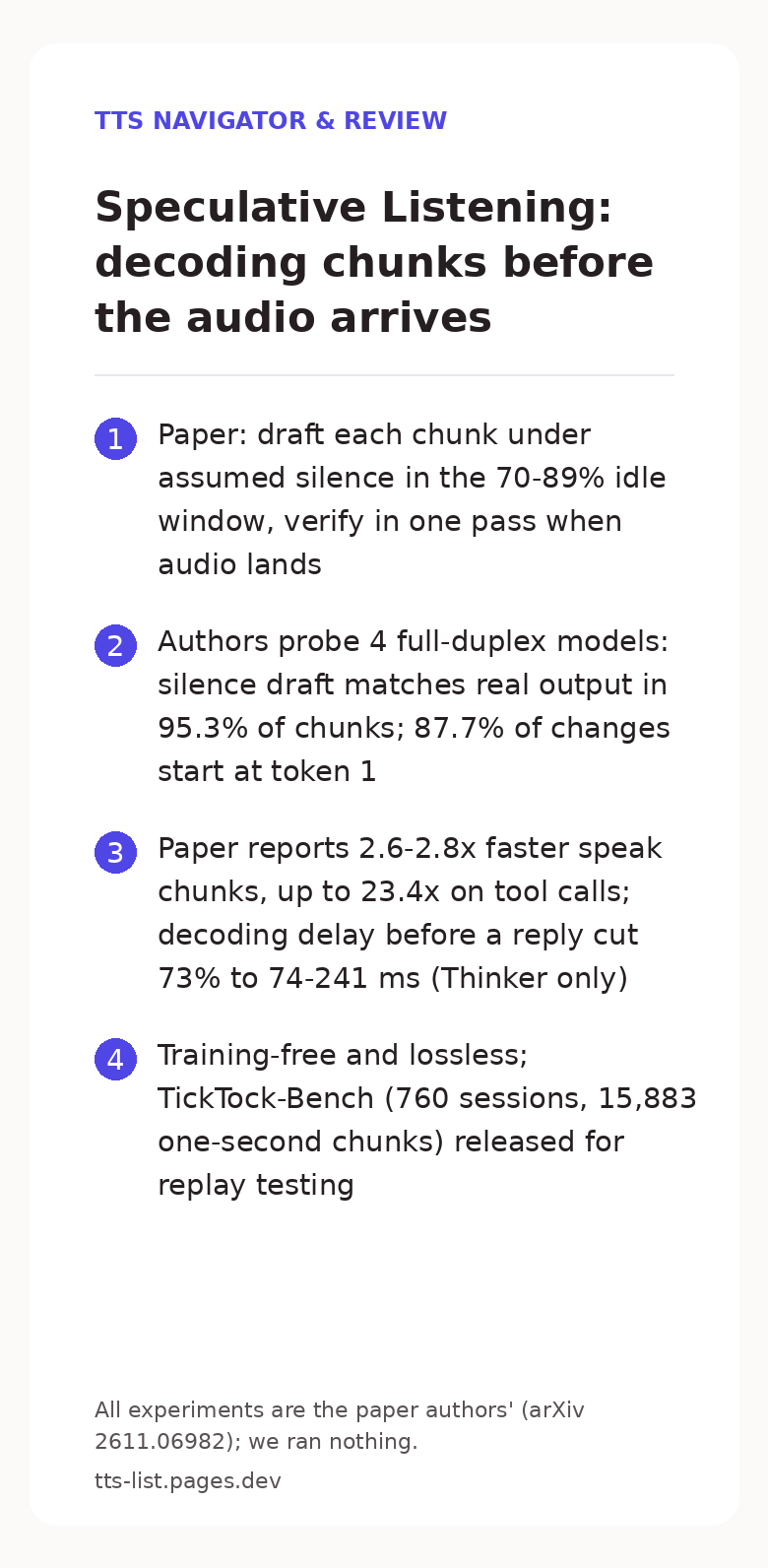
Full-duplex speech language models - the kind that listen and talk at the same time, like Moshi or MiniCPM-o-style systems - process conversation in fixed time chunks, and each chunk is a hard deadline. A new paper from CUHK-Shenzhen and Amphion Technology (Speculative Listening, arXiv 2611.06982) spots something the field had left on the table: while the model is listening, its compute sits idle for 70-89% of the chunk. Their question: why wait for the audio to start decoding?
Paper authors' experiment: the silence hypothesis
The authors profiled four chunk-interleaved models (their own Streaming SLM built on Qwen2.5-Omni-7B, plus Gander, Realtime-Venus and LWS) by decoding every chunk twice - once with the real audio, once with the audio replaced by silence. Two observations fell out, pooled over the four models:
- The next audio chunk does not change the output in 95.3% of chunks - most of the time the model would have produced the same tokens anyway.
- When the output does change, 87.7% of divergences start at the very first token - the listen-or-speak decision point.
Speculative Listening turns those into a training-free, lossless decoding scheme: during the idle window, the model drafts the next chunk under the silence hypothesis, plus a second "runner-up" branch from the alternative first token; all drafts go into a cross-chunk hypothesis pool indexed by N-grams. When the real audio arrives, one forward pass prefills it and verifies the whole draft. Output is identical to autoregressive decoding - every committed token is the target model's own choice.
Reported results on TickTock-Bench
The authors also built TickTock-Bench, an eight-task replay benchmark (760 sessions, 15,883 one-second chunks, one A100, Thinker text decoding only - speech synthesis excluded from wall-clock). Paper-reported numbers: speak chunks speed up 2.6-2.8x on average across the four models; tool-call chunks up to 23.4x on Streaming SLM (3.45x on Gander), because a user request spans several chunks and earlier idle drafts already contain most of the call. Classic training-free baselines (prompt lookup, token recycling, lookahead) reach only 0.96-1.23x here - their N-grams rarely match a fresh spoken response. The maximum lag behind real time drops by 94.4% on average; response onset decoding delay falls 73%, from 417-1089 ms under autoregressive decoding to 74-241 ms - near the roughly 200 ms gap humans leave between turns. Under bf16 the AlpacaEval judge score differs from AR by under 0.1 point; under fp32 outputs match nearly token for token.
Scope limits, as the authors state them
Three honest caveats: the method targets low-concurrency, latency-sensitive serving (idle windows shrink as sessions share a GPU, and the multi-session experiment shows the speedup falling); only the Thinker was compared, since the four models' Talkers synthesize speech differently; and the formulation needs chunk-interleaved architectures - parallel-stream designs like Moshi decode every 80 ms frame and would need a different approach. Under temperature sampling the speedup shrinks but survives (1.4x on speak, 5.4x on tool calls at T=1.0).
Our analysis
This is speculative decoding with the draft model replaced by time itself - the insight that a full-duplex model's bottleneck is not compute but the serial wait for audio, and that "assume silence, verify later" is correct 95% of the time, is the kind of measurement-driven simplicity that tends to ship. The 23x tool-call number is the headline-grabber, but the more durable result is the response-onset figure: closing in on the 200 ms human turn gap matters more for how voice agents feel than any throughput metric. If you run a chunk-interleaved voice agent, the ablation table doubles as an implementation guide - silence drafting alone buys most of the speak-chunk win, and the hypothesis pool is what rescues tool calls. Watch for whether the big full-duplex runtimes adopt it; the barrier is refreshingly low.
Sources
- Decode Before You Hear: Speculative Listening for Chunk-Interleaved Full-Duplex Speech Language Models (arXiv 2611.06982, read in full, November 7, 2026)