Higgs Realtime Duplex: Boson AI's 45B full-duplex model that thinks and calls tools while you talk
November 18, 2026 - TTS Navi. We read the official technical blog in full. Capabilities and benchmarks are Boson AI's own reports, not our tests.
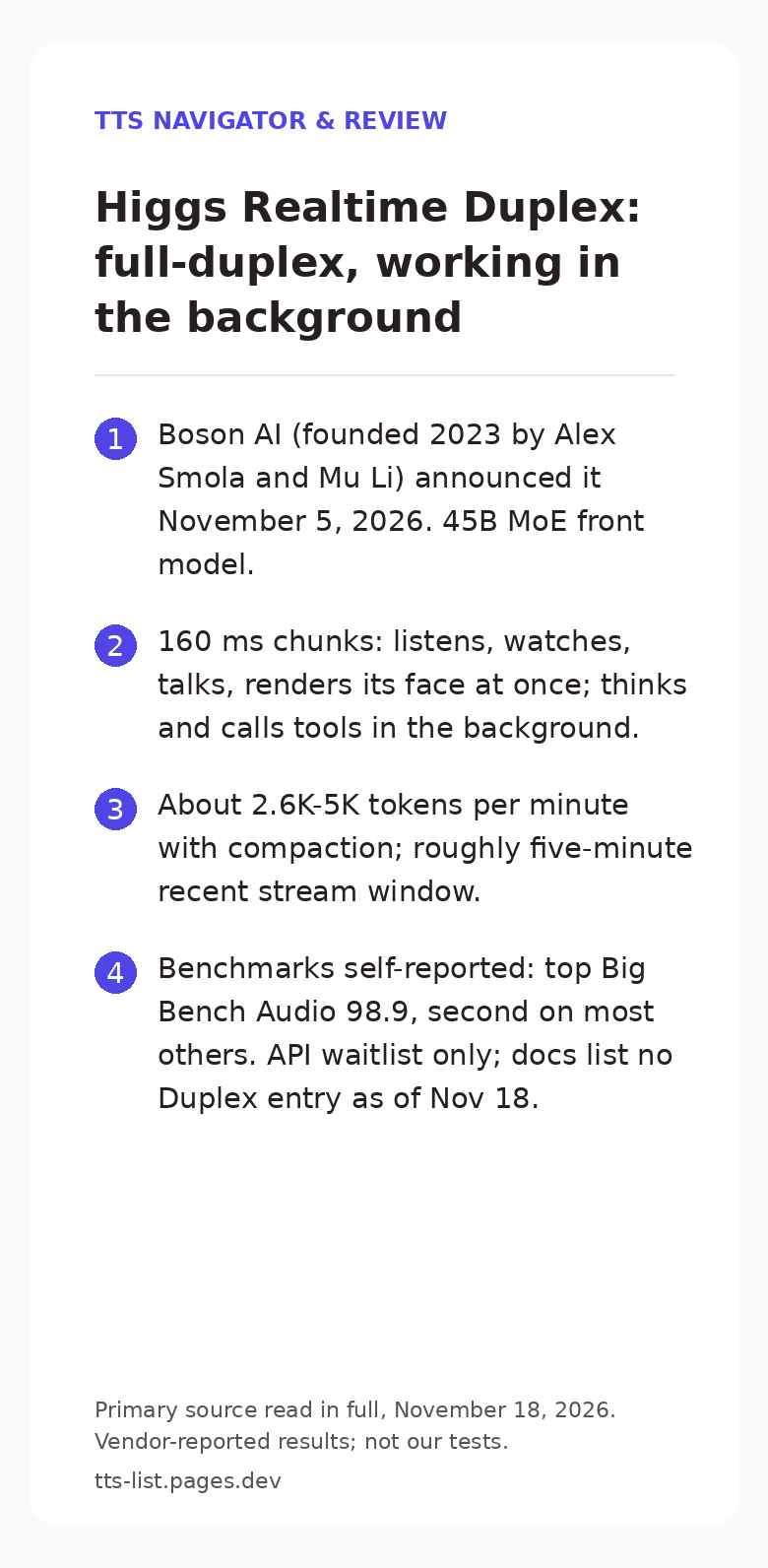
Boson AI, the company founded in 2023 by Alex Smola and Mu Li, announced Higgs Realtime Duplex on November 5, 2026: a full-duplex interactive omni model that listens, watches, talks and renders a face at the same time, while thinking, calling tools and delegating to a bigger model in the background. For anyone building voice agents, the architecture is the interesting part. Everything below comes from Boson's own technical blog; benchmark numbers are Boson-reported, and we have not independently tested the model.
Slice time, not turns: the 160 ms chunk design
Instead of alternating speaking turns, every stream is cut into 160 ms chunks: your voice and camera feed in, the model's voice, face and background work out. Each step the model reads the chunk that just arrived and writes the chunk that plays next, and silence is represented as chunks too, so with video enabled the model never stops listening and watching. Thinking and tool-call generation can span multiple chunks, tool results stream in as payloads over several chunks, and the model can start speaking from partial results. This is what lets it say "mm-hm" while you talk, stop when you cut in, and keep a conversation going while a background task runs.
A tight token budget, with a cost target that is not pricing
Boson reports audio input at 6.25 tokens per second, audio output at 12.5, one camera frame (about a dozen tokens) every six chunks, and two face latents per chunk. Audio and visual streams total about 2.6K tokens per minute; with thinking, tool calls and results, roughly 2.6K to 5K per minute, assuming progressive compaction of reasoning and tool traces. In production the model reportedly keeps about the last five minutes of streams plus compacted text, around 13K to 25K tokens, with older history retained as text. Boson's stated design target is that an hour with the model costs at most one-tenth of an hour of a person's time. That is an aspiration, not a published price: the blog points to a waitlist and gives no Duplex rates.
A 45B front model that does its own thinking
The front model is a 45B mixture-of-experts model, continued from a text-pretrained base on about 2 trillion tokens of text, audio and visual data, trained on Boson's own NVIDIA H100 cluster with a Megatron-based stack. Boson explicitly contrasts its design with Thinking Machines' interaction models: the Higgs front model thinks and calls tools itself, delegating only hard turns to a bigger backend model with full shared context, arguing that calling a large reasoning model every turn would make cost hard to control. Post-training uses multi-teacher on-policy distillation - specialist teachers trained with reinforcement learning including GRPO, distilled into one student - plus a recursive self-improvement loop where an agent system interacts with simulated environments and turns failures into training data.
Zero-shot voice and face live in the decoders
Voices and faces are not baked into the model. A short reference audio clip conditions a causal flow-matching audio decoder to set the voice; a single reference image conditions a causal DiT video decoder that renders the face, using the previous two latents for continuity. Each output chunk carries two audio frames and two image latents. Swapping references changes voice and face with no fine-tuning. This separation matters for deployment: identity rights sit with whoever supplies the references, and Boson notes it does not report voice- or avatar-cloning benchmarks because compared models lack those capabilities.
Benchmarks: strong, second on most, self-reported
Boson's table compares Duplex with TML Interaction Small (276B MoE) and GPT and Gemini realtime/live series across seven suites. Boson reports the highest Big Bench Audio score at 98.9, and second-highest on Audio MultiChallenge (44.9), ProactiveVideoQA (31.9), tau-Voice task completion (69.8) and IFEval (94.1). On Full-Duplex-Bench v1.5 it scores 75.5, behind GPT-Live-1 at 80.1 and TML at 77.8; on QIVD streaming accuracy its 56.0 trails two GPT RT-2 configurations. Boson says competitors' scores come from published reports and leaderboards and that it reproduced more than half to validate its pipeline. There is no third-party replication, and Boson itself notes GPT and Gemini models usually reach their best scores only with thinking set high. Treat the table as the vendor's own benchmark run, not an independent ranking.
Availability, verified November 18
The November 5 blog says a Duplex API is "coming soon" and offers a waitlist; the previous-generation Higgs Realtime, an end-to-end model with avatar output, is available today with published pricing. As of November 18, 2026, the official documentation product list at docs.boson.ai shows Higgs Realtime, Higgs TTS 3 and Higgs Avatar, with no Duplex entry. That absence only means we could not find a listed Duplex API - it is not proof of the launch state either way, and we have not confirmed any current access method. Do not conflate the public Higgs Realtime API with Duplex. For a voice-agent stack decision, the verifiable takeaways today are architectural: 160 ms full-duplex chunking, background tool use and delegation, a five-minute compacted context window, and decoder-side zero-shot voice and face.