Silencio-2: an 18M-class open TTS you direct like a script - [sigh], <whisper>, voice cloning, all on a CPU
Published November 2, 2026 · Built from the Hugging Face model card (BlueRoseLabs/Silencio-2), read in full on November 2, 2026. All performance and behavior claims are the card author's; we did not run the model. The repo was created October 31, 2026 - two days old at read time, with no third-party validation yet.
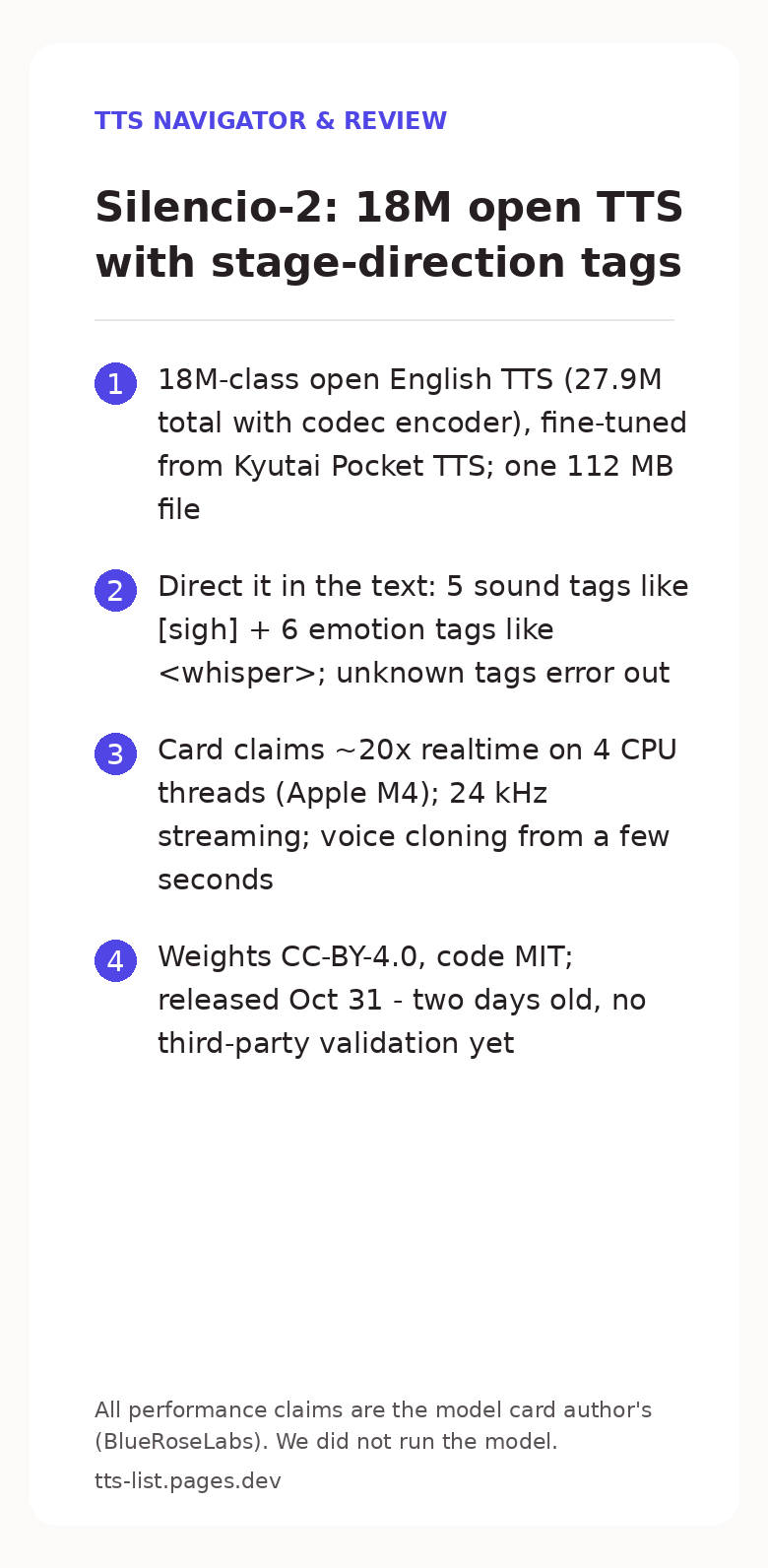
Most small TTS models read your text; Silencio-2 lets you direct it. Write What a long day. [sigh] and the sigh happens where you put it; write <whisper> Keep your voice down. and the delivery changes until the next tag. BlueRoseLabs released the model on Hugging Face on October 31 - an 18M-class English TTS that fits in one 112 MB file and, the card claims, streams at roughly 20x realtime on four CPU threads of an Apple M4.
What it is
- A fine-tune of Kyutai's Pocket TTS 18M, retrained on a custom dataset to follow tags. The lineage matters: this is the CPU-first "pocket" branch of open TTS, now with direction controls. It ships with its own
silencio2inference package, sopocket-ttsis not needed. - 27.9M parameters total in
model.safetensors: 18.2M generate speech, the rest is the Mimi codec encoder that voice cloning needs. Output is 24 kHz mono, streamed in float32 chunks as it is generated. - 11 control tokens, added to the tokenizer: five sound tags placed where they happen -
[laugh][sigh][gasp][cough][clear_throat]- and six emotion tags that hold until the next one -<happy><sad><angry><fear><surprised><whisper>. An unknown tag raises an error instead of being read aloud - the right failure mode. - Voice cloning from a few seconds of reference audio, eight bundled voices, a seed parameter for reproducible takes, and an int8
quantize=Trueoption for CPU. Weights are CC-BY-4.0 (inherited from Pocket TTS), the adapted core code is MIT.
How the tags were taught (the interesting part)
The card's training notes are unusually concrete for a hobby-scale release: the team extended Pocket TTS's tokenizer and text table with the 11 tag tokens, then fine-tuned with Kyutai's training code. Two details do the heavy lifting. First, a tag was removed from a fifth of the training texts, so the model cannot rely on tags always being present. Second, the voice prompt of tagged clips was often a neutral take of the same voice - forcing the tag, not the prompt's delivery, to carry the emotion. A final distillation stage bakes classifier-free guidance into the weights, so inference needs one pass per frame.
The card's own warnings, kept intact
- Delivery varies from take to take: the same tag can come out strong in one generation and faint in another - the card suggests trying a few seeds.
<whisper>is the least steady tag; it works best on short lines and varies by voice. (generatealso raises quiet takes to speech level, since a true whisper lands about ten times quieter - passnormalize=Falseto keep the raw level.)- "Check important lines by ear." English only.
Why it matters
- Directability is arriving at the bottom of the stack. Emotion control used to mean a frontier model's prompt engineering or a vendor's style slider. Here it is 11 tokenizer tokens in a 112 MB file that runs on a laptop CPU - deterministic placement, explicit failure on typos, MIT-licensed code to inspect.
- The open pocket-TTS ecosystem is compounding. Kyutai publishes Pocket TTS and its training code in January; within the year, third parties are shipping specialized fine-tunes with inherited permissive licenses. That is what a healthy open-weight lineage looks like - and it is happening below the API vendors' price floor.
Caveats
- Every performance figure (20x realtime, cloning quality, tag reliability) is the card author's; the repo is two days old with effectively no downloads or third-party testing at read time.
- English only, and the emotion vocabulary is fixed at six tags - there is no free-form style text.
Source (read; link verified November 2, 2026)
- BlueRoseLabs/Silencio-2 - Hugging Face model card (created October 31, 2026) - architecture, tags, training notes, limitations, license, and all performance claims above.