AksharaVP-17M v2: Telugu, Hindi and Indian English in one 18M checkpoint, honest about what got worse
November 19, 2026 - TTS Navi. We read the AksharaVP-17M model card in full. All metrics are the author's measurements on the dev split, not our tests and not a third-party evaluation.
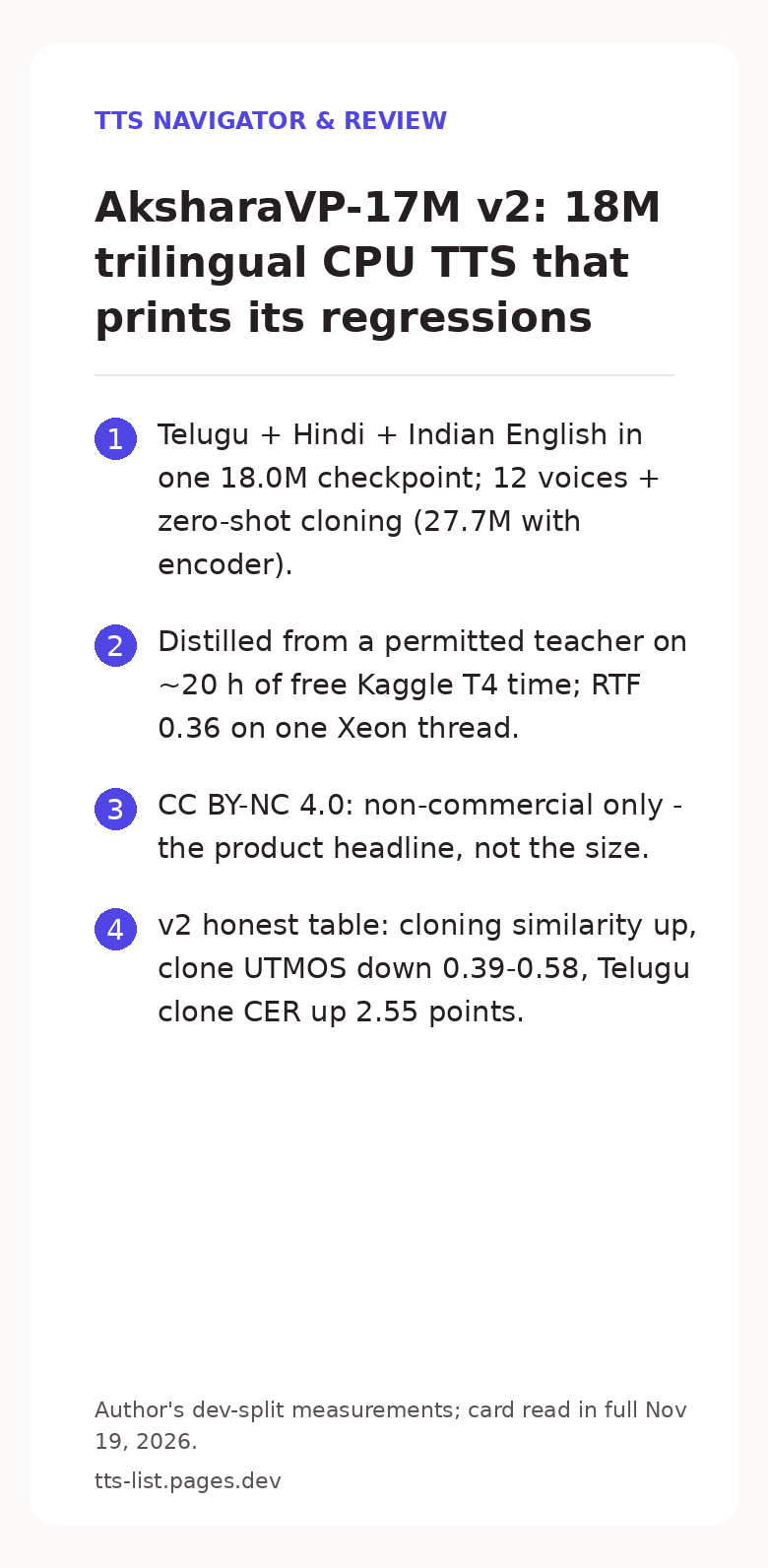
AksharaVP-17M (sourojitdotcom, first released November 17, 2026, v2 update two days later) is a 17,988,627-parameter TTS covering Telugu, Hindi and Indian English in a single checkpoint, with 12 built-in voices and zero-shot voice cloning; the clone encoder adds 9.75M parameters, 27.7M total when used. It was trained by distillation from a larger in-house teacher model, with written permission, entirely on free-tier Kaggle T4 GPUs: about 10.8 hours for v1 and 9.8 hours for v2. The Mimi audio decoder comes from Kyutai's Pocket TTS under CC-BY-4.0.
The license is the headline for products
CC BY-NC 4.0 means non-commercial use only. Everything below is technically encouraging, but for a commercial product this license is the first fact, not the parameter count. The author is explicit about it, which is better than discovering it in the files tab.
The numbers, including the bad ones
Author-measured on the FLEURS dev split (100 sentences per language, mms-1b-all ASR): character error rates of 6.20% (Telugu), 4.17% (Hindi), 4.79% (English). UTMOS naturalness sits at 2.65, 2.84 and 3.19 respectively, and the author names that as the model's weak point outright. Speed: RTF 0.36 on a single Xeon thread, 0.19 on four threads - roughly 2.8x and 5.2x faster than real time. Weights ship in GGUF and are bit-exact against the f32 originals, but note: llama.cpp has no runtime for this architecture, so GGUF here means portable weights, not an existing inference stack you can download and run. A browser WASM demo exists.
v2 prints its regressions
The v2 update is where the card earns trust. A new SpkPool speaker fingerprint (172,993 parameters) improved cloning similarity substantially - ECAPA cosine 0.295 to 0.402 on Telugu - and cut dropouts from 11.2% to 1.1%. But the same table shows clone UTMOS falling 0.39-0.58 points and Telugu clone CER rising 2.55 points, a significant regression, printed next to the wins. The author's own hypothesis, labeled as such: clones may be copying the reference's recording conditions along with the voice.
Context and caveats
Against Hima TTS nano (two 72M-parameter models), AksharaVP lands similar error rates at a quarter of the parameters, but 0.77-0.84 lower UTMOS - the card states the naturalness gap rather than hiding it. Model selection used the dev split with the test set untouched, which the author discloses; treat dev-split selection as optimistic. All metrics are author-run, not third-party, and there is no human listening test.
Practical fit
An 18M trilingual CPU TTS trained for about 20 GPU-hours total is a genuinely useful data point for anyone building Indic-language voice features on a budget, and the GGUF-plus-WASM packaging shows a real portability path. What you do not get: commercial use without separate licensing, third-party evaluation, and - by the author's own table - natural-sounding clones yet.