Scylla's Band v4: A 131M-Parameter TTS That Sings, on Your Phone
November 7, 2026 - by TTS Navi. We read the model card in full; all performance and quality numbers below are the developer's own measurements unless marked otherwise.
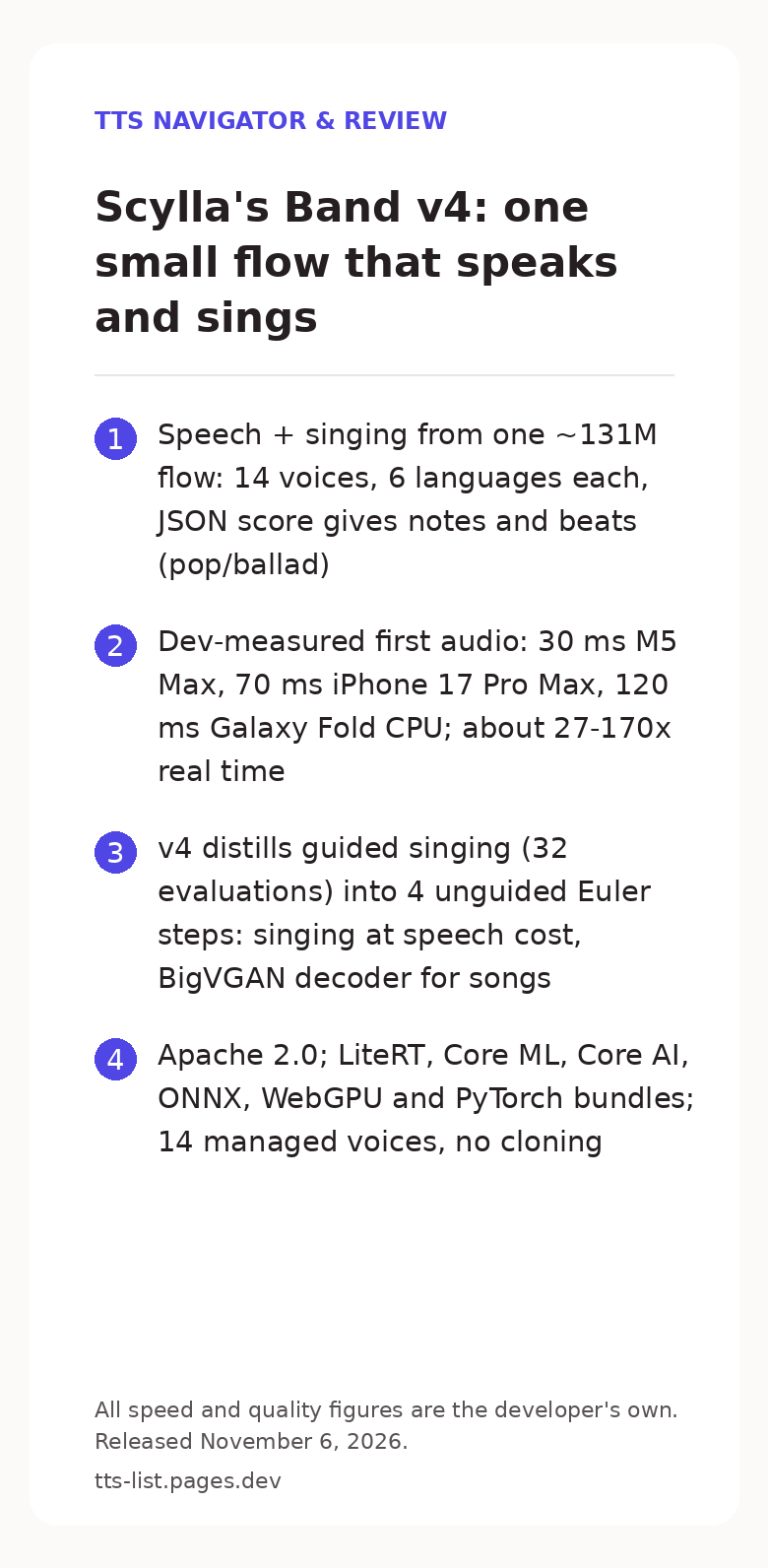
A solo developer's year-long project just did something no small TTS model does: Scylla's Band v4 (release tag v4-20261106, November 6) speaks and sings from one flow. Fourteen voices each cover English (US/UK), Spanish, Italian, French, German and Vietnamese - 84 trained voice/locale pairs - and every voice can sing pop or ballad from a JSON score of lyrics, notes and beats. Apache 2.0, with day-one bundles for LiteRT (Android/Linux/Windows), Core ML and Core AI (Apple), ONNX Runtime, WebGPU and PyTorch.
One model, two decoders, distilled to 4 steps
The pipeline is a phone-duration predictor feeding a rectified-flow pitch predictor, then a rectified-flow latent generator that follows the pitch contour, then a vocoder. Speech renders through Vocos; singing through a BigVGAN v2 decoder (112M parameters) fine-tuned on the voices. The v4 trick is a second distillation of the singing flow: the first singing candidate (v4-20261105, never published) needed 8 Heun steps with guidance - 32 evaluations per phrase - while v4 reproduces the guided output unguided in 4 Euler steps, the same cost as speech. Delivery controls are intensity, pace and pitch (each -2 to +2, measured in standard deviations of each voice's own range); there are no emotion labels, and the model never free-sings - a score is required.
The developer's speed and quality numbers
Measured through the native runtime on a 10.3-second test passage, warm: first audio in 30 ms on an M5 Max (Core ML, GPU), 70-77 ms on an iPhone 17 Pro Max (GPU), and 120 ms on a Galaxy Z Fold 8 (LiteRT, CPU only) - at roughly 170x, 65x and 27x real time respectively. Singing is heavier (BigVGAN is about 90x the work of Vocos per second of audio): the 71-second example song renders in 12.5 s on the iPhone GPU, or 0.95 s through the "turbo" Vocos path with some artefacts on held notes. Speech quality on the developer's own 168-clip sweep: ASR word error rate 0.062, with the distilled 4-step flow matching the undistilled model. For singing, the score tests report lyric precision 0.981 (Whisper-scored) and 100% of notes within a semitone across all fourteen voices. Separately, the developer reports 0.85% WER and UTMOS 4.35 from an Open TTS Leaderboard evaluation whose submission is still pending - treat those two as unverified.
Engineering honesty worth copying
The card's validation section reads like a release engineering doc: ONNX-vs-PyTorch latent parity within 8.5e-5, quantized bundles compared against full precision on every voice at both control limits, export graphs rewritten into FP16-exact forms, and plain statements of what is broken - occasional pronunciation errors, roughness on fast wide pitch movements, three voices that drop the occasional sung word, and a trained rap style that is not exposed in this release. Voices are managed (14 fixed identities), not arbitrary cloning; the developer explicitly bans impersonation use.
Our analysis
Scylla's Band lands in the same week as ZEN-TTS and the Phonon family - small, local, licensed-to-use TTS is suddenly a crowded shelf. Its differentiator is not another speed claim but a second modality at speech cost: folding singing into the same flow and then distilling away the guidance overhead is a genuinely elegant trick, and the JSON-score interface makes it programmable rather than a demo. The caveats are real: all numbers are self-measured, singing needs a written score (no lyrics-to-melody), and a one-person project carries one-person maintenance risk. But with Apache 2.0, a C ABI, and ports from browser WebGPU to the iPhone's Neural Engine, this is the most deployable singing-capable open TTS we have covered.
Sources
- spybyscript/scyllasband model card (read in full, November 7, 2026; release v4-20261106)
- lowkeytea/scyllasband on GitHub (runtime, sample apps, native library)