RSE-TTS: a 118M voice cloner whose generator doubles as its own reference encoder
November 14, 2026 - by TTS Navi. We read the full paper; all results below are the authors' own experiments, not ours.
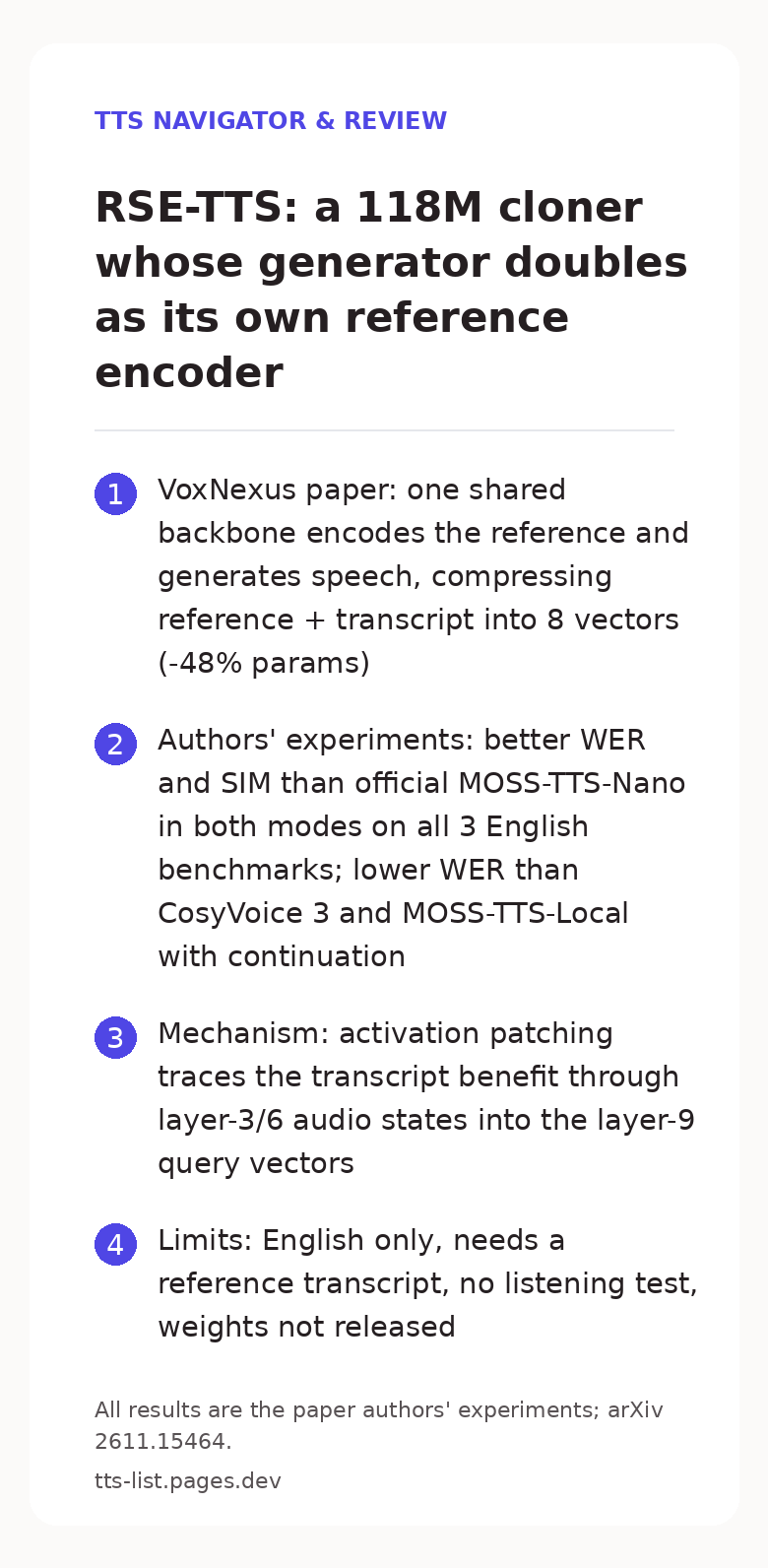
Zero-shot TTS has two standard ways to use a reference recording: keep it as acoustic context (VALL-E-style continuation, which works but couples generation to the reference's content and artifacts) or compress it into a fixed-size condition (small and clean, but lossy). A VoxNexus paper (arXiv 2611.15464, submitted November 11) asks a sharper question: can the same pretrained backbone that generates speech also do the compressing? The answer is yes, and the finding becomes a system - RSE-TTS, a 118M-parameter cloner whose Reconstructive Speaker Encoder shares the generation backbone and squeezes a reference recording plus its transcript into eight continuous vectors, cutting combined encoder-generator parameters by 48% against using a second transformer.
The mechanism experiments
The paper earns its keep in the ablations. Five encoder variants trained identically on the same 20k-hour subset separate the ingredients: a randomly initialized independent encoder reaches 0.400 SIM on the Seed-TTS English set; initializing that encoder from the pretrained TTS backbone jumps to 0.530 - generative pretraining transfers to compression even with no weight sharing at inference. Adding the reference's own transcript improves every variant further (0.564 independent, 0.552 shared), and sharing the backbone retains most of the best independent result at 118.2M versus 228.5M parameters. The eight vectors are not a bottleneck in the obvious way: as the reference grows from 3 to 24 seconds, similarity to a held-out recording of the same speaker climbs from 0.378 to 0.569, even though generation always sees exactly eight vectors. The vectors also carry delivery, not just identity: conditioned on parallel EARS readings, fast references shorten outputs 7.0%, slow ones lengthen 13.4%, high-pitched references raise generated pitch by 6.01 semitones on average - with the auxiliary speaker embedding held fixed.
Tracing why text helps
The most unusual section is mechanistic. Encoding the same recording with its transcript reversed (same tokens, broken correspondence) drops SIM from 0.538 to 0.497. The authors then activation-patch between the two runs: restoring reference-audio hidden states at layers 3 or 6 recovers the loss (0.497 to 0.545 at layer 3), and the reverse patch damages the clean run - while at layer 9 the effect migrates to the eight query states (restore: 0.497 to 0.542). Their reading: the transcript's benefit is expressed in intermediate acoustic representations first, then captured into the compressed vectors. Matched-magnitude random perturbations do not reproduce the restorations, and the layer-3 effect replicates on free-form recordings.
The system numbers
The full model trains on a large-scale in-house English corpus (size not disclosed) on top of the MOSS-TTS-Nano architecture: a 12-layer Global transformer over summed codec-frame embeddings (12.5 fps, 16 codebooks, 48 kHz reconstruction) plus a single-layer Local decoder, with a frozen CAM++ 192-dimensional speaker embedding added to each of the eight vectors. At 129.2M generation-chain parameters - against 128.4M for official MOSS-TTS-Nano, 859.2M for CosyVoice 3 and 3,948M for MOSS-TTS-Local - the authors report better WER and SIM than the official Nano in both reference-conditioning and continuation modes on all three English benchmarks (Seed-TTS, CV3-eval, MiniMax; Whisper large-v3 for WER, WavLM cosine for SIM, matched RE-USE-enhanced references for all systems). Combined with continuation, RSE-TTS posts lower WER than CosyVoice 3 and MOSS-TTS-Local on each benchmark while approaching their similarity, at 6.6x and 30.5x smaller generation chains. Ablations confirm the compressed condition trades similarity for intelligibility: a continuation-only twin scores higher SIM but worse WER everywhere.
Limits, as stated
Compressed conditioning still trails continuation on similarity; a diagnostic on an earlier checkpoint shows the gap opens in the first two seconds of generation and persists, which the authors attribute partly to teacher forcing encouraging reliance on acoustic history. RSE needs a reference transcript, so audio-only applications depend on transcription robustness. Everything is English. The full system's training corpus is private and its size undisclosed, and the model weights are not released - only audio samples on the demo page.
Our analysis
The transferable-insight finding - that generative pretraining is itself a good initializer for reference compression - is the part other labs can use tomorrow, and it is established cleanly: the pretrained-initialization gain appears even in the fully independent encoder, where sharing cannot explain it. The eight-vector result also reframes the prompt-versus-encoder debate: the compression loss is smaller than assumed, and what is lost looks more like early-alignment reliance than missing capacity. Caveats to hold: every number is automatic (Whisper, WavLM), there is no listening test, the headline WER wins against CosyVoice 3 and MOSS-Local come with a similarity deficit the paper acknowledges, "approaches larger systems" is doing work in the abstract, and the full model is neither open nor trained on disclosed data - so this is a method paper with a strong demo, not an artifact you can verify. If VoxNexus releases weights, the first thing to check is whether the 3-to-24-second similarity curve holds on non-English references.
Sources
- RSE-TTS paper (arXiv 2611.15464) (read in full, November 14, 2026)
- Audio samples (project page)