PiVo-1.4M: a complete TTS stack in 1.4 million parameters - and an unusually honest model card
Published November 3, 2026 · Built from the Hugging Face model card (empero-ai/PiVo-1.4M), read in full on November 3, 2026. All measurements are the author's (Leon Lehmann, Empero Research); we did not run the model. The repo was created November 1, 2026 - two days old at read time.
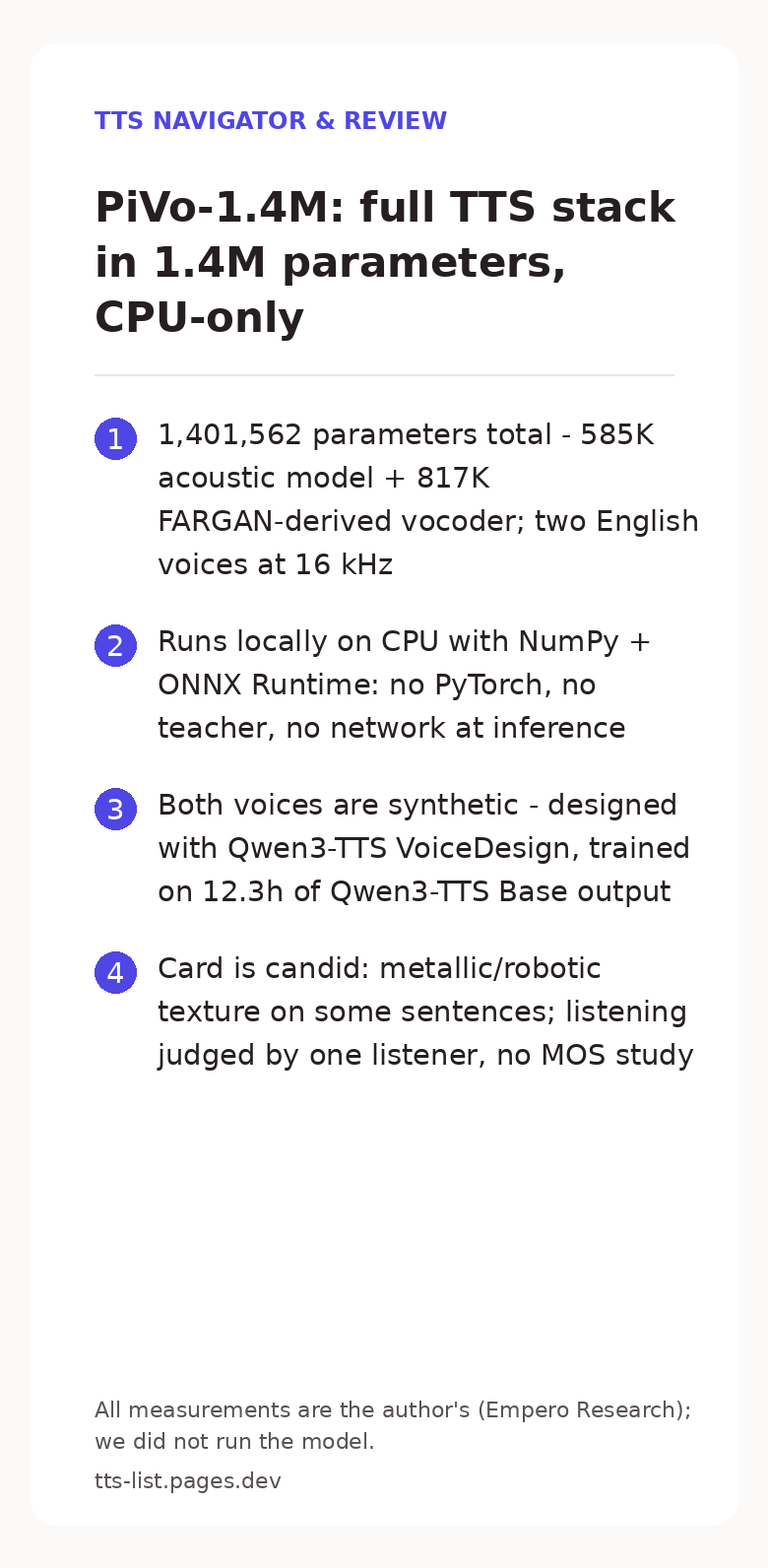
How many parameters does a voice need? Empero Research's answer is 1,401,562 - vocoder included. PiVo-1.4M pairs a 585K-parameter acoustic model (predicting 18 cepstral coefficients, pitch and pitch correlation every 10 ms) with an 817K-parameter FARGAN-derived vocoder, producing two English voices, Pi and Vo, at 16 kHz. It runs entirely locally on a CPU with NumPy and ONNX Runtime: no PyTorch, no teacher model, no speaker encoder, no network connection at inference time.
What stands out
- The teacher is named, the lineage is documented. Pi and Vo are synthetic voices designed with Qwen3-TTS VoiceDesign; the training corpus (8,628 utterances, ~12.3 hours) was recorded from Qwen3-TTS Base. Exact teacher revisions live in
evidence/teachers.json, and ONNX graphs are hash-checked against a manifest at load. This is what provenance looks like. - The evaluation warns you about itself. Test WER is 0.53% (Whisper small.en on 152 held-out utterances) - and the card immediately says this measures only that "the words come through clearly," not naturalness, and that held-out text from the same sources and teacher "is not a general English benchmark."
- A failed experiment is reported and acted on. The author tried adapting the vocoder to reduce the robotic texture; a blind comparison (one listener, 20 pairs, 6.10 vs 6.15 out of 10, 18 ties) showed no consistent difference, so the release keeps the original vocoder. Negative result, stated, decision explained.
- Errors instead of guesses. Pronunciation comes from the CMU dictionary; unknown words raise an error (you can supply ARPAbet overrides). Slash dates, fractions and unsupported characters also fail loudly. For embedded and accessibility uses, loud failure beats confident nonsense.
The limitations, in the author's own words
- Some text sounds metallic or robotic, especially around sibilants and pauses.
- Listening results come from a single listener and are not a MOS study.
- No speed or memory measurements on ARM or mobile yet; no quantized versions tested.
Why it matters
- A loose pattern worth watching, not a proven trend. Within three days we covered new releases at 18M (Silencio-2), 1.4M (PiVo) and 100K parameters (TiHon, covered separately today) - but these are different languages, architectures and quality bars, so the numbers are not directly comparable. What does seem to be shifting is the question: from "how small can it go" to "what do you lose, and does the author tell you?"
- Distillation keeps showing up as the enabler of tiny TTS. PiVo's voices never existed as recordings - they were designed in a large model and distilled down three orders of magnitude. Whether tiny models become a compression format for big-model voices is an open question; this release is one data point.
- A research-model card done right is a feature. Named teachers, hash-checked artifacts, self-limited claims, published negative results. PiVo is not going to replace your production voice, but as a template for how to ship small research models honestly, it is worth more than its parameter count.
Practical notes
- Streaming: the whole input is encoded up front, then
iter_audioyields 10 ms frames so playback can start mid-generation. Limits: 2,000 characters, one utterance up to 30 s, speed 0.5-2.0x. - Licensing: code and acoustic weights Apache-2.0; vocoder keeps the Xiph/Opus BSD license; dictionary keeps its CMU license. Teacher weights and training audio are not included.
Source (read; link verified November 3, 2026)
- empero-ai/PiVo-1.4M - Hugging Face model card and technical report (created November 1, 2026) - architecture, training data, evaluation, limitations and license above.