Klein-TTS X1.5: a 0.4M-13M multilingual TTS family with unusually well-caveated benchmarks
Published November 4, 2026 · Built from the Hugging Face model cards (klein-ml/Klein-TTS-X1.5-Flash, -Flash-Lite, -Pro), read in full on November 4, 2026. All measurements are the authors' (Klein ML); we did not run the models. Uploaded to Hugging Face on November 3, 2026 - one day old at read time.
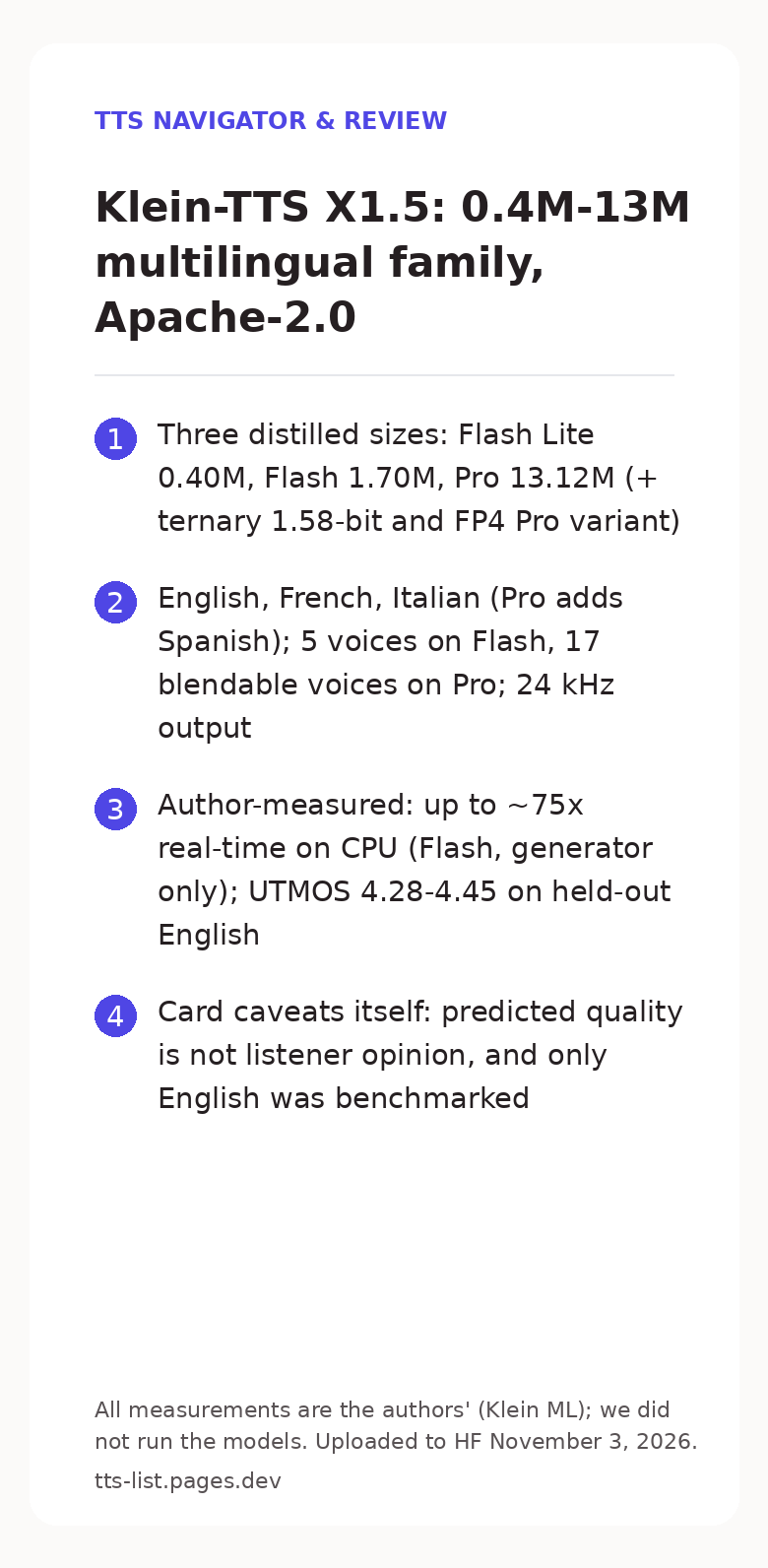
Klein ML's X1.5 release is a family rather than a model: Flash Lite (0.40M parameters), Flash (1.70M) and Pro (13.12M), the last also shipping in a ternary (1.58-bit) + FP4 quantized variant. All are StyleTTS 2 / ISTFTNet-style generators trained by distillation on synthetic speech (FineWeb/FineWeb-2 text, 0.9-1.1x speed augmentation), producing 24 kHz audio. Flash covers American/British English, French and Italian with 5 voices; Pro adds Spanish and goes to 17 blendable voices. Everything is Apache-2.0, with three consumption paths: plain Transformers (custom code included), a kleintts pip package, and an ONNX-based Node.js package that runs offline on CPU.
What stands out
- Speed at this size is the point. Author-measured real-time factors: Flash Lite 0.0066 and Flash 0.013 on CPU (about 150x and 75x faster than real time), Pro 0.002 on GPU. The card is careful to say Klein figures are generator-only, while some compared models were measured end-to-end.
- The benchmark section grades itself. UTMOS 4.28-4.45 across the family on 300 public + 97 private held-out English sentences, ahead of the similarly-sized SupraTTS (1.0M) and Kitten TTS Nano (14M) on the authors' composite "TTS Index" - but the card then states plainly: predicted-quality scores are "predictions of listener opinion, not listener opinion," gaps of a few hundredths are ties, the private set is only 97 sentences, and only English was benchmarked (French/Italian/Spanish support is unscored).
- Checkpoint selection is shown, not asserted. UTMOS plateaued from step 89,200 (4.34) to 150,000 (4.37) while SCOREQ kept improving, so the final checkpoint shipped. That is the kind of provenance detail most cards skip.
- Honest capability ceiling. No emotion or style control beyond voice and speed; voice blending is explicitly "experimental" (not trained on blends); long text is chunked at ~250 characters; digits only expanded for English.
Why it matters
- The multilingual tiny tier is filling in. Most sub-5M open TTS so far has been English-only. A distilled family covering 3-4 European languages at 0.4-13M parameters - with per-language voices and an offline Node.js path - is directly useful for embedded and browser-adjacent apps.
- Same pattern as this week's other tiny releases, with a caveat we keep repeating: Klein, PiVo (1.4M) and TiHon (100K) are all distilled from larger teachers, but they target different languages, architectures and quality bars - the parameter counts are not comparable as a league table, and none of these cards' scores are third-party verified.
- The self-caveating benchmark is the part worth copying. Publishing the metric's failure modes alongside the metric is still rare enough to be a differentiator.
Source (read in full; links verified November 4, 2026)
- klein-ml/Klein-TTS-X1.5-Flash - main card: architecture, training, full benchmark table and caveats above. Sibling cards: Flash-Lite (0.40M) and Pro (13M, 4 languages, 17 voices, ternary+FP4 variant).