Inflect v3: a 34M English TTS whose model card is a lesson in honest benchmarking
November 19, 2026 - TTS Navi. We read the Inflect-Mini-v3 model card and the hosted Open TTS Leaderboard snapshot (November 18, 2026) in full. Benchmark figures are the leaderboard's and the author's reports, not our tests.
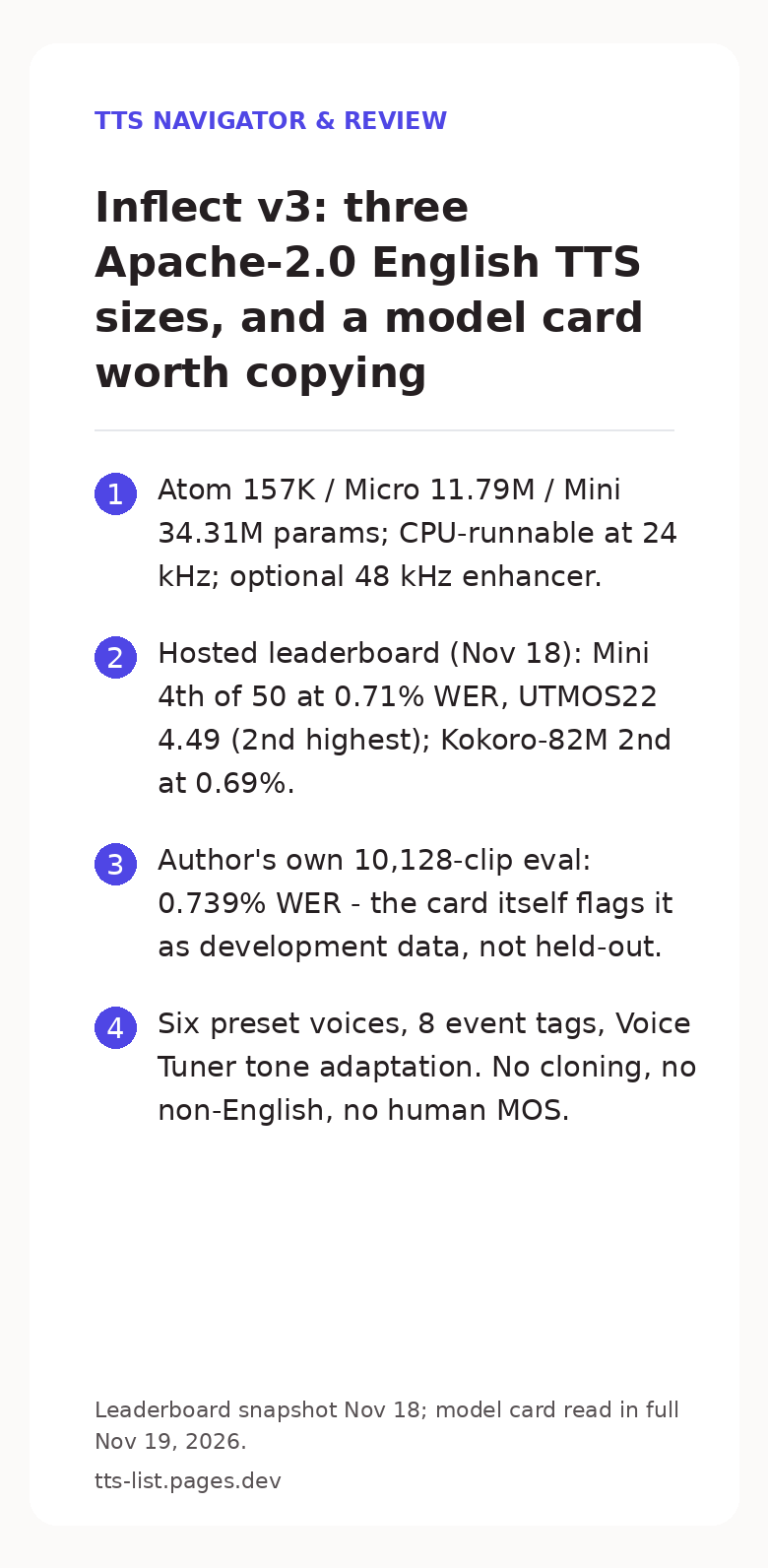
Inflect v3, released on Hugging Face around November 10 by owensong, is a family of three English TTS models under Apache-2.0: Mini (34,310,790 parameters, 138.4 MB fp32), Micro (11.79M), and Atom (157.19K, small enough to sit inside a notification system). The release ships weights and runnable inference but no training pipeline and no training data, so it is open-weights rather than fully open-source. This article is about what the models do and, more usefully, how the card reports its numbers, because that part is worth copying.
What the models give you
Capabilities are deliberately scoped. Six preset English voices, no cloning. Eight event tags such as [laugh] and [breath] insert vocal events, but the card is explicit that they are not emotion conditioning. A "Voice Tuner" adapts tone, energy and pace from a 5-15 second authorized reference clip (Linux CPU enrollment), and the author states it is adaptation, not exact cloning. An optional 2.85M-parameter enhancer upsamples output to 48 kHz; the base models run on CPU at 24 kHz. English only.
The leaderboard numbers, read carefully
The v3 card separates three kinds of evidence instead of blending them. First, the hosted Open TTS Leaderboard (snapshot November 18, 2026, English no-cloning track, 50 models): Mini ranks 4th with 0.71% WER and UTMOS22 4.49, the second-highest UTMOS22 on the board; Micro is 7th at 0.73%; Atom is 19th at 0.85%, measured on CPU. Kokoro-82M sits 2nd at 0.69% WER with UTMOS22 4.51. Second, the author's own evaluation: 10,128 clips, 0.739% average WER, UTMOSv2 3.917, UTMOS22Strong 4.479 - with the card itself flagging that this corpus was used during development, so it is not a sealed held-out set. Third, historical v1/v2 panels stay on the page but are explicitly marked as older harnesses, not comparable to v3 numbers.
Speed, with sample size attached
The card reports 162.1x real-time on an RTX 5090 with the optimized CUDA path and 1.81x real-time on a Ryzen 3900X CPU, and notes these come from about 12 renders. Indicative, not a controlled CPU-versus-GPU study - and the card says so rather than letting the reader assume it.
Why the reporting style matters
Two traps this card avoids are everywhere in small-TTS releases. First, UTMOS is a predictor, not a human MOS panel, and UTMOS22 and UTMOSv2 scores are not interchangeable; the card labels which variant each number uses. Second, mixing a hosted benchmark with a self-run development corpus inflates credibility; Inflect keeps the two in separate sections with separate labels. If you are comparing Inflect against Kokoro or Pocket-TTS-class models, only the hosted leaderboard rows are apples-to-apples.
Practical fit
Apache-2.0, CPU-runnable, event tags and tone adaptation make Mini a reasonable default for English voice UI where cloning is not needed, and Atom is an interesting extreme for constrained devices. What you do not get: non-English languages, true voice cloning, emotion control, and human listening-test scores. The card says so itself, which is the point of this article.
Sources
- https://huggingface.co/owensong/Inflect-Mini-v3
- https://huggingface.co/collections/owensong/inflect-v3
- https://github.com/owenawsong/Inflect