Phonic-1: speech-to-speech that acts while the caller is still talking - and a $27.5M Series A
Published October 30, 2026 · Built from Phonic's launch post, read in full on October 30, 2026. Benchmark figures are Phonic's own post citing third-party boards (Artificial Analysis, Sierra, Cekura, Podonos) - we label which is which. We did not run the model.
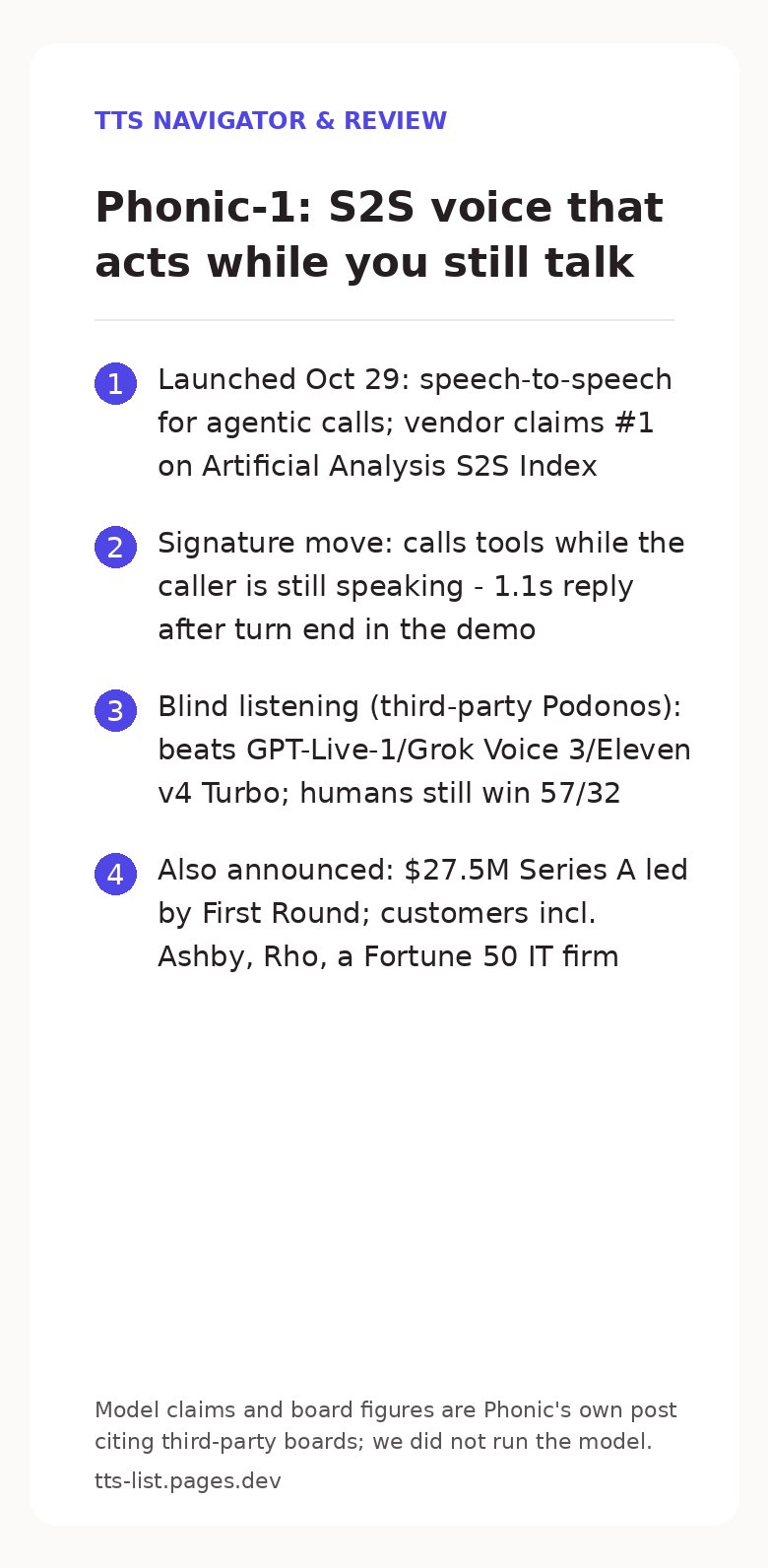
Phonic - a two-year-old startup working only on speech-to-speech - has launched Phonic-1, and it is pitching one behavior as the frontier: the model calls tools while the caller is still talking, instead of waiting for the end of the turn. In the launch demo, the same travel request goes to Phonic-1 and GPT-Live: Phonic-1 fires all five tool calls mid-speech and answers 1.1 seconds after the caller stops; the compared system starts calling tools only after the turn ends and answers after 15.7 seconds. Alongside the model, Phonic announced a $27.5M Series A led by First Round (Lux Capital, Felicis, Definition, Essence participating), taking total funding to $31.5M.
The vendor's claims - with the boards named
- #1 on the Artificial Analysis Speech to Speech Index, and "highest task success rate on agentic tasks at the lowest latency" - Phonic's launch benchmark table is sourced to Artificial Analysis, Sierra's τ³-Voice, and Cekura S2S, all dated October 29, 2026. These are real third-party boards, but the table is the vendor's selection; we have not independently re-pulled the boards today.
- Blind human listening, run by a third party (Podonos): Phonic-1 preferred over GPT-Live-1 (61.5% to 32.0%), Grok Voice 3 (66.5% to 26.5%) and Eleven v4 Turbo (78.0% to 14.0%). The honest part: human voice actors beat Phonic-1 (57.0% to 32.0%) - the vendor publishes its own naturalness gap and calls closing it a core research direction.
- Multilingual: trained on 50+ languages, switches language mid-conversation while keeping the same speaker identity. On Sierra's multilingual full-duplex τ³-Voice it scores 83.2, vs GPT-Live-1 at 79.9 and Gemini 3.8 Live at 68.5.
- Endurance demo: a 44-minute call as a Brazilian hotel concierge - 123 tool calls across English and Portuguese, with per-turn latencies and full transcript published in their platform.
Why speech-to-speech is the bet
The launch argument against cascaded pipelines (ASR → LLM → TTS): a transcript is a lossy copy of a conversation - it drops the frustration in a caller's voice, the long pause before an answer, the way someone says their own name. S2S models keep all of it, but until now "demos can be remarkable, few of these models make it into production" - the trade has been intelligence for naturalness. Phonic says it rebuilt the whole stack (data, pre-training, RL, kernels, infrastructure) around production calls, and points to customers as the proof: Ashby (AI interviews in 25 countries), Maven AGI, Rho, and a Fortune 50 IT infrastructure company, across support, healthcare, recruiting and logistics on six continents.
What the post does not tell you
- No pricing. The post has no per-minute or per-character figure - the model is a hosted service, and cost is a sales conversation.
- Closed model. No weights, no self-hosting option mentioned; this is an API bet, the opposite end of this week's open-weights releases.
- The 1.1s vs 15.7s comparison is a vendor demo with an unnamed "GPT-Live" configuration - tool-call timing depends heavily on the tools themselves; treat it as a capability statement, not a measured benchmark.
- Humans still win on naturalness (57/32) - by the vendor's own third-party test, this category is not solved.
Why it matters
- Acting mid-speech is a real architectural difference. Overlapping tool execution with the user's turn attacks the biggest perceived-latency cost in agentic calls - the "let me look that up" dead air. If it holds up outside demos, expect every S2S competitor to copy it.
- The funding says production S2S is now a category. First Round leading $27.5M into a two-year-old S2S-only company, with named enterprise customers, moves speech-to-speech from research demo to procurement line item.
- Vendor honesty as a feature. Publishing a human-preference gap (57/32) next to the wins is the same eval-culture shift we noted in AssemblyAI's launch this week - buyers are asking, and launch posts are adapting.
Source (read in full; link verified October 30, 2026)
- Introducing Phonic-1 and our $27.5M Series A - Phonic (October 29, 2026) - all model claims, demos, Podonos figures, τ³-Voice scores and funding details above.