Paper: when the persona contradicts the line - locating exactly where counter-textual acting breaks in chain-of-thought TTS
Published October 28, 2026 · Built from arXiv:2610.35008, read in full on October 28, 2026. Every number below is the paper's own experiment - we say so each time it matters. We did not run the pipeline.
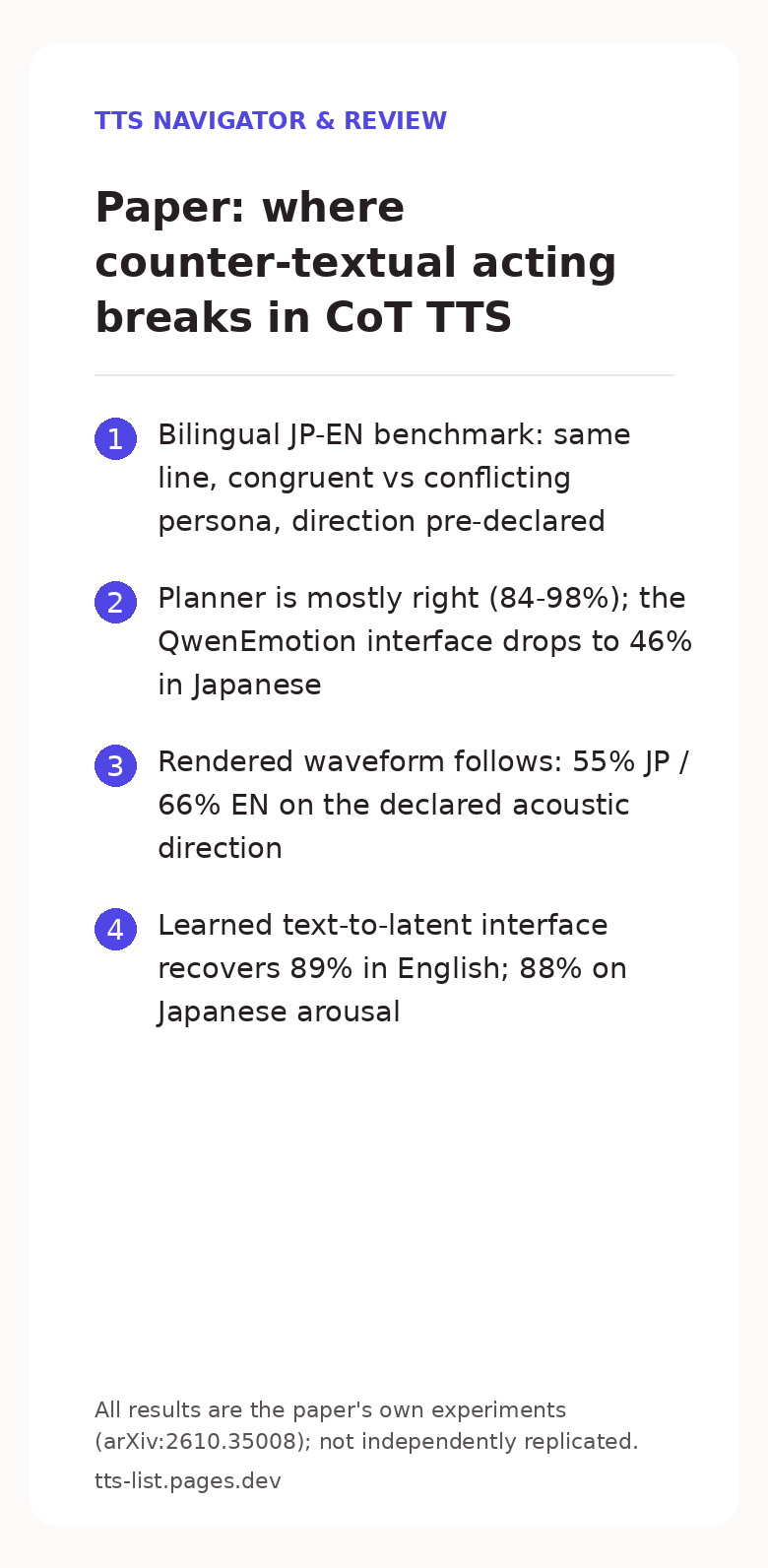
"Congratulations on your engagement" - said by a character who is quietly devastated. Acting constantly demands delivery that contradicts the words' sentiment, and instruction-following TTS reliably fails here: it reads the text's emotion, not the prompt's. A new paper from Spellbrush asks the more useful question: where does the instruction die? The answer, from a new bilingual benchmark that probes every intermediate stage: the planner usually knows what to do - the handoff to the synthesizer is what loses it.
The benchmark: declare the direction before any audio exists
Each of the 150 Japanese and 150 English items pairs one spoken line with a congruent persona (the line reads naturally) and a conflicting persona (the same words need an opposing affect), and pre-declares an acoustic target: which axis - arousal or valence - should move, and in which direction, between the two renditions. That pre-declaration is the methodological point: it lets the authors score not just the final waveform but every intermediate representation against the same target. The acoustic scorer (a wav2vec2-based regressor) is validated on parallel human recordings: 99.6% direction recovery on 24,334 arousal pairs, 83.1% on 15,601 valence pairs.
Where it breaks - stage by stage
The pipeline under test: an LLM planner (Gemini 3.5 Flash-Lite) writes a free-form delivery phrase and an 8-dimensional emotion vector; the stock IndexTTS-2.5 route then has QwenEmotion convert the phrase into its own emotion vector, mapped through a prototype bank to the synthesizer's conditioning. Direction agreement with the declared target:
| Probe point | Japanese | English |
|---|---|---|
| Delivery phrase (LLM jury) | 84% | 98% |
| Planner-written emotion vector | 86% | 89% |
| QwenEmotion vector (stock interface) | 46% | 83% |
| Rendered waveform (stock route) | 55% | 66% |
The Japanese collapse at the QwenEmotion stage is the headline: 46% overall, and just 37% on valence - below coin-flip on the axis that carries most emotional meaning. The authors caution these are independent per-stage readouts, not conditional survival rates, but the pattern is clear: intent survives planning and dies in the emotion-control interface.
Three repairs, kept honest
Holding the synthesis backbone fixed, the paper compares three interface treatments (all with the planner's duration control):
- Bypass - feed the planner's own emotion vector straight to the prototype bank: 68% JP / 79% EN, not significantly better than base (p=.58 / .26). The planner's structured output alone is not the fix.
- Supervise QwenEmotion with render-selected training pairs (LoRA fine-tune): 75% JP / 84% EN, significantly above base in both (p=.033 / .036).
- Learned text-to-latent interface - replace QwenEmotion and the prototype bank with a small MLP that maps the delivery phrase directly to a 1,280-dim emotion-conditioning shift, trained on 30,083 acted clips: 89% in English (p=.008, the best English rate), but 66% overall in Japanese - while hitting 88% on Japanese arousal, the best rate there. The repair works, and its effect is strongly axis- and language-dependent.
A quieter finding in the ablations: the planner's duration control (how fast the line is spoken) is the clearest single contributor - removing it drops the base from 65% to 55% in Japanese (p=.014) and 74% to 66% in English (p=.008), while removing emotion conditioning alone does little. Some of what looks like "emotion control" in these systems is pacing.
Where the humans disagree with the metric
The listening test (10 listeners per language, blinded matching) is deliberately reported as descriptive: only the supervised English condition beats chance at the item level (22/30, p=.016), and listener majorities agree with the acoustic predictor on 68% (JP) and 77% (EN) of item-condition pairs. The authors' treatment comparison therefore rests on the predictor numbers, and they say so - exactly the kind of scope-limiting yesterday's accent-control paper also practiced.
Why it matters
- A reusable diagnostic shape. Declare the direction first, probe every intermediate representation, and "the model can't act" decomposes into "this specific interface loses 40 points." Any planner-plus-synthesizer stack can run this audit.
- The interface is the product surface. As delivery descriptions become the control API of TTS (directions in Lure, instruct strings in OmniVoice), the text-to-conditioning mapping is where product quality is won or lost - and this paper shows it is trainable independently of the synthesizer.
- Cross-lingual caution with numbers attached. An interface tuned on one language's emotional phonetics can silently fail in another - 46% in Japanese versus 83% in English, same code.
Limitations (the paper's own)
- One planner-synthesizer pipeline (Gemini planner + IndexTTS-2.5), two affective axes, and a reference-free acoustic scorer whose cross-lingual transfer "remains imperfectly characterized."
- Benchmark items are LLM-authored (with a five-vote jury reproducing the declared target on 96% of audited items); the learned interface's training clips include Mandarin, not just the two test languages.
- All results are the authors' experiments; not independently replicated.
Source (read in full; link verified October 28, 2026)
- When the Persona Contradicts the Line: Diagnosing Plan-to-Synthesis Failures in Chain-of-Thought TTS - arXiv:2610.35008 (Park, Li; Spellbrush) - all benchmark, probe, treatment and listening-test numbers above.