OmniVoice: zero-shot voice cloning in 600+ languages - what k2-fsa shipped, the speed claim, the license split
Published October 27, 2026 · Built from the k2-fsa/OmniVoice GitHub README and the Hugging Face model page, read in full on October 27, 2026, plus GIGAZINE's hands-on walkthrough. Every performance number below is the authors' own - we say so each time it matters. We did not run the model.
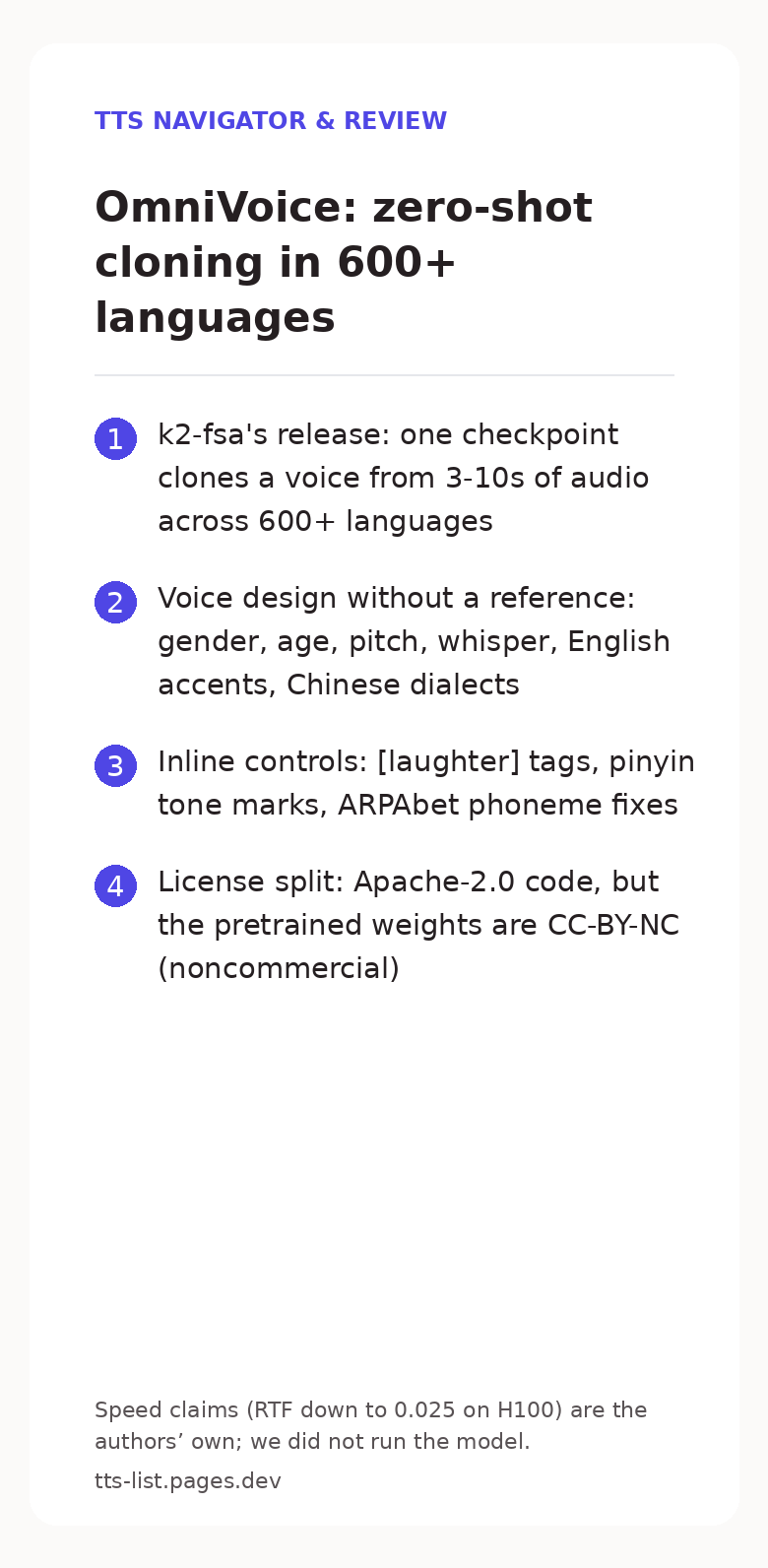
k2-fsa - the open-source speech group behind sherpa and icefall, with Daniel Povey among the paper's authors - has released OmniVoice, a "massively multilingual" zero-shot text-to-speech model covering more than 600 languages. That language count is the headline: most zero-shot TTS releases cover a handful of languages, and the previous open releases we have covered topped out around ten. OmniVoice pairs the breadth with a full toolkit: voice cloning from a few seconds of reference audio, voice design from text attributes, and inline non-verbal controls. GIGAZINE walked through a local install on October 25 and found the demo flow working as described.
What shipped
- 600+ language zero-shot voice cloning. Give the model 3-10 seconds of reference audio and it reads new text in that voice; a
ref_texttranscript is optional - the model falls back to Whisper ASR to transcribe the reference itself. Output is 24 kHz audio. - Voice design without a reference. An
instructstring sets speaker attributes: gender, age (child to elderly), pitch, whisper style, English accent (American, British, and so on), and Chinese dialect (Sichuan, Shaanxi...). Attributes combine freely:"female, low pitch, british accent". - Fine-grained inline control. Non-verbal tags like
[laughter]can be inserted in the text, and pronunciation can be corrected inline with pinyin tone markers or ARPAbet phonemes. - Reusable cloned voices.
create_voice_clone_promptencodes a reference once into a saved prompt file, so later sessions skip the audio and transcription steps. - Three ways to run it.
pip install omnivoice; a local web UI viaomnivoice-demo --ip 0.0.0.0 --port 8001; or a hosted Hugging Face Space and Google Colab notebook. NVIDIA GPU, Apple Silicon (MPS) and Intel Arc (XPU) are all supported paths, and the full training, evaluation and finetuning pipeline ships inexamples/.
The architecture and the speed claim - vendor numbers
OmniVoice uses what the authors call a "diffusion language model-style architecture," described as a clean, scalable design that delivers both quality and speed. The paper (arXiv:2604.00688) carries the detail; the README's quantitative claim is speed:
- RTF "as low as 0.025" - 40x faster than real time - is the headline figure. The benchmark table behind it is specific: seed-tts Chinese test set (2,020 samples, 3.3 hours), voice cloning, single H100 in fp16 with 32 sampling steps, measured by the project's own
omnivoice-infer-batchtool with ASR-verified lossless outputs. On that setup, baseline batch-1 RTF is 0.0899; an optional FlashInfer path with CUDA graphs reaches 0.0367 at batch 1 and 0.0115 at batch 8. - These are the authors' measurements on their own hardware and their own test set. The configuration is documented well enough to reproduce, but we did not reproduce it. Treat "40x real time" as "fast on an H100 under batching," not as a promise for a laptop CPU.
The license split - read this before shipping
Like last week's Phonon-in-Ollama release, OmniVoice does not put everything under one license:
| Component | License | Commercial use |
|---|---|---|
| Code (inference, tools, training pipeline) | Apache-2.0 | Yes |
| Pretrained model weights | CC-BY-NC | No - noncommercial only |
The weights carry the noncommercial clause because of training-data constraints (the card names the Emilia corpus among them). "Free" in coverage headlines means free to download and try - a commercial product cannot ship these weights. The Apache training code is the path to a model you own, at the cost of training it.
Why it matters
- Language coverage is the real story. A single open checkpoint doing zero-shot cloning across 600+ languages moves low-resource languages from "no open option" to "try it this afternoon" - the same demo UI switches between 102 sample languages.
- Voice design lowers the cloning bar. For prototyping, describing a voice (gender, age, pitch, accent) is faster than sourcing clean reference audio - with a real caveat below.
- A complete open stack. Weights, pip package, demo UI, and the full training/eval pipeline in one repo is still the exception rather than the rule; k2-fsa continues its track record of shipping reproducible speech tooling.
Caveats
- All quality and speed numbers are the authors' own; we did not run the model. GIGAZINE's walkthrough exercised the official samples and demo, not an independent evaluation.
- Voice design is trained on Chinese and English data only; the authors warn it can be unstable for low-resource languages. Voice cloning is the stable mode.
- Cross-lingual cloning carries the reference's accent into the target language - the authors recommend using a reference in the same language as the target speech. (Fixing exactly this leakage is the subject of today's paper coverage.)
- Arabic numerals are read digit-by-digit unless you opt into text normalization (
normalize_text=True, an extra dependency). - The weights are CC-BY-NC: noncommercial use only.
Sources (read in full; links verified October 27, 2026)
- k2-fsa/OmniVoice - GitHub README, LICENSE (Apache-2.0 code), features, install, benchmark table - all product and performance claims above.
- k2-fsa/OmniVoice - Hugging Face model page (CC-BY-NC weights, training-data constraint) - the license split.
- GIGAZINE - OmniVoice hands-on walkthrough (October 25, 2026) - independent confirmation the demo flow works as described.