Ollama adds speech models: local TTS with one command - what shipped, the speed claim, the license split
Published October 26, 2026 · Built from Ollama's official "Speech models in Ollama" blog post, read in full on October 26, 2026. Every performance number below is Ollama's own measurement on its own hardware - we say so each time it matters. We did not run the models.
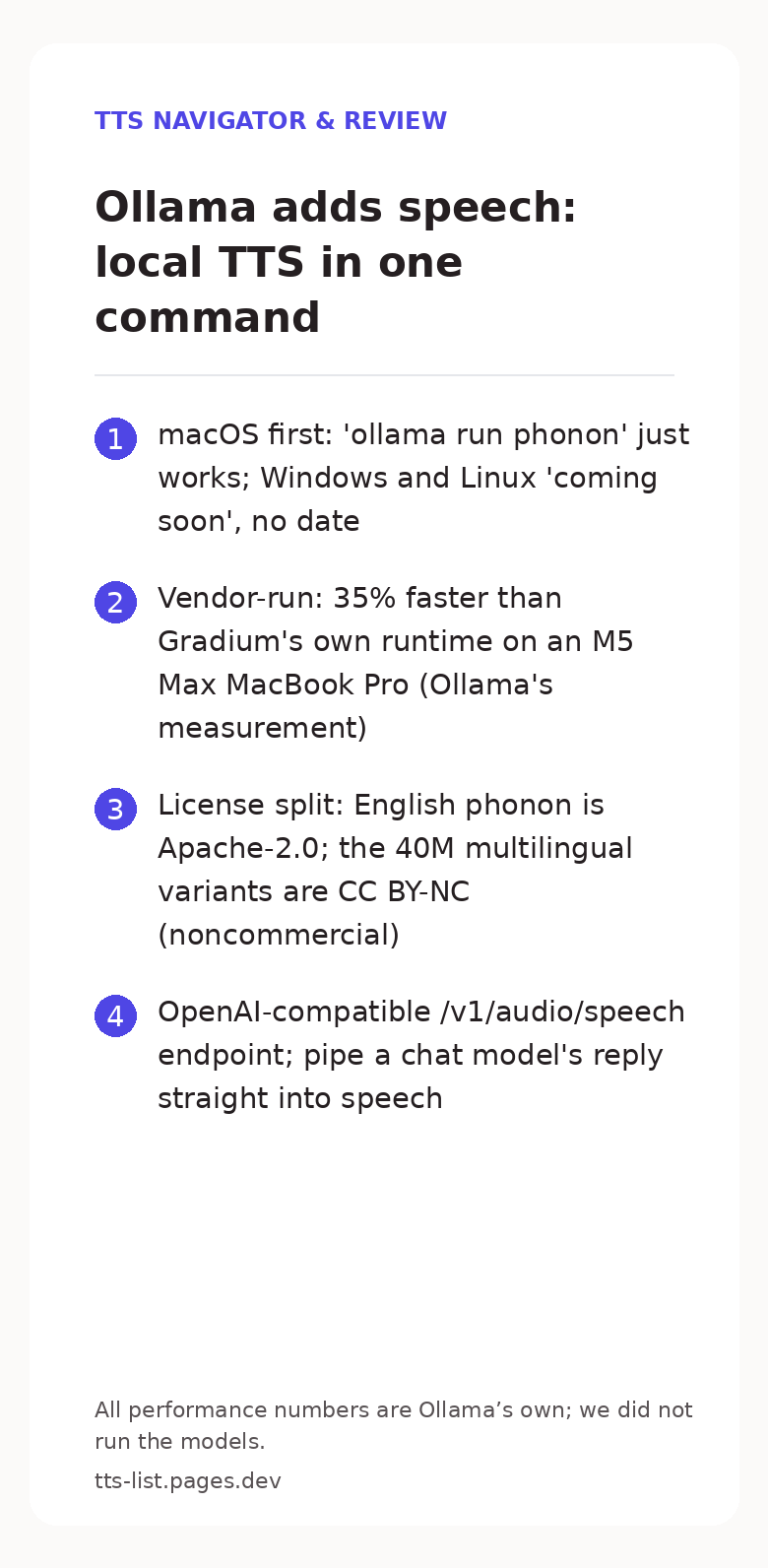
On October 24, Ollama - the tool that made running LLMs locally a one-command affair - added speech models. The first one is Phonon, the small open text-to-speech family from Gradium that we covered when it launched. The significance is less the model (which already had weights and a runtime) and more the packaging: TTS now installs and runs through the same ollama run flow people already use for chat models, with an OpenAI-compatible API on top. For local-first voice prototyping, this removes most of the setup friction.
What shipped
- One-command TTS.
ollama run phonon "Hello from Ollama."synthesizes speech. With no text argument it reads lines from a prompt; redirect output to save a WAV (> speech.wav). - macOS first. Speech models are available on macOS now; Ollama says Windows and Linux support is "coming soon" - no date given.
- Voice selection.
--voice Hadleypicks a voice from Gradium's voice catalog;ollama show phononlists them all. - Six model variants.
phonon(English), plus 40M-parameter variants:phonon:40m-fr,40m-de,40m-es,40m-pt, and40m-multilingualcovering all five languages. - OpenAI-compatible API. Phonon works with the
/v1/audio/speechendpoint, so code written against the OpenAI SDK only needs a new base URL (localhost:11434) - examples given in cURL, Python, and JavaScript. - Chaining with chat models. Piping works:
ollama run gemma4 --hidethinking "..." | ollama run phononspeaks the reply as it arrives, starting after the first sentence.
The performance claims - vendor-run, vendor hardware
Ollama's post includes two quantitative claims, both measured by Ollama itself:
- Speed. On a MacBook Pro with M5 Max, Ollama says it ran Phonon 35% faster than "the next fastest engine," Gradium's own runtime (ptts) - measured as throughput generating 45 seconds of speech, median of 10 runs. The comparison is asymmetric in precision: Gradium's runtime uses 8-bit weights on CPU, fp16 on the Neural Engine, and f32 on GPU; Ollama runs the model in bf16, accelerated by Apple's MLX framework. This is one hardware configuration, chosen and measured by the vendor. Treat it as "Ollama is competitive on Apple Silicon," not as a universal ranking.
- Accuracy. Ollama says its implementation matches the word error rate of the Hugging Face Transformers reference implementation, measured on 200 sentences from the Seed-TTS English test set transcribed with Whisper large-v3. Again vendor-run, but the claim is narrow - parity with the reference, not superiority - and the test set is public.
The license split - read this before shipping
The model variants do not share one license:
| Variant | License | Commercial use |
|---|---|---|
| phonon (English) | Apache-2.0 | Yes |
| phonon:40m-fr / de / es / pt / multilingual | CC BY-NC 4.0 | No - noncommercial only |
The English base model is safe for commercial products; every 40M variant is noncommercial. If your plan is a multilingual product, the Ollama packaging does not change the underlying license situation.
Why it matters
- Local voice prototyping just got cheaper to try. The same audience that runs local LLMs can now add a voice with one command and an OpenAI-shaped API - no Python environment wrangling.
- Streaming composition. The pipe pattern (chat model into TTS, speaking from the first sentence) is the shape of a local voice agent loop, and it works out of the box on a Mac.
- A distribution channel for open TTS. Ollama's model library is where many developers first encounter open models; Phonon being the launch speech model gives Gradium's work a large on-ramp.
Caveats
- All speed and accuracy numbers are Ollama's own measurements on its own hardware; none are independently reproduced here. We did not run the models.
- macOS only at launch; Windows and Linux timing is unannounced.
- The 35% figure compares against Gradium's runtime with different weight precision on one specific MacBook configuration - not a general benchmark.
- The 40M multilingual variants are CC BY-NC 4.0 (noncommercial); only the English base is Apache-2.0.
Sources (read in full; link verified October 26, 2026)
- Ollama Blog - Speech models in Ollama (official announcement, October 24, 2026) - all product, performance, and license claims above.