NVIDIA Nemotron 3.5 Transcribe: one open-weight checkpoint for 40-language transcription, speaker labels, and translation
Published October 31, 2026 · Built from NVIDIA's Hugging Face model card (primary source), read in full on October 31, 2026. Benchmark figures are NVIDIA's own model-card table (results captured October 12, 2026); the Artificial Analysis / David AI / VoiceArena numbers come from secondary coverage and are labeled as such. We did not run the model.
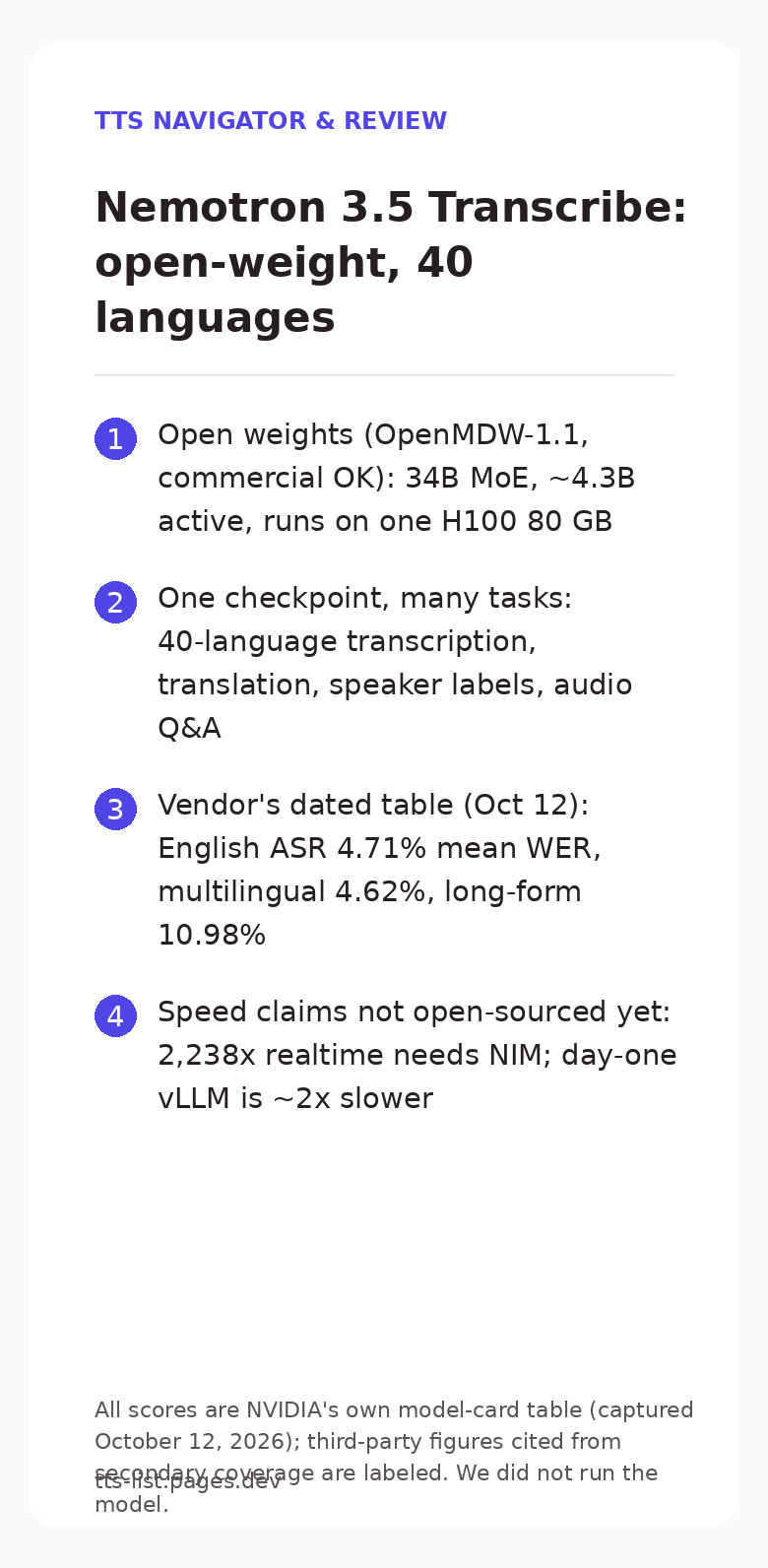
NVIDIA has released Nemotron 3.5 Transcribe as open weights on Hugging Face and ModelScope (published October 28, 2026), under the OpenMDW-1.1 license - the card states it is "ready for commercial or non-commercial use." It is a promptable speech model: the same checkpoint turns a recording into a verbatim transcript, a cleaned written-form transcript, a speaker-labeled dialogue, an English translation, or answers about the audio, depending on the instruction you attach. Speech is the modality most self-hosted stacks still send to a hosted API; this is NVIDIA's bid to make that last call unnecessary.
What one checkpoint does
- 40 languages (see the card's support matrix - task coverage varies per language), recordings up to one hour, 65,536-token context, word-level timestamps via built-in CTC heads.
- Speaker-attributed transcription (a dedicated speaker encoder feeds the language model), rich/contextual transcription with domain terms you supply, speech translation, language ID, audio Q&A - plus a small dose of PII tagging/redaction and text instruction following in the training mix.
- Architecture: a Mamba-2–Transformer hybrid MoE with a Parallel Expert Encoder; 34B total, about 4.3B active per token, in BF16, FP8 and NVFP4. Deployment target: one H100 80 GB; Blackwell supported; native MTP speculative decoding with an optional DFlash2 draft model.
The vendor's numbers - dated October 12, 2026
The card's "results at a glance" table carries its own capture date, which is the discipline we like to see. Against the next best published system on each track:
- English ASR (Open ASR Leaderboard, 9 public sets): 4.71% mean WER vs Qwen3-ASR-1.7B at 4.94.
- Multilingual ASR (7-language Open ASR track): 4.62% vs 6.49.
- Long-form (55-minute chunks, CORAAL/Earnings21/22): 10.98% vs Parakeet-TDT-0.6B-v3 at 13.37.
- Multi-speaker (AMI, CALLHOME, Mixer 6, NOTSOFAR-1 full sessions): mean cpWER 15.80 vs DiCoW v3.3 + DiariZen at 16.83. Style control (Preference-ASR): 7.56 default / 6.16 instructed vs Canary-Qwen 8.16/8.36.
Secondary coverage (DeAI, October 29) cites third-party measurements - Artificial Analysis at 2.81% AA-WER tying Mistral's Voxtral Small with roughly one-sixth the active parameters, and the lowest error rate on David AI's 21-language diarization leaderboard. We did not re-pull those boards today, so treat them as that coverage's claims. One eval-hygiene note from the card itself: training data includes audio licensed from David AI, but the DAI-ASR-I18N evaluation set was excluded from it.
The honest catch on speed
The headline serving figure - up to 2,238 seconds of audio per second on one RTX PRO 6000 Blackwell Server Edition, a 30-second clip back in 0.13 seconds - comes from the Nemotron Transcribe NIM with NVFP4 and DFlash2, and the card says plainly: "these serving optimizations are not yet part of the open-source release." The vLLM integration that shipped on day one is "intended for model development" and runs roughly two times slower; upstreaming is promised "at a later date." Also explicit: this is an offline model - its internal 30-second chunking is not a streaming-latency claim, and it is not a real-time ASR service.
Why it matters
- Self-hosted speech stacks close their last hosted gap. ASR/diarization/translation was where even open-everything shops still called an API; a commercially-usable open checkpoint changes that procurement conversation.
- Promptability collapses a pipeline into a prompt. Verbatim vs cleaned, speaker labels, domain-term biasing, PII redaction - previously separate models or post-processing steps, now instruction variants on one checkpoint.
- ~4B active parameters is the efficiency story. If the third-party accuracy-versus-size framing holds, MoE speech models just did to transcription what they did to text: near-flagship quality at small-model serving cost.
Sources (read in full; links verified October 31, 2026)
- nvidia/NVIDIA-Nemotron-3.5-Transcribe-30B-A4B - Hugging Face model card - primary source: architecture, tasks, the dated benchmark tables, serving caveats, license.
- DeAI coverage (October 29, 2026) - secondary; source of the Artificial Analysis, David AI and VoiceArena figures quoted above, labeled as its claims. Companion release: the Granary v2 dataset (463k hours, 48 languages in public manifests, per the same coverage).