Ninada: streaming 24 kHz TTS inside the browser, across twelve scripts
November 12, 2026 - by TTS Navi. We read the full paper; all results below are the author's own experiments, not ours.
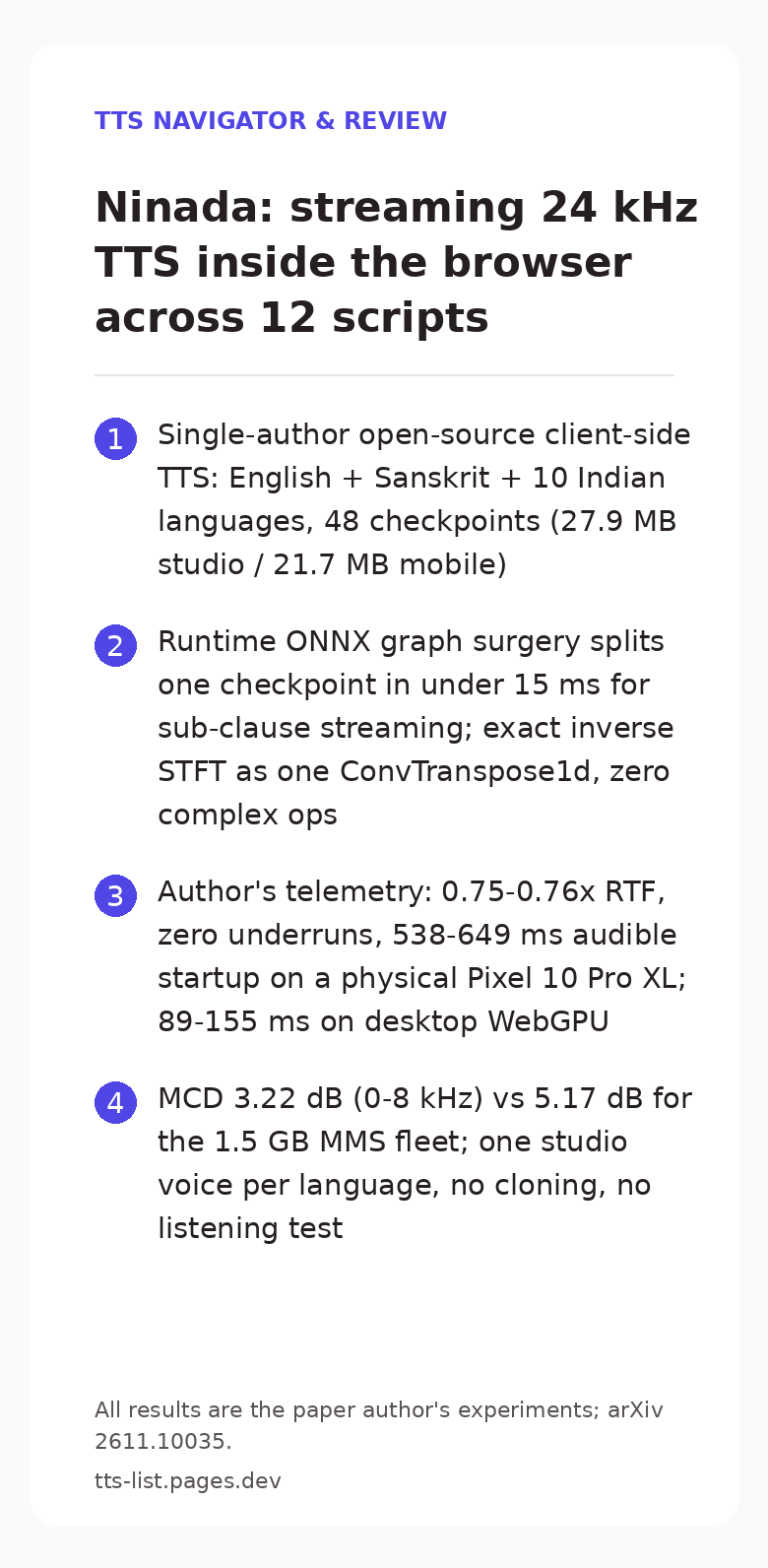
Ninada (arXiv 2611.10035, single-author work by Hemanth HM) is an open-source client-side TTS system covering English, Classical Sanskrit and ten Indian languages across a 48-checkpoint fleet - 24 studio specialists (27.9 MB) for desktop WebGPU and 24 distilled mobile specialists (21.7 MB) for phone-class WebAssembly, plus a zero-dependency Klatt formant fallback that weighs nothing. The premise: screen readers, language-learning tools and offline readers need full-band 24 kHz audio, native-script fidelity, sub-second startup and no server. The engineering target is the messy reality of mobile browsers, where Meta's MMS-TTS line ships 138.8 MB of 16 kHz per language and standard VITS ONNX exports run monolithically over an entire clause.
The three contributions
First, runtime graph surgery: instead of shipping separate encoder, flow and vocoder files for 48 checkpoints, Ninada ships one ONNX file per voice tier and splits it in memory in under 15 ms - a zero-dependency protobuf splitter partitions the graph at two topological cut points shared by both vocoder families, so sub-clause streaming becomes possible without custom ONNX Runtime builds. Latent windows stream with 12-frame halos and raised-cosine crossfades, and a seam audit reports boundary steps below 3.3e-5 with more than 38 dB split-versus-monolithic SNR parity. Second, an ONNX-native mobile vocoder: the author observes that standard InverseSTFT and complex operators lack portable WASM SIMD kernels, and reformulates exact inverse STFT as a single static real-valued ConvTranspose1d filterbank via the NOLA dual-window identity - greater than 138 dB reconstruction SNR against torch.istft, zero complex ops, 62% fewer vocoder MACs than the HiFi-GAN decoder. Third, a deployment playbook derived from a stability bound: playback cushion grows only when the raw per-frame compute ratio is below 1 and windows exceed 2Hr/(1-r), which motivates distilling the mobile vocoder (r about 0.56 on WASM), a bimodal thread policy (2-3 WASM threads run 1.5-2.3x slower than one on big.LITTLE phones because pthreads block on efficiency cores, so it is 6 threads or 1), sentence-gated clause admission when throttled, hardware-rate C++ audio queuing, and a synchronous iOS AudioSession unlock that plays even with the mute switch on.
The author's numbers
On 480 held-out 24 kHz studio utterances (40 per language), the Studio ONNX specialists score 3.22 dB 0-8 kHz MCD against 5.17 dB for Meta's 1,526.8 MB eleven-checkpoint MMS fleet - about 55x smaller active footprint - and 6.07 dB 8-12 kHz error against 64.97 dB, since MMS rolls off above 8 kHz. The mobile iSTFTNet tier shows 1.33 dB mean teacher-student distillation MCD across 24 voices and 3.09 dB against ground truth. On a physical Pixel 10 Pro XL, the author profiles mobile WebGPU at 5.9-14.0 s of cold shader compilation followed by 1.44-1.53x warm effective RTF - slower than real time - which is why the phone path bypasses the GPU entirely: on 6-thread WASM SIMD the mobile specialist streams end-to-end at 0.75-0.76x RTF with audible startup of 538-649 ms and zero underruns across multi-sentence passages. Desktop WebGPU starts in 89-155 ms at about 0.09x RTF. The native-script front end is rule-based and language-specific: Sanskrit vocalic sonorants and Vedic pitch marks, Hindi/Marathi schwa deletion, Malayalam atomic chillus, Tamil/Kannada retroflex contrasts - the author argues Romanization erases exactly these. Checkpoints are on Hugging Face under CC-BY-4.0 training corpora (AI4Bharat Rasa, hifi-tts).
Limits, as stated
Each specialist is one anechoic studio voice per language - no zero-shot cloning, no style control - traded deliberately for compact client caching. Quality evidence is MCD and device telemetry, not a listening test. Single-threaded or thermally throttled phones can still cross r = 1, where the sentence-gating absorbs the deficit into inter-sentence pauses rather than mid-word dropouts; iOS WKWebView gets one thread to avoid Jetsam kills. The MMS comparison favors Ninada on bandwidth (16 kHz vs 24 kHz), which the author addresses by scoring only the shared 0-8 kHz band on that metric.
Our analysis
Ninada reads like a field guide to everything that breaks when TTS meets a real phone: shader compilation that costs more than the synthesis itself, thread pools that get slower as they grow, iOS audio sessions that stay silent until a user gesture. The graph-surgery trick is the most reusable idea - splitting one checkpoint into streamable sub-sessions at load time means any existing VITS-family model could get sub-clause streaming without retraining or multi-file packaging, and the NOLA-as-ConvTranspose1d formulation removes the last reason to avoid iSTFT heads on WASM. The evaluation is honest about what it is: MCD against studio ground truth plus real-device streaming telemetry, on held-out utterances, with bootstrap intervals - but no perceptual test, and one author building and measuring 48 checkpoints. If the numbers hold up under independent ears, this is a practical blueprint for offline Indic-language reading tools, and the 21.7 MB mobile tier undercuts MMS's per-language footprint by 6.4x while doubling the sample rate.
Sources
- Ninada paper (arXiv 2611.10035) (read in full, November 12, 2026)
- GitHub: hemanth/ninada