Nano Urdu TTS: 443k parameters distilled from a 36M teacher - and a release that prints its own failed quality gate
November 27, 2026 - TTS Navi. We read the model card in full. All figures are the author's own measurements, not our tests.
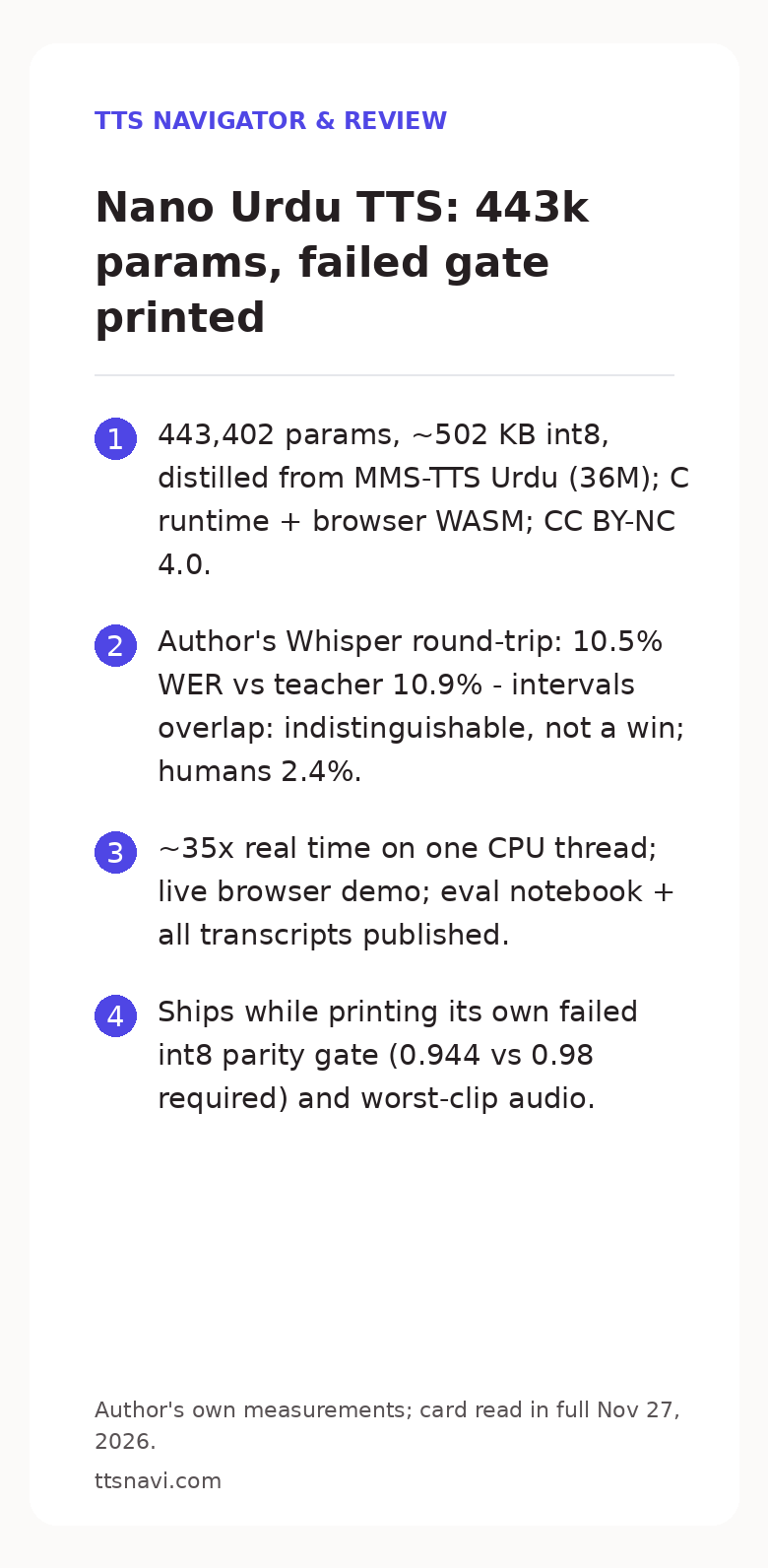
Nano Urdu TTS (zafar205, released November 26, 2026) is a 443,402-parameter Urdu voice, about 502 KB as int8, distilled from Meta's MMS-TTS Urdu (36.3M parameters): the teacher read ~20,000 UrduTTS corpus sentences, and three small networks (duration, acoustic, waveform decoder, built on the sanoTTS C runtime) learned to reproduce that voice from eSpeak NG phonemes. CC BY-NC 4.0, research use. It runs on CPU through a C runtime and in the browser as WebAssembly compiled from the same C (verified to match the C output to about 1e-7), with a live demo page.
An evaluation that argues with itself
The author's Whisper large-v3 round-trip (WER, lower is better, 95% bootstrap intervals over sentences) on 200 held-out corpus sentences: human recordings 2.4%, teacher MMS-TTS 10.9%, Nano Urdu int8 10.5%. The card then tells you how not to read its own win: nano minus teacher is -0.4 points with an interval of -1.7 to +0.8 that includes zero - statistically indistinguishable from the teacher - and nano sits +8.1 points above real recordings, a gap inherited from the teacher. On a 47-sentence everyday set nano scores lower than the teacher and the card explicitly says the difference is not significant: "do not read it as nano beating the teacher." Median real-time factor 0.029 (about 35x real time) on one Kaggle CPU thread.
The failed gate, printed
The most unusual section: the sanoTTS runtime's own int8 parity gate requires waveform correlation of at least 0.98 against the float model, and this release fails it - mean 0.944, minimum 0.913, 7 of 8 clips below threshold. The card ships anyway, explains that the published intelligibility numbers were measured on the int8 files that ship (so the effect is already in the scores), and points to float checkpoints for comparison. Typical failures are listed too (rare sounds replaced by similar ones). For a half-megabyte voice of an under-served language, this is what honest small-model documentation looks like.
Sources
- https://huggingface.co/zafar205/nano-urdu-tts-worlds-smallest-urdu-tts-450k-parameters
- https://nano-urdu-tts.vercel.app/