MOSS-TTS v1.5: 31 Languages, Explicit Pause Control, Steadier Cloning
November 5, 2026 - by TTS Navi. We read the model card in full; every capability claim below is the vendor's unless marked otherwise.
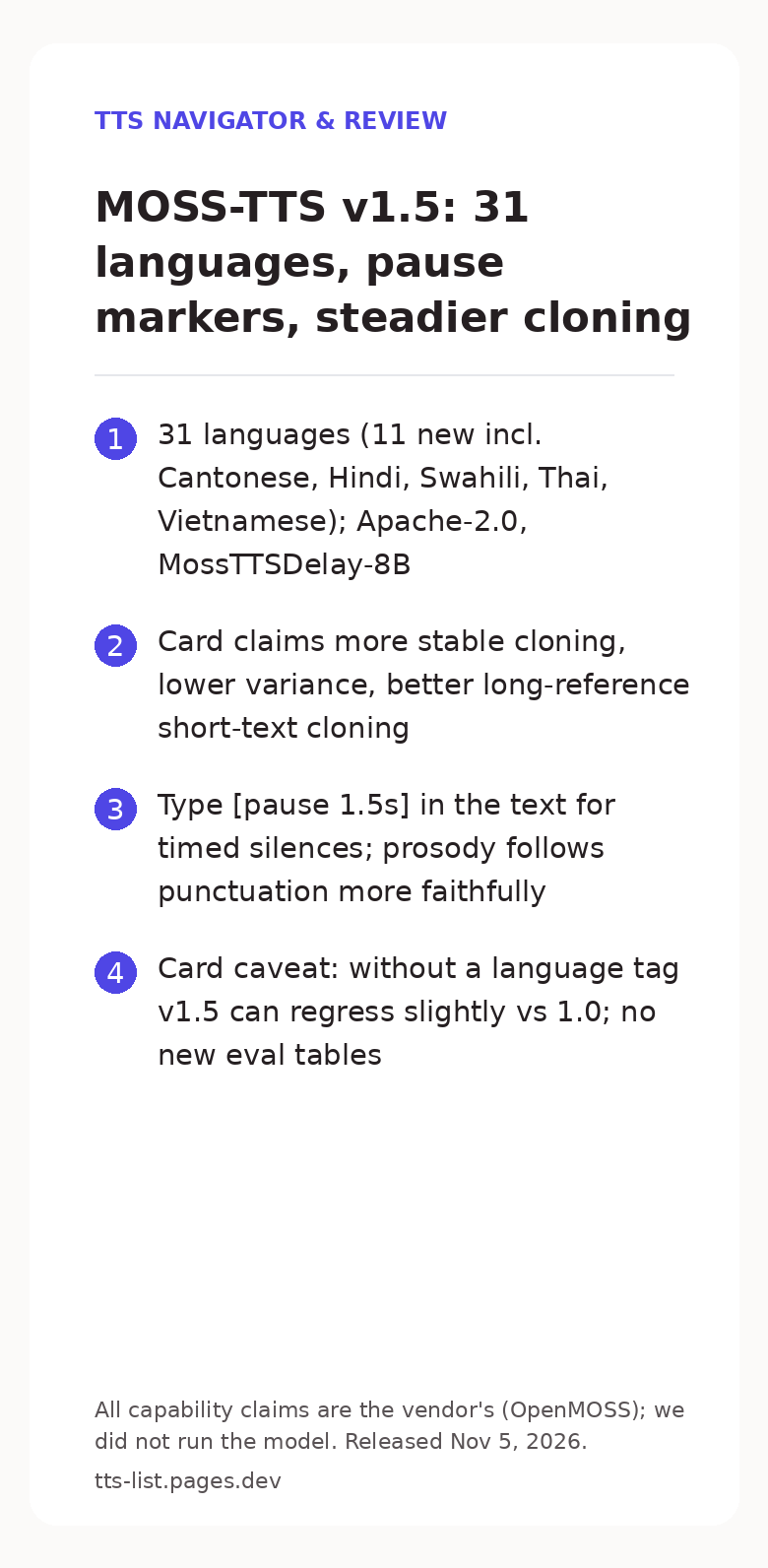
OpenMOSS published MOSS-TTS v1.5 on Hugging Face today (repos Infinix-io/MOSS-TTS-v1.5 and OpenMOSS-Team/MOSS-TTS-v1.5), the direct successor to MOSS-TTS 1.0. It keeps the same MossTTSDelay-8B architecture and the Apache-2.0 license, and the card frames v1.5 as a quality-and-coverage update rather than a new model family. The headline: language coverage jumps from 20 to 31 languages, cloning gets more stable, and you can now type explicit pauses into the text.
What v1.5 adds, per the card
- 31 languages. The 11 additions over 1.0 are Cantonese, Dutch, Finnish, Hindi, Macedonian, Malay, Romanian, Swahili, Tagalog, Thai, and Vietnamese. That pushes OpenMOSS's open-weights line into several large underserved markets (Hindi, Swahili, Tagalog, Vietnamese) in one step.
- More stable voice cloning. The card claims improved cloning stability and lower output variance, plus better behavior in the "long reference, short text" corner - cloning a short sentence from a long prompt, a common failure point for reference-based TTS.
- Punctuation-following prosody. Prosody is supposed to track punctuation more faithfully, so commas, question marks and sentence breaks land where a reader would put them.
- Explicit pause markers. You can write
[pause 1.5s]-style markers directly in the input text to force a timed silence - a small feature that matters a lot for dialogue editing, IVR menus and video voice-over timing.
The language-tag caveat is worth reading twice
The card is unusually direct about a trade-off. If you omit the language tag, v1.5 "may improve some languages and regress slightly" relative to 1.0. If you specify the language, the card says v1.5 is stronger than 1.0 on almost all of them. In practice: tag your language explicitly when you know it, and regression-test your existing 1.0 prompts before switching production traffic. This is the vendor's own wording, not an independent measurement - there are no new evaluation tables in the v1.5 card, which instead points back to the MOSS-TTS 1.0 README for evaluation results.
Practical notes
v1.5 is API-compatible with 1.0, so existing integrations should swap weights without code changes. The card links the same GitHub repo (github.com/OpenMOSS/MOSS-TTS) and the mosi.cn demo, and keeps the quickstart pattern of 1.0: AutoModel.from_pretrained with trust_remote_code=True, a processor that builds conversations, and model.generate. Prefix-audio continuation, Pinyin/IPA preprocessing and generation hyperparameters are unchanged from the 1.0 documentation.
Our analysis
Three things stand out. First, the cadence: this is OpenMOSS shipping a meaningful multilingual expansion as a minor version, days after MOSS-TTS-Speech appeared, which suggests a rapid iteration loop on the Delay architecture rather than one big launch per year. Second, the pause-marker feature is a quiet but real product gap-closer - timed pauses are one of the most-requested controls in production TTS, and most open models still force you to hack them in with punctuation or silence splicing. Third, the honest language-tag caveat is the kind of disclosure more model cards should copy: it tells you exactly where the upgrade can bite you. What we cannot verify from the card alone is the claimed cloning-stability improvement; with no new eval tables, that rests on vendor self-report until third parties run comparisons.
Sources
- Infinix-io/MOSS-TTS-v1.5 model card (link unavailable) (read in full, November 5, 2026)
- OpenMOSS-Team/MOSS-TTS-v1.5 (mirror)
- OpenMOSS/MOSS-TTS on GitHub