Africa TTS: 92 African Languages, One 316M Model, Voice Cloning Included
November 7, 2026 - by TTS Navi. We read both model cards (Africa TTS and Africa TTS Turbo) in full; every benchmark number below is the developers' own measurement unless marked otherwise.
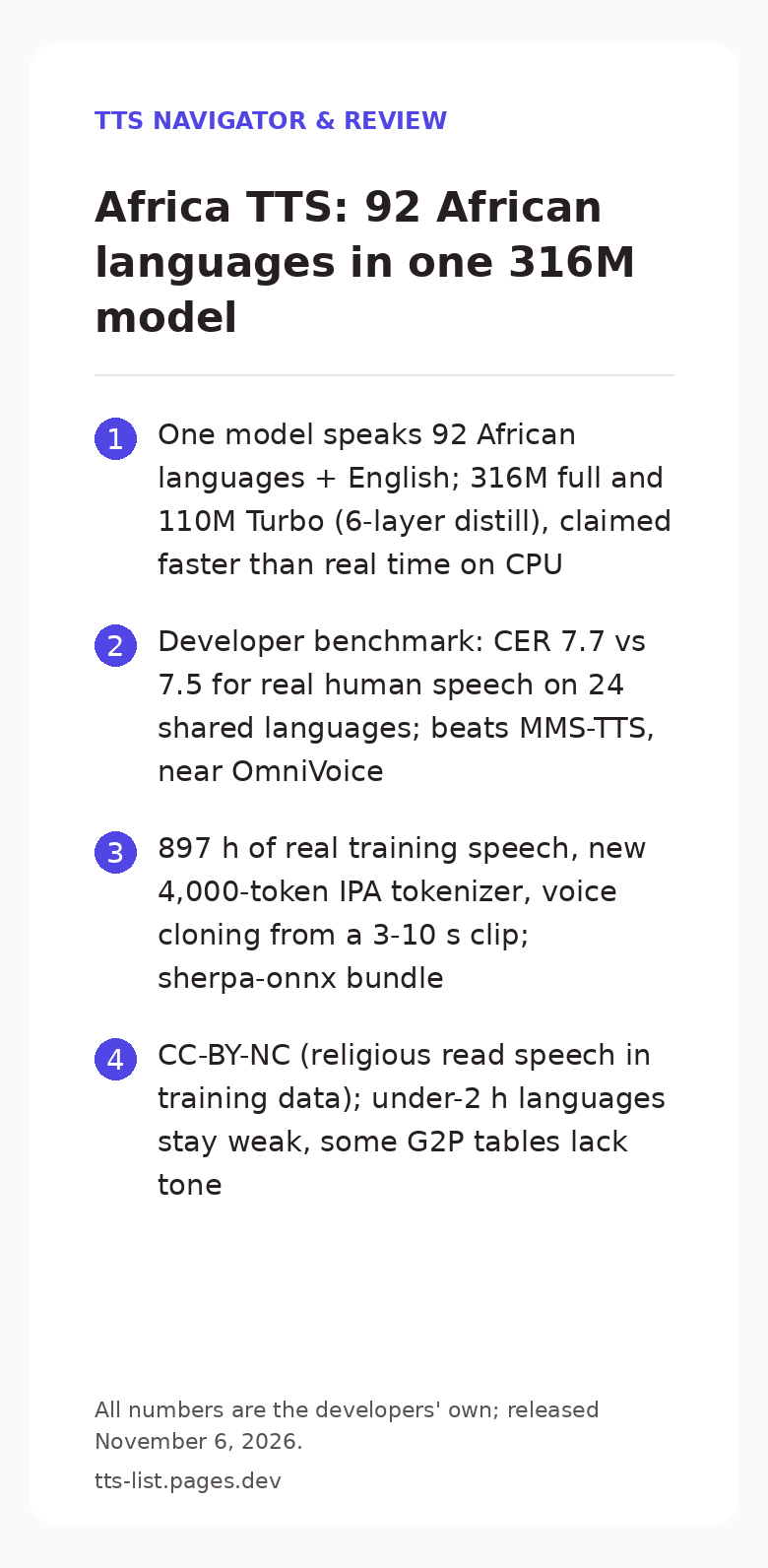
Most of the world's TTS coverage maps onto a small set of high-resource languages. Africa TTS, released November 6 by AfriSpeech / Ghana NLP, goes the other way: a single text-to-speech model covering 92 African languages plus English, from Swahili (27.0 h of training speech) down to Luvale (2 minutes). It ships in two sizes - a 24-layer, 316M-parameter model and Africa TTS Turbo, a 6-layer 110M distilled version the team says runs faster than real time on a CPU - plus a sherpa-onnx bundle for servers and devices. Voice cloning from a 3-10 second clip is built in.
Built on Pocket TTS, re-tokenized for IPA
The base is Kyutai's Pocket TTS FlowLM, fine-tuned from the English checkpoint with a new 4,000-token IPA tokenizer. Text is converted to IPA by the team's own africa-g2p (English falls back to espeak-ng), so pronunciation rules live outside the neural model. Training data is 897 hours of real speech: JW recordings, the team's africa-female-speech-v2 dataset, Ghanaian English and HiFiTTS-2. The full model runs in two modes - guided (classifier-free guidance 2.0, the package default) and unguided - while Turbo is a depth-wise distillation (Kyutai's depth_distill recipe, 200k steps) from the guided 24-layer teacher.
The benchmark is unusual: it includes the ASR's own error
The headline evaluation is intelligibility measured as character error rate (CER): each system reads the same held-out sentences (drawn from the Omnilingual ASR corpus, FLEURS, WAXAL and FLORES+, none of it in training), and a 7B Omnilingual ASR model transcribes the output. The clever part is the reference row - the same ASR transcribes human recordings of the same sentences, so you can see how much of the "error" is the judge's own.
Developer-reported averages (lower is better):
- 24 languages with human references: real speech 7.5, Africa TTS guided 7.7, Turbo 7.7, unguided 8.9 - the synthetic voices land essentially on the human bar.
- 27 languages shared with MMS-TTS: Africa TTS guided 8.7, Turbo 9.0, MMS-TTS 10.3.
- 29 languages shared with OmniVoice (813M): OmniVoice 8.4 edges out Africa TTS at 8.8.
- 11 languages shared with Sunbird Orpheus (3.3B): Africa TTS guided 5.6 versus Orpheus 10.3 - a 30x smaller model far ahead on this slice.
Per-language results span 47 languages and swing widely: Swahili is excellent everywhere (real speech 1.8, Africa TTS 1.2, OmniVoice 0.6), while Kpelle is hard for everyone (real speech 21.1, best synthetic 26.0). Languages with under roughly two hours of training data are visibly weaker - the team says so itself.
Limits and license
The cards are candid: most training audio is read religious speech, so other registers sound less natural; some G2P tables do not mark tone, which matters for tonal languages; and both models are CC-BY-NC-4.0 (non-commercial), following the JW recordings in the training data. The team also asks users not to use the cloning feature for impersonation.
Our analysis
Two things make this release stand out beyond the language count. First, the evaluation design: publishing the ASR's error rate on human speech alongside synthetic results is the kind of reference framing most TTS benchmarks skip, and it makes the "matches real speech" claim checkable rather than marketing. Second, the honest data map: the per-language training-hours table (0.0-322.6 h) predicts the per-language CER table almost line by line, which is a useful public lesson in what drives low-resource TTS quality - hours, not architecture. The NC license, inherited from the training data, blocks commercial use; for research, accessibility tools and community deployments in the 92 covered languages, this is currently the most credible open starting point we have seen.
Sources
- AfriSpeech/africa-tts model card (read in full, November 7, 2026)
- AfriSpeech/africa-tts-turbo model card (read in full, November 7, 2026)
- AfriSpeech/africa-tts on GitHub (code, benchmark scripts, data recipe)