LFM3-Audio-2B: Liquid AI packs voice chat, ASR, TTS and tool calling into one 2B on-device model
Published November 1, 2026 · Built from Liquid AI's LFM3 launch post and the Hugging Face model card, both read in full on November 1, 2026. All benchmark tables are the vendor's own; we did not run the model.
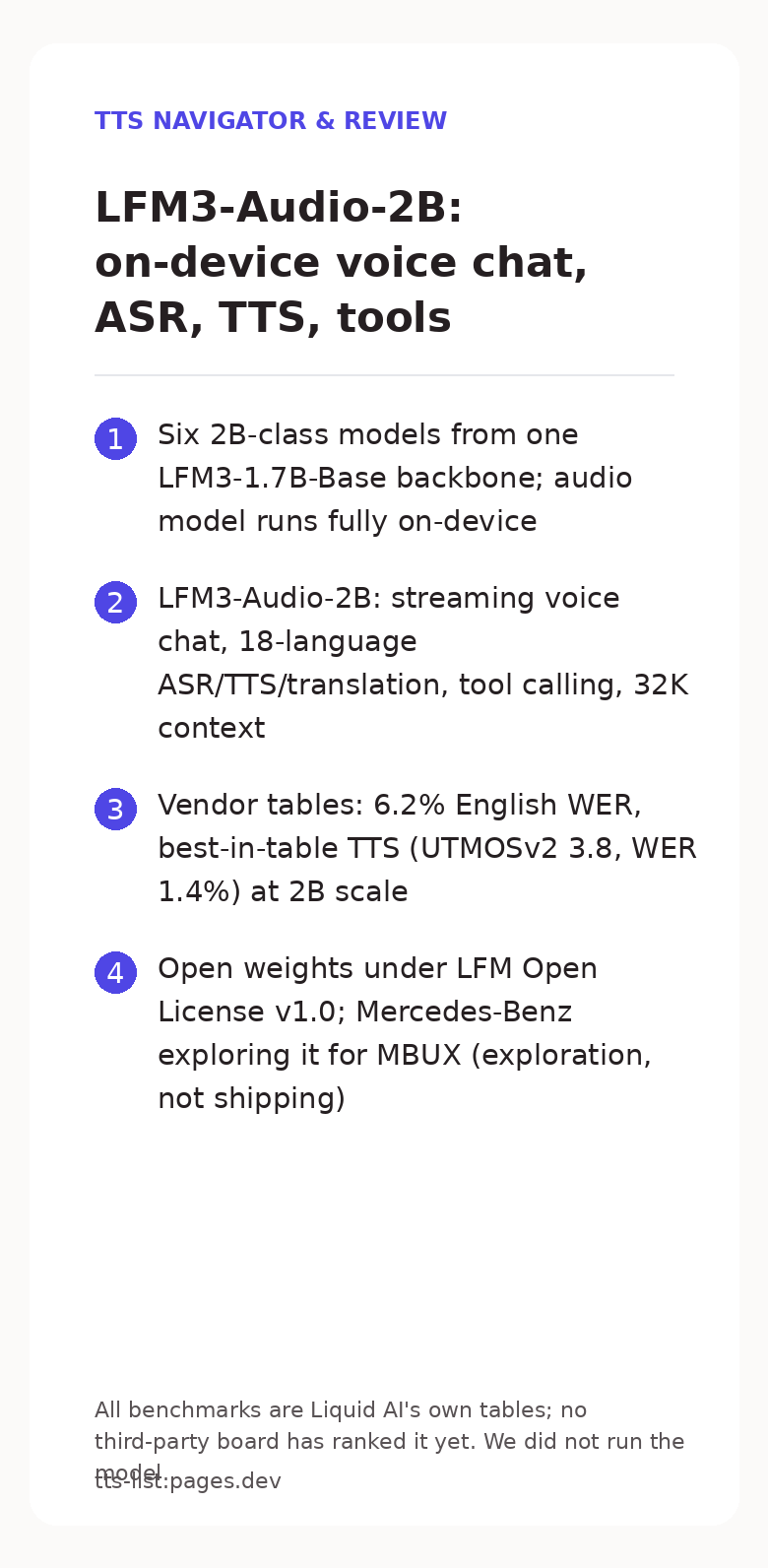
Liquid AI has launched LFM3, a family of six ~2B-parameter models - text, vision, audio, omni, and two decision specialists - all branched from a single LFM3-1.7B-Base backbone, with open weights under the LFM Open License v1.0. The one that matters for this site is LFM3-Audio-2B: a compact audio model that takes text or audio in, replies with text, speech, or both, and is meant to run locally on laptops and edge devices - no cloud round-trip.
What the audio model does
- Streaming voice chat: ask aloud, get streaming replies in text and speech; a text-only mode can reason before answering.
- 18 languages for transcription, synthesis and translation - up from LFM2.5-Audio, with a new in-house audio encoder and codec (previous Liquid audio models leaned on external encoders).
- Audio understanding + tool calling: answer questions about recordings (speech, sounds, events), and turn spoken requests into structured tool calls - the on-device voice-agent pattern, with the model small enough to sit next to the app it controls. 32K-token context.
The vendor's tables - labeled as such
- ASR: English WER 6.2%, competitive within its size class in Liquid's table (Kimi-Audio-7B 5.3, Voxtral Mini 3B 5.5, NVIDIA Audex 2B 6.0, Qwen2.5-Omni-3B 6.3, Gemma 4 E4B 7.8) - note the two models beating it are 5-8× its size, and the table is Liquid's own selection and runs.
- Multilingual ASR: 6.0% average across nine languages - the best average among entries that report one.
- English TTS: UTMOSv2 3.8 (vs 3.2 for its LFM2.5 predecessor and 3.4 for Qwen2.5-Omni) and synthesis WER 1.4%, the best in its table. VoiceBench tool-calling and audio-understanding rows are also claimed strong - same vendor-table caveat.
The ecosystem signal
The launch quote comes from Mercedes-Benz's CTO: the companies are "exploring" LFM-class on-device models for the MBUX Virtual Assistant on MB.OS - explicitly for "fast, private and cloud-independent" in-car voice. That is an exploration statement, not a shipping announcement, but it marks where 2B-class audio models are being pulled: cars, wearables, and devices where a cloud call is a product failure. Liquid also notes Ambarella silicon support (LFM2.5-VL today, LFM3 enablement begun).
What to check before adopting
- License terms: "LFM Open License v1.0" is Liquid's own license, not OSI-standard Apache/MIT - read its commercial-use terms for your scale before shipping.
- 18-language coverage is uneven by design; the multilingual number is a nine-language average - per-language quality will vary, and the vendor table leaves some cells blank for competitors.
- All numbers are Liquid's own runs; no third-party board has ranked LFM3-Audio yet.
Why it matters
- The on-device voice stack just consolidated. ASR + TTS + reasoning + tool calls used to mean three or four components on-device; a single 2B checkpoint doing all of them changes the BOM for edge voice products.
- Contrast with this week's cloud S2S launches (Phonic-1, Rime Prism, Cartesia Managed Agents): the frontier is splitting into "rent a frontier voice agent" vs "own a small one that fits on the device" - and both sides shipped within days.
Sources (read in full; links verified November 1, 2026)
- Introducing LFM3: Every Modality for Specialized Intelligence - Liquid AI (October 27, 2026) - primary: family architecture, audio capabilities, all benchmark tables, Mercedes-Benz quote.
- LiquidAI/LFM3-Audio-2B - Hugging Face model card - license (LFM Open License v1.0), context length, usage details.