Ming-3.0-TTS: inclusionAI's MIT-licensed 0.5B multilingual TTS - and a model card that lists its own weaknesses
Published October 29, 2026 · Built from the inclusionAI/Ming-3.0-tts-0.5B Hugging Face card and the project README, read in full on October 29, 2026. Benchmark tables are the project's own ASR-based evaluations; leaderboard ranks are Artificial Analysis's, both cited as such. We did not run the model.
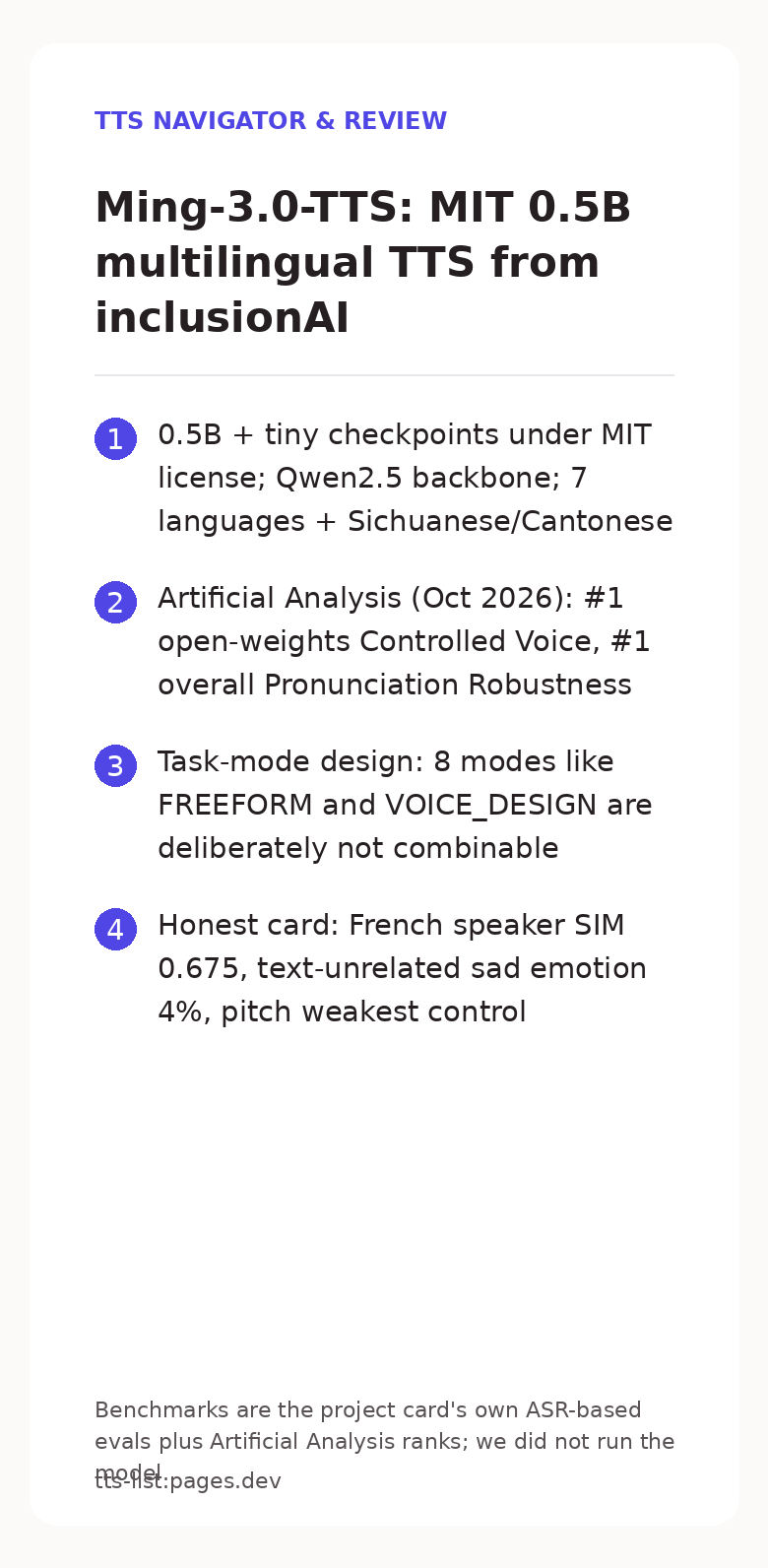
inclusionAI - Ant Group's open-source arm - has released Ming-3.0-TTS: a dense 0.5B-parameter speech synthesis model plus a tiny variant, with code and checkpoints under the MIT license (no noncommercial rider, unlike two releases we covered this week). The GitHub repo was created October 19 and the release carries October's Artificial Analysis ranks: #1 among open-weights models on Controlled Voice, #1 overall on Pronunciation Robustness, and #3 open-weights on Provider Voice - with the project's own caveat that "ranks change as new models are added."
What shipped
- Two checkpoints. Ming-3.0-tts-0.5b (Qwen2.5-0.5B backbone + DiT head + audio tokenizer + speaker encoder) and Ming-3.0-tts-tiny. 44.1 kHz output. The HF repos are checkpoint distribution only - inference runs through the GitHub repo's CLI (
infer.py) or Python API (ming_tts.MingTTS). - Seven languages plus dialects. Chinese, English, German, Spanish, French, Korean, Japanese - plus Sichuanese and Cantonese as first-class dialect modes, where its evaluation is strongest relative to the field.
- Eight task modes, deliberately not composable. TTS, FREEFORM, VOICE_DESIGN, MULTILINGUAL, BASIC, EMOTION, DIALECT and IP are separate modes: FREEFORM (natural-language delivery instructions) cannot be combined with voice design, built-in voices, emotion, dialect or attribute controls. An unusual choice - most cards imply everything stacks - and stated plainly.
- Controls. Zero-shot cloning from a short reference; voice design from a text description; 14 inline paralinguistic tags (breath, cough, sigh, laughter, hesitation, surprise, question/confirmation) in Chinese or English; explicit emotion, speed, pitch and volume control.
The card's own benchmarks - strong dialects, stated gaps
- Zero-shot (Seed-TTS eval): zh WER 0.80% / en WER 1.584% for the 0.5b - behind CosyVoice3-1.5B (0.71% / 1.45%) and the Qwen3-TTS rows, competitive for its size; the tiny model's zh SIM (0.781) actually beats the 0.5b (0.758).
- Dialect control is the standout: on WSC-Eval-TTS, 2.27% CER (easy) and 3.35% (hard) vs CosyVoice3-0.5B's 3.17% / 4.07%; on WSYue (Cantonese), 98.0% accent accuracy on the Base split.
- Attribute control: 93.3% average across speed/volume/pitch with WER 0.317% - pitch is the weakest axis (86%), which the limitations section also calls out.
- Emotion has a hard ceiling, and the card says so: 72.33% average on CV3, but on CV3N (hard emotion control) just 37.33% - and when the words carry no emotional signal, text-unrelated sad lands at 4%. That mirrors yesterday's persona-line conflict paper: when text and instruction disagree, the interface loses.
- Stated limitations: speaker similarity trails content accuracy (French SIM 0.675 is the clearest multilingual gap); NVBench multi-event paralinguistics trail single-event; open-ended voice design (72.29%) does not match Qwen3-TTS (77.13%).
Deployment notes
- Tested on NVIDIA H800/H20 with CUDA 12.4; flash-attn optional.
- The tiny checkpoint needs a separate pinned environment (Python 3.10.15, PyTorch/torchaudio 2.7.1+cu118, transformers 4.46.3) - different dependency versions from the 0.5b, so budget an extra venv.
- A usage disclaimer asks for consent before cloning a real person and for labeling synthetic speech - no technical watermark is mentioned.
- No human listening study on the card; the tables are ASR-based WER/CER plus embedding similarity and task-accuracy metrics, evaluated "using each model's recommended inference settings under a unified ASR-based protocol."
Why it matters
- MIT end to end. After OmniVoice (code Apache-2.0, weights CC-BY-NC) and Lure (all Apache-2.0), Ming-3.0-TTS joins the fully-permissive column at 0.5B - small enough to fine-tune, dialect-capable, and commercially usable out of the box.
- Dialect support as a first-class mode - Sichuanese and Cantonese with dedicated evals - is still rare in open releases and directly useful for Chinese-market voice products.
- The card as a honesty sample. Non-composable modes, a limitations section with numbers, a "ranks change" caveat on its own leaderboard claims. This is the pattern we keep rewarding on this site.
Sources (read in full; links verified October 29, 2026)
- inclusionAI/Ming-3.0-tts-0.5B - Hugging Face model card - model details, task modes, benchmark tables, limitations, license.
- inclusionAI/Ming-3.0-tts - GitHub README - release note ([2026.10]), Artificial Analysis ranks, inference setup, MIT license statement.