Character-level prosody control for Mandarin TTS: JD.com's Unicode-marker approach on a frozen CosyVoice2, read in full
Published October 25, 2026 · Built from the paper arXiv:2610.29123, read in full on October 25, 2026 - method, experiments, and limitations included. All results are the authors' own; we did not run their code or models. Our judgments are marked as such.
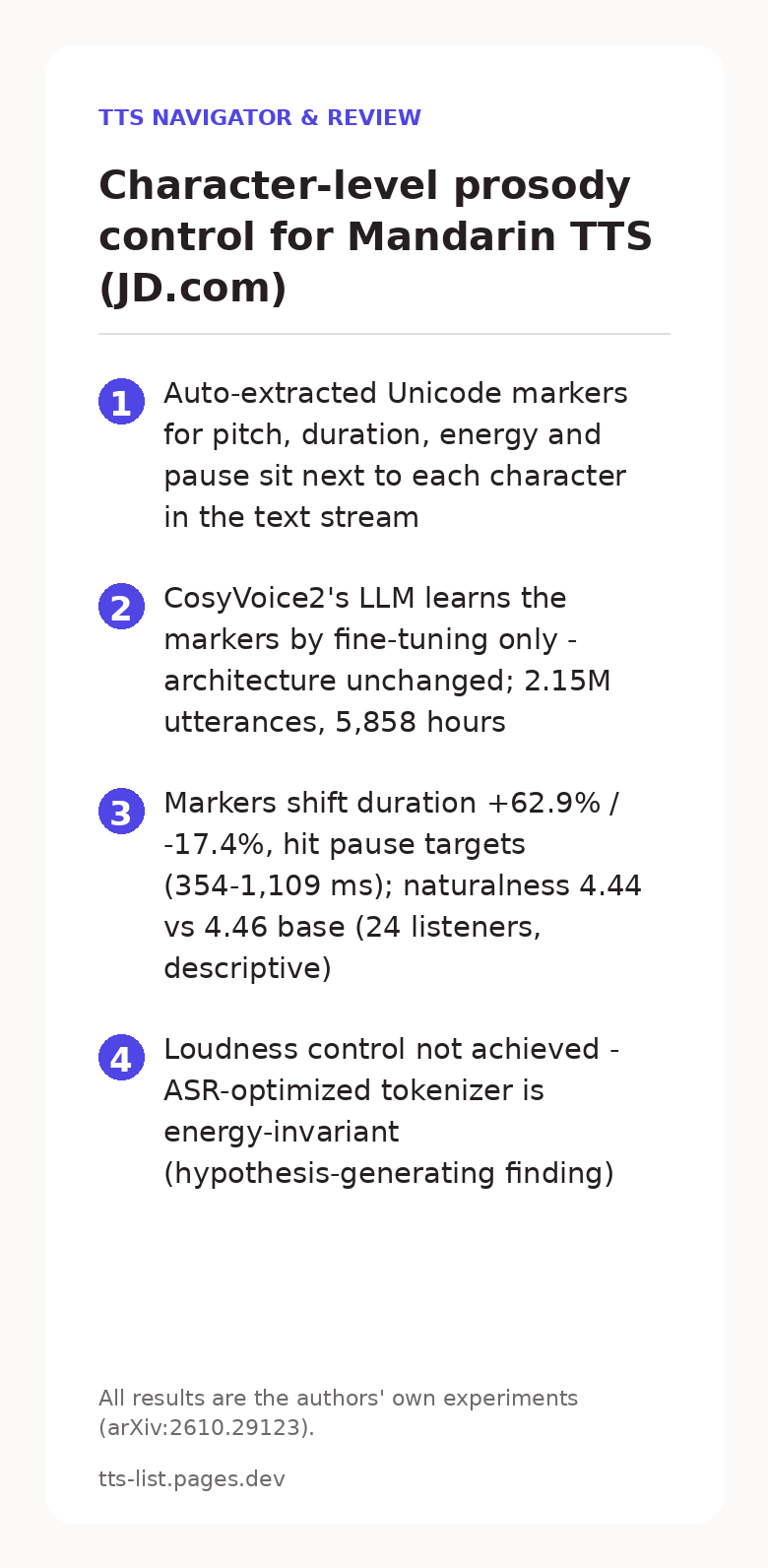
If you produce Chinese dubbing, audiobooks, or game dialogue with LLM-based TTS, you have hit the same wall: you can ask for a style ("speak sadly"), but you cannot say which character should rise in pitch, hold longer, or be followed by a beat of silence. A new paper from JD.com (arXiv:2610.29123, October 21, 2026) attacks exactly that gap for Mandarin: automatically extracted prosody markers, inserted into the text as out-of-vocabulary Unicode symbols, that an existing TTS model learns to obey through fine-tuning alone - with no change to the model's architecture. This is a full read of the paper; every result below is the authors' own experiment, not ours.
The problem with today's controls
The paper splits existing control into two camps, each with a real limitation. Utterance-level control - natural-language style prompts (PromptTTS2, InstructTTS) or reference-audio style transfer (Seed-TTS, NaturalSpeech 2/3) - sets a global mood but cannot place a pitch rise on a specific syllable or a pause at an exact point. Fine-grained markup - SSML, ToBI, learned word/phoneme tags - offers local precision but typically needs expert annotation, language-specific rules, or changes to the acoustic model, none of which drops cleanly into a pretrained LLM-based TTS.
The approach: Unicode markers through the text stream
The framework has two parts. First, an automatic extraction pipeline turns raw audio-text pairs into prosodically marked text. Second, the LLM inside an existing TTS system - instantiated here on CosyVoice2, chosen for its fully open-source stack - is fine-tuned to render those markers as acoustic variation. The base architecture (tokenizer, LLM, decoder) is left intact; only the input distribution changes.
- Alignment. Two forced aligners are ensembled - MFA for acoustic precision, WhisperX for robustness on spontaneous speech. Samples where the two disagree by more than 150 ms are discarded; the rest are fused by confidence-weighted averaging.
- Four marker types. Pitch (rising U+2197, falling U+2198), energy (stressed U+2191, weak U+2193), duration (lengthened U+2192, shortened U+2190), and inter-phrase pause in four levels (U+201A short, U+2025 moderate, U+2026 long, U+3002 very long). Pitch labels require a clean level shift against the phrase mean with limited intra-character movement; duration thresholds come from corpus percentiles (95th percentile at 430 ms, lowest 5% band at 30-50 ms).
- Global speaking rate. A five-level prompt (very slow to very fast, from corpus percentiles) precedes the text, separated by a special token.
- Pitch tracking. RMVPE, chosen over PYIN and CREPE for its accuracy-cost trade-off.
Markers sit directly beside the character they modify (prefixes for pitch and energy, suffixes for duration and pause), so the lexical text is untouched and the prosodic instruction is human-readable. An optional front-end can translate free-form instructions into marker sequences: a multimodal LLM (Qwen3-Omni) generates training triplets by "inverse prosody captioning," and a Qwen3-8B is LoRA-tuned on about 210,000 of them (TV dramas 60.75%, lectures 34.97%, live streaming 4.29%). On the held-out test set this front-end reduces normalized edit distance to reference markup from 7.91 (zero-shot) to 4.61 - an improvement the authors describe as a usability layer only, with end-to-end instruction-to-speech evaluation left to future work.
Scale and training
The corpus is the Mandarin subset of VoxBox: utterances of 3-25 seconds and at most 60 characters, filtered to those carrying at least one marker - 2,150,447 utterances, 5,858 hours, re-split 9:1 with speakers disjoint between train and validation. The TTS-LLM was fine-tuned on 8 NVIDIA B200 GPUs for 20 epochs, and the three lowest-validation-loss checkpoints were weight-averaged before evaluation.
Controllability results (authors' measurements)
| Control | Base CosyVoice2 | Marker-conditioned | Change |
|---|---|---|---|
| Lengthen target character | 240 ms | 391 ms | +62.9% |
| Shorten target character | 144 ms | 119 ms | -17.4% |
| Rising pitch marker (F0 shift) | +6 Hz | +11 Hz | +83.3% |
| Falling pitch marker (F0 shift) | -8 Hz | -12 Hz | +50.0% in magnitude |
Duration and pitch were measured on 11 hand-composed sentences covering all marker types across 12 speaker identities, scored with the same extraction stack used at training time. The authors flag that reusing the training extractor could hide systematic extraction errors but argue the bias hits both conditions equally, so the relative shifts remain meaningful; absolute calibration against human annotation is future work. Note also the design choice: lengthen/shorten markers were applied to characters already relatively long or short at baseline, so the numbers measure the additional shift the marker induces, not an absolute duration target.
Pause markers land inside their training ranges: measured means of 354, 525, 824, and 1,109 ms against target ranges of 300-500, 500-800, 800-1,000, and 1,000-1,500 ms (2,000 samples per marker, inserted at sentence-medial punctuation). The five global rate prompts produce well-separated, correctly ordered group means across speakers - reported, the authors are careful to say, as group means only, not as proof of non-overlapping distributions.
One control is conspicuously absent: loudness. The authors do not report energy-control results because their tokenizer analysis (below) showed the backbone's ASR-optimized tokens are largely invariant to energy perturbations, and the measured effects were marginal.
Perceptual quality: preserved, within a small descriptive study
Twenty-four self-reported native-Mandarin listeners rated 12 stimuli per system on three 5-point scales. The marker-conditioned model tracks the base model closely: naturalness 4.44 vs 4.46, realism 4.15 vs 4.10, speaker similarity 4.00 vs 3.95. The authors themselves emphasize this is a descriptive comparison - the study was not powered for inferential testing, used no MOS anchors, and they cite recent methodology work recommending AB/CMOS protocols for differences this small. Read the result as "no obvious quality cost," not "proven equivalent."
The tokenizer observation - hypothesis, not verdict
The cross-tokenizer analysis perturbs 1,000 audio samples (volume, F0, noise) and measures normalized edit distance between original and perturbed token sequences for four tokenizers. CosyVoice2's ASR-optimized tokenizer is the least sensitive overall and especially insensitive to energy changes; reconstruction-oriented TaDiCodec nearly rewrites its token sequence under strong perturbations; DualCodec sits between. The authors are explicit about the limit: with only one ASR-optimized tokenizer in the comparison and a graded rather than categorical pattern, this is hypothesis-generating evidence - consistent with a trade-off in which ASR objectives favor linguistic content over prosodic detail, but not proof of it. It does not contradict their controllability results (markers enter through the text stream and the fine-tuned LLM learns to realize them anyway), but it suggests reconstruction-oriented tokenizers may offer more headroom for marker-based control.
Limitations the authors state
- Mandarin only, one backbone (CosyVoice2). Character-level alignment does not transfer directly to non-tonal or agglutinative languages; other tokenizers and architectures are untested.
- Marker thresholds are fixed corpus constants; extraction quality depends on forced-alignment accuracy and may degrade on spontaneous or atypical speech.
- The perceptual study is descriptive (24 listeners, no inferential testing); controllability is reported as condition means; marker quality was not compared against human annotation; the instruction front-end is evaluated only at the text level, not end-to-end.
- Strong marker combinations can trade small amounts of neutral naturalness for expressive realism; quantifying that trade-off is planned work.
Our read (judgment, not from the paper)
- If you build Chinese voice content, this is the missing layer. Dubbing and audiobook tools today offer global style knobs; character-level placement is what editors actually ask for. The architecture-preserving angle matters: fine-tuning only the LLM of an open TTS stack is within reach of a small team.
- The honest weakness is the front-end. Hand-placing Unicode markers is precise but tedious, and the natural-language front-end's NED of 4.61 (per reference length) is still far from reliable. Treat "describe the prosody you want in words" as a roadmap item, not a shipped feature.
- Watch the tokenizer thread. If the hypothesis holds - ASR-optimized tokenizers systematically wash out prosody - it has implications beyond this paper, for any prosody-sensitive work built on ASR-derived codecs.
Sources (paper read in full October 25, 2026)
- An, Ma, Wang, Su, Tian (JD.com) - "Character-Level Prosody Control for Mandarin Speech Synthesis: An Architecture-Preserving Approach," arXiv:2610.29123v1, October 21, 2026 - all methods, numbers, and limitations above. The authors note that split seeds and file lists will be released upon publication; we did not run their code or models.