M5-TTS: a 50M-LM multilingual TTS that puts RL feedback on individual frames
November 11, 2026 - by TTS Navi. We read the full paper; all results below are the authors' own experiments, not ours.
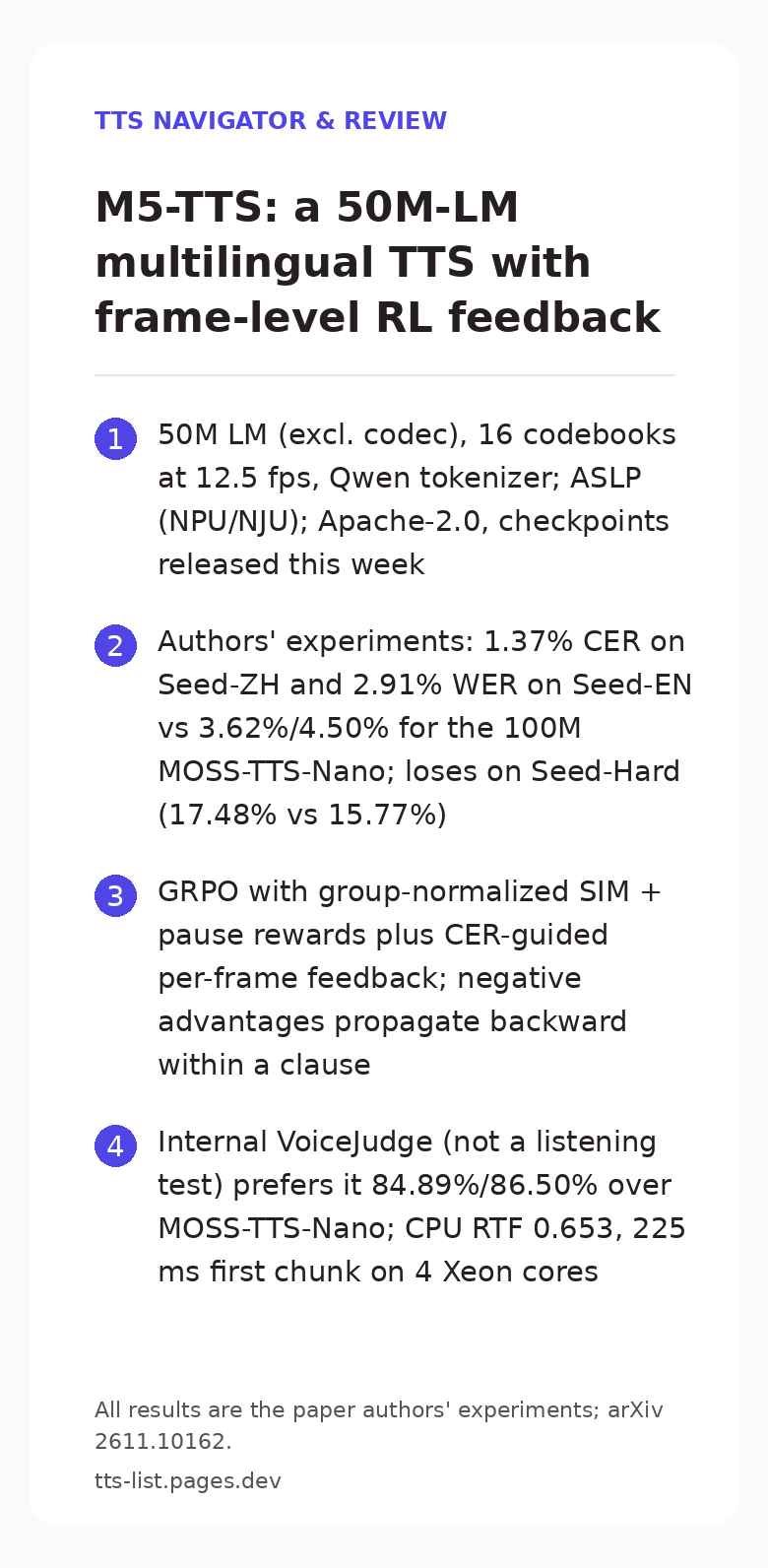
ASLP (the Audio, Speech and Language Processing groups at NPU and NJU, with industry collaborators) has released M5-TTS: a mini-scale multilingual and multi-dialect TTS language model whose language model is just 50 million parameters, excluding the speech codec. The arXiv paper (2611.10162) describes the system, and the Hugging Face rollout has been arriving in pieces this week - the base model on November 2, voice-cloning and custom-voice checkpoints plus the audio tokenizer on November 9-10, and an ONNX build on November 11. Apache-2.0. It supports Chinese, English, German, French, Japanese and Korean, plus Cantonese and Sichuanese, with zero-shot voice cloning, speaker-specific voices, and CPU streaming.
Architecture and the GRPO recipe
The model adopts the Qwen-TTS-Tokenizer-12Hz (16 codebooks at 12.5 frames per second), a temporal backbone that predicts the first codebook of each frame, and a local multi-token-prediction module that fills in codebooks 1-15 within the frame. Pre-training covered roughly 400,000 hours (Emilia, Emilia-YODAS, about 160,000 in-house hours, and the WenetSpeech collections), followed by continued pre-training on a curated 65,000-hour subset. The interesting part is post-training: GRPO with two feedback paths. A global path scores speaker similarity and pause placement, each normalized separately within the candidate group before weighting (1.0 and 0.5). A local path aligns each candidate's ASR transcript to the target text, converts character edit counts into group-relative advantages, propagates only negative advantages backward within a clause with exponential decay, and projects them onto codec frames - so a mispronounced word penalizes the frames that produced it, not just the utterance as a whole.
The authors' numbers
Against MOSS-TTS-Nano (a 100M LM), the authors' GRPO variant reports 1.37% CER on Seed-ZH and 2.91% WER on Seed-EN, versus 3.62% and 4.50% - relative error reductions of 62.2% and 35.3% with half the language-model parameters, with speaker similarity slightly higher (0.65/0.53 vs 0.64/0.50). The comparison flips on Seed-Hard, where MOSS-TTS-Nano keeps the lead (15.77% vs 17.48% CER), and the 170M Audio8-TTS Preview beats M5-TTS on the standard sets while losing on Seed-Hard. On the MiniMax multilingual set, M5-TTS reports lower content error in five of six languages (the largest: Japanese CER 40.22% to 9.70%), with Chinese the exception (2.05% vs 1.80%). Dialects are mixed: lowest Cantonese MER among compared systems on both Easy and Hard (8.55%/8.70%) but lower speaker similarity than both baselines; better Sichuanese Hard CER, worse Easy. GRPO versus CPT alone cuts error on all three Seed subsets (relative 19.4%, 19.2%, 16.4%) - though the paper notes this evaluates the whole recipe and does not isolate the pause reward from the CER feedback. Naturalness is assessed by VoiceJudge, the authors' own internal reward model trained on about 100,000 human preference pairs: on 311 deduplicated pairs it prefers M5-TTS over MOSS-TTS-Nano in 84.89% and 86.50% of judgments under the two A/B orders, with 92.60% order consistency. That is an internal judge, not a listening test - the paper says weights are planned for release. Efficiency: on four Intel Xeon Gold 6530 cores, RTF 0.653 (about 1.53 seconds of audio per second of compute) and 225 ms warm first-chunk latency, excluding model loading; the paper is careful to say this does not establish mobile or ARM performance.
Limits, as stated
The 16-codebook design burdens the local decoder and limits CPU efficiency; output is 24 kHz only; highly expressive synthesis can produce voice breaks and hoarse or muted segments; Seed-Hard pronunciation robustness "is still insufficient." Planned: 8-codebook inference, 48 kHz output, emotion and paralinguistic control. The open release covers inference code and the voice-cloning and speaker-specific checkpoints - training and GRPO code are explicitly not included.
Our analysis
M5-TTS is the most complete small-TTS package to appear this month, and the reason to read it is the local process feedback: converting ASR edit positions into per-frame advantages is a concrete, reproducible answer to "RL improves the average but I can't tell where it helped." The evaluation is also unusually well-fenced - the authors show where they lose (Seed-Hard, Chinese MiniMax, dialect similarity), label their naturalness evidence as an internal judge, and scope their CPU numbers to one server configuration. The caveat to hold onto is that the headline 62.2% is against a single 100M baseline chosen by the authors; against the 170M Audio8-TTS the same table shows M5-TTS behind on the standard sets. For on-device multilingual work, though, a 50M Apache-2.0 model with streaming CPU inference, dialect support, and checkpoints already on Hugging Face is immediately usable - and the paper's honesty about where it loses makes the wins easier to trust.
Sources
- M5-TTS paper (arXiv 2611.10162) (read in full, November 11, 2026)
- Hugging Face: ASLP-lab/M5-TTS (Apache-2.0) and the week's checkpoint releases: VoiceClone, CustomVoice, Audio-Tokenizer, ONNX
- GitHub: ASLP-lab/M5-TTS; demo page; HF Space