Laghu TTS: a 7M Hindi voice that speaks its first chunk in 26 ms on a CPU
November 8, 2026 - by TTS Navi. We read the full model card and its evaluation protocol; all measurements below are the developer's (Abhay J Kashyap), not ours.
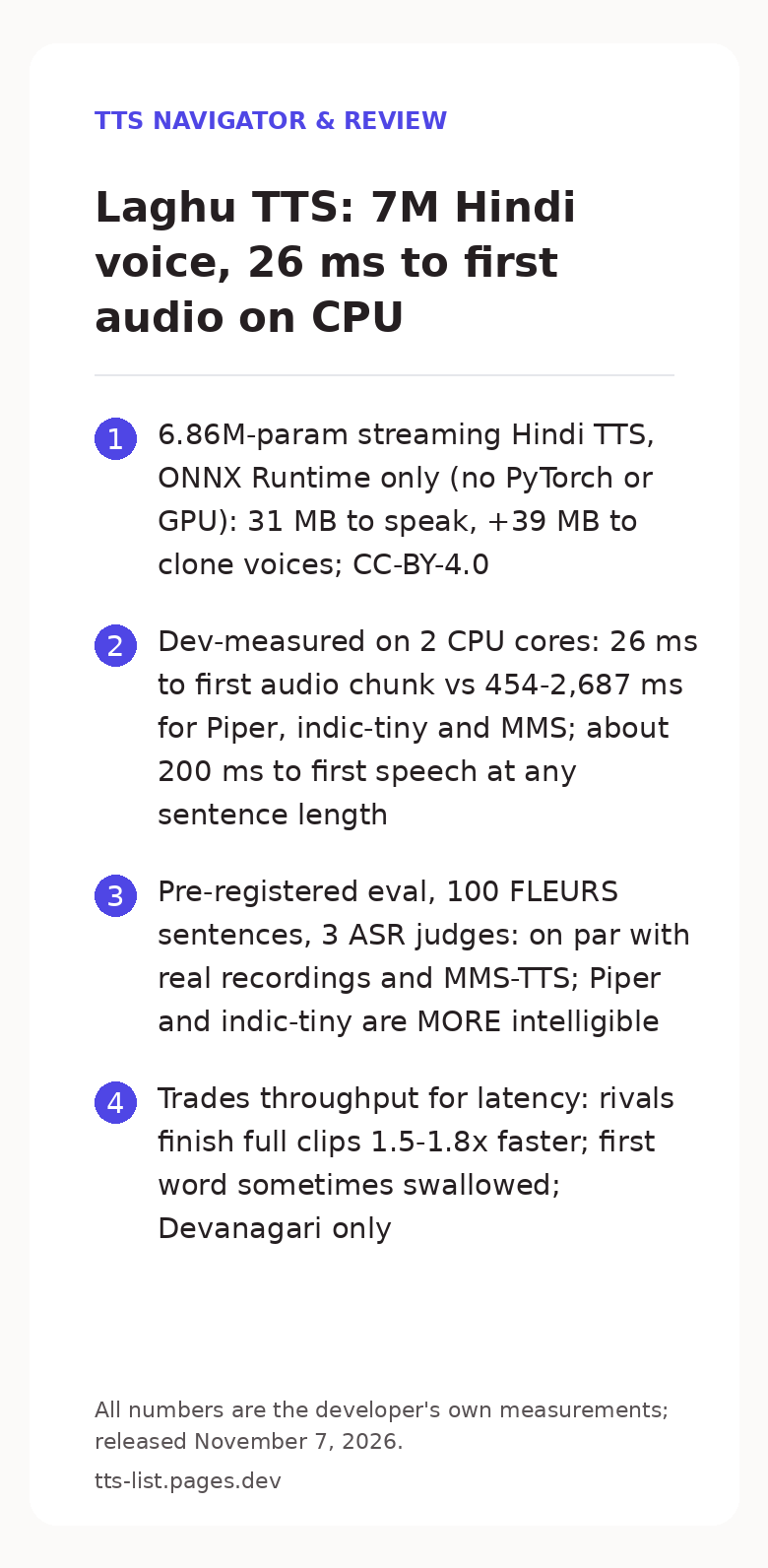
Most small TTS releases ask you to trust a demo clip. Laghu (लघु, "small"), a Hindi text-to-speech model released on Hugging Face on November 7, goes the other way: a pre-registered evaluation protocol, three independent speech recognisers as judges, bootstrap confidence intervals on every comparison, and a limitations section that names the models that beat it. The model itself is a 6.86-million-parameter streaming Hindi voice that runs on ONNX Runtime alone - no PyTorch, no GPU - in about 31 MB of files, with voice cloning from a few seconds of audio. It is a fine-tune of Kyutai's English Pocket TTS 7M with a new Devanagari tokenizer, trained on roughly 114 hours of Hindi speech from AI4Bharat's Rasa and IndicVoices-R datasets. License: CC-BY-4.0, code MIT.
What the developer measured
The protocol was written down before any audio was generated, with amendments numbered and dated. One hundred FLEURS Hindi test sentences, fixed seed, every system given the same pre-normalised text, each clip transcribed by three Hindi ASR models (AI4Bharat's IndicConformer-600M and IndicWav2Vec, plus a Vakyansh wav2vec2). On intelligibility: Laghu scores 5.3-9.0% character error rate depending on the recogniser, statistically indistinguishable from real crowd-sourced FLEURS recordings and from Meta's MMS-TTS Hindi ("no clear difference" under the protocol's all-three-recognisers rule). Two other small models, Piper Hindi and indic-tiny-tts-hindi, are more intelligible - a third to a half of Laghu's error rate - and the card says so in its own table. No listening study was done; these numbers measure whether a recogniser understands the speech, not whether it sounds pleasant.
Where it wins: time to first sound
On two pinned CPU cores (one Kaggle session, systems run one at a time), Laghu's median time to the first audio chunk is 26 ms, against 454 ms for Piper, 503 ms for indic-tiny and 2,687 ms for MMS-TTS. First audible speech lands at about 200 ms (each clip opens with a short silence) and stays near 195 ms whatever the sentence length, because Laghu streams frame by frame while the others return whole sentences. The honest trade-off, also in the card: Laghu is not the fastest overall - Piper and indic-tiny finish a full clip 1.5-1.8x quicker, because Laghu's classifier-free guidance runs its transformer twice per frame. It is first to speak; it is not first to finish.
Under the hood
A small causal transformer turns text into continuous audio latents at 12.5 per second, a flow head samples each latent, and Kyutai's Mimi decoder renders 24 kHz audio. Speaking uses 3.97M transformer/flow parameters fine-tuned from Kyutai's English weights, a 0.27M rank-64 Devanagari embedding, and the unchanged 2.62M Mimi decoder; cloning adds the 39 MB Mimi encoder, also unchanged. The ONNX export was verified graph by graph against the PyTorch reference (max difference 7x10^-6). A final whole-sentence fine-tuning stage raised first-word accuracy from 69.2% to 80.0% on one recogniser - and the card flags that this gain came with added training steps, not proven to come from the stage alone.
Limitations, as stated
Devanagari Hindi only - Latin-script words are spoken unreliably and trigger a warning. The first word is sometimes wrong or swallowed (recognisers got it right in 61-77% of clips, versus 71-87% for Piper and indic-tiny). Long unpunctuated runs can drop words. Two built-in calm reading voices from one dataset; cloned voices are only as good as the recording. One training run, 100 test sentences, no human listening test.
Our analysis
Laghu's model is a competent fine-tune; its release is a template. A pre-registered protocol with named amendments, declared biases in its own favour (the frontend every competitor's text passed through was Laghu's own; one judge shares a builder with part of its training data), and a table row that says "more intelligible than Laghu" for two rivals - this is what "evaluated" should mean for small community models, and it is rare enough to be the story. The engineering bet is also well aimed: for IVR-style and assistive Hindi applications, speaking 200 ms after the request matters more than finishing the sentence fastest, and 31 MB with an ONNX-only runtime fits exactly the cheap-CPU niche those applications live in. If you need maximum intelligibility today, the card itself points you to Piper.
Sources
- Hugging Face model card: Abhay2310/laghu-tts-7m-hindi (read in full, November 8, 2026)
- Kyutai Pocket TTS (base model and architecture)
- Training data: AI4Bharat Rasa and IndicVoices-R (both CC-BY-4.0); evaluation sentences from Google FLEURS