Kolokwa TTS: a 110M pocket model gives Liberian English a synthetic voice
November 10, 2026 - by TTS Navi. We read the full model card; all measurements below are the developers' (AfriSpeech), not ours.
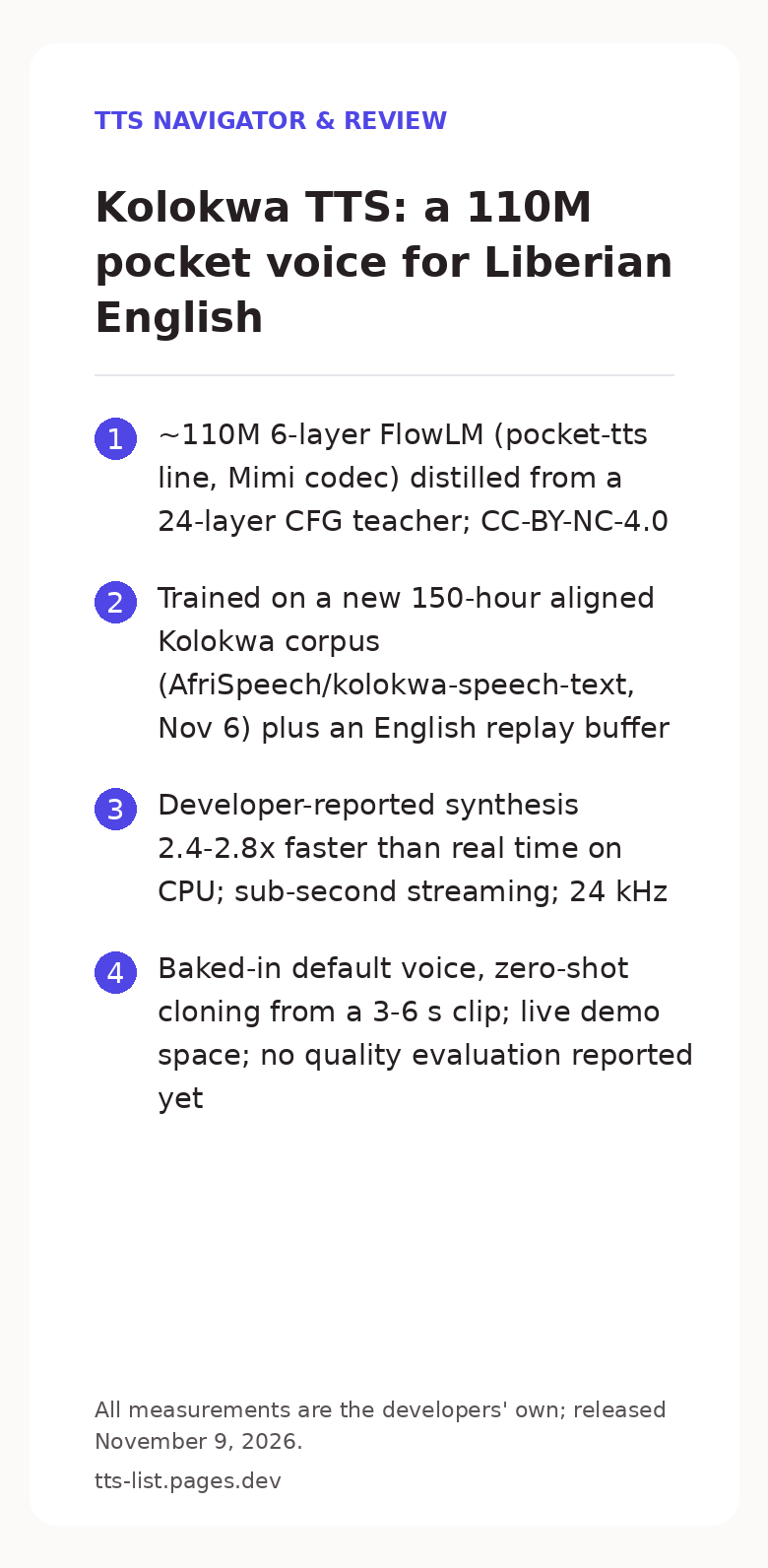
Kolokwa - Liberian English, also called Liberian Creole, ISO 639-3 lir - is the most widely spoken variety in Liberia and has had essentially no open speech technology. Kolokwa Pocket TTS, released on Hugging Face on November 9 by the AfriSpeech project, is a ~110-million-parameter text-to-speech model for it, built as a fine-tune on the pocket-tts architecture line: a 6-layer FlowLM with Lagrangian Self Distillation over the Mimi neural codec, distilled from a 24-layer teacher run with classifier-free guidance 2.0 so the small model keeps the teacher's guided quality in a single forward pass per step. The developers report it running at 2.4-2.8x real time on CPU - that is, faster than real time - with sub-second streaming latency. CC-BY-NC-4.0, following the training dataset.
The data did the work
The model sits on a dataset AfriSpeech published days earlier: AfriSpeech/kolokwa-speech-text, 150 hours of aligned Liberian English speech (created November 6). Training anchored that with a clean English replay buffer so the small model does not forget foundational structure while specializing. Voice handling follows the pocket-tts pattern: a default Kolokwa voice is baked in, and any 3-6 second clean clip becomes a zero-shot voice prompt through get_state_for_audio_prompt. Output is 24 kHz, and usage is the upstream pip install pocket-tts stack with the config loaded straight from the HF repo.
What ships around the model
The release comes with the scaffolding low-resource releases often skip: an audio-samples space, an interactive live demo space, and a source repository (AfriSpeech/Liberia-English-Speech). That matters for a creole whose speakers can immediately hear whether the model actually sounds like home. One honest gap: the card reports speed figures but no intelligibility or quality evaluation - no WER round-trip, no listening test - so the samples and demo are currently the evidence.
Our analysis
Two things stand out. First, the sequencing: dataset first, model days later, both named and linked - the opposite of the "weights appear, provenance never does" pattern. For a variety like Kolokwa, the 150-hour aligned corpus is arguably the more durable contribution, and licensing the model CC-BY-NC to follow the dataset keeps the chain consistent. Second, the architecture choice is the emerging low-resource template: take a small distilled flow-matching model with a baked-in teacher's guidance, specialize it on a few hundred hours, and you get CPU-real-time speech without a datacenter - the same shape we saw this week in Khmer (VoxPocket) and Sakha (Anadil), now for West Africa. The missing piece is evaluation: "2.4-2.8x real time" tells you it is fast, not that it speaks Kolokwa well, and until native speakers weigh in, the demo is the test. If you work on Liberian language tooling, this is the starting point - and the dataset is open for the next person to beat it.
Sources
- Hugging Face model card: AfriSpeech/kolokwa-tts (read in full, November 10, 2026)
- Training dataset: AfriSpeech/kolokwa-speech-text (150 hours, created November 6, 2026)
- Live demo space and source code on GitHub (link unavailable)