Anadil Sakha TTS: a 72 MB LoRA that gives Yakut a synthetic voice
November 9, 2026 - by TTS Navi. We read the full model card; what few measurements exist are the developers' own, and we say so where there are none.
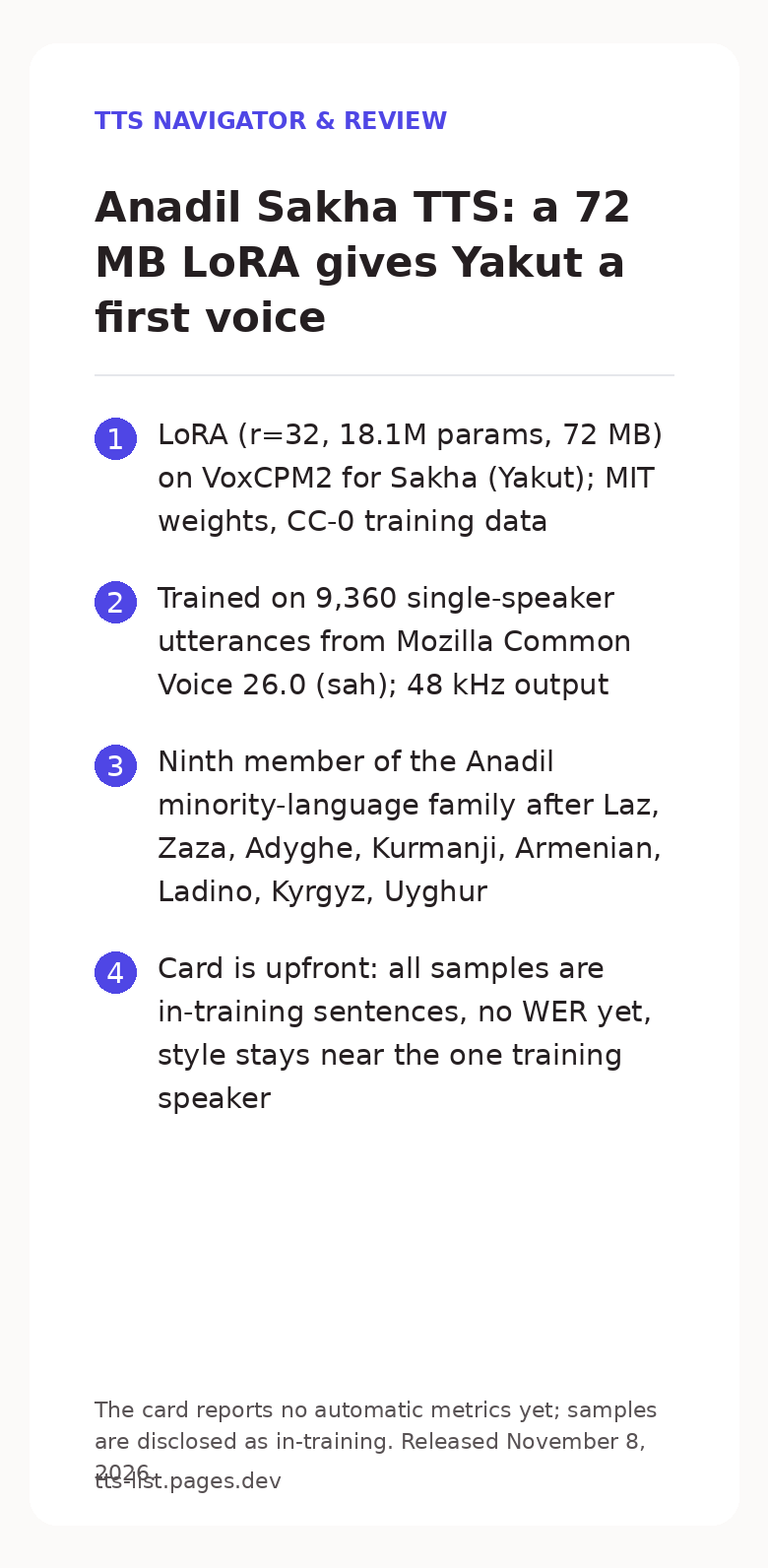
Sakha (Yakut) - a Turkic language of Russia's Sakha Republic, several hundred thousand speakers - has essentially no open speech technology. AnadilSakhaTTS, released on Hugging Face on November 8, takes the cheapest honest path that exists in 2026: a LoRA adapter (rank 32, about 18.1M parameters, 72 MB) on top of OpenBMB's VoxCPM2, trained on 9,360 single-speaker utterances from Mozilla Common Voice 26.0's Sakha section. It is the ninth member of the Anadil family's minority-language TTS adapters, after Laz, Zaza, Adyghe, Kurmanji, Armenian, Ladino, Kyrgyz and Uyghur. MIT license; training data is CC-0.
What the card does and does not claim
The card provides five sample sentences with the original speaker's recording next to the synthesized output - and states plainly that all five are in-training sentences, and that automatic quality metrics (WER and the like) have not been computed yet. There is no benchmark table because there is nothing honest to put in one yet: 9,360 segments from one speaker is far less data than the family's other languages had, and the card says the model's style stays close to that one training speaker when talking freely. Other voices are approached only through VoxCPM2's zero-shot cloning with a reference clip. The adapter trains the language model and DiT layers (r=32, alpha=32), outputs 48 kHz audio, and needs about 9 GB of memory in fp32 with CUDA preferred.
Why this shape of release matters
The Anadil project is running a repeatable play: take a strong open multilingual base (VoxCPM2), take the one public corpus that exists for the language (Common Voice), train a small LoRA, and publish everything - weights, inference script, smoke tests, a Gradio demo - under MIT. Each release makes the next one easier, because the tooling and the recipe are identical across the family. For a language like Sakha, the alternative to a rough open adapter is not a polished commercial product; it is nothing. Common Voice's Sakha section exists at all because volunteers recorded those 9,360 sentences, and this release is what turns that kind of community data into something a developer can call from Python in five lines.
Our analysis
Judge this as a starting point, not a voice. The disclosure is exactly right - in-training samples labeled as such, metrics absent rather than invented, data-size weakness stated before any praise - and it sets the bar for what "v0.1" should look like for low-resource releases. The honest reading: with one speaker and under ten thousand segments, expect intelligible Sakha with the training speaker's timbre, usable for prototyping and community tools, not for production narration. The two things that would move it forward are the two things the card itself points at: more Common Voice contributors for Sakha, and a held-out evaluation once the data supports one. If your language is in the same position, the Anadil recipe is currently the most legible template for cloning this approach.
Sources
- Hugging Face model card: Anadilorg/Anadil_Sakha_TTS (read in full, November 9, 2026)
- OpenBMB VoxCPM2 (base model); training data: Mozilla Common Voice 26.0 (sah, CC-0)