Kitten TTS 2 goes small: 82M, 17M and 7.2M models that run on CPU from an 8 MB ONNX file
November 13, 2026 - by TTS Navi. We read all three model cards in full; the cards contain no quality benchmarks at all, and everything below is what the cards state.
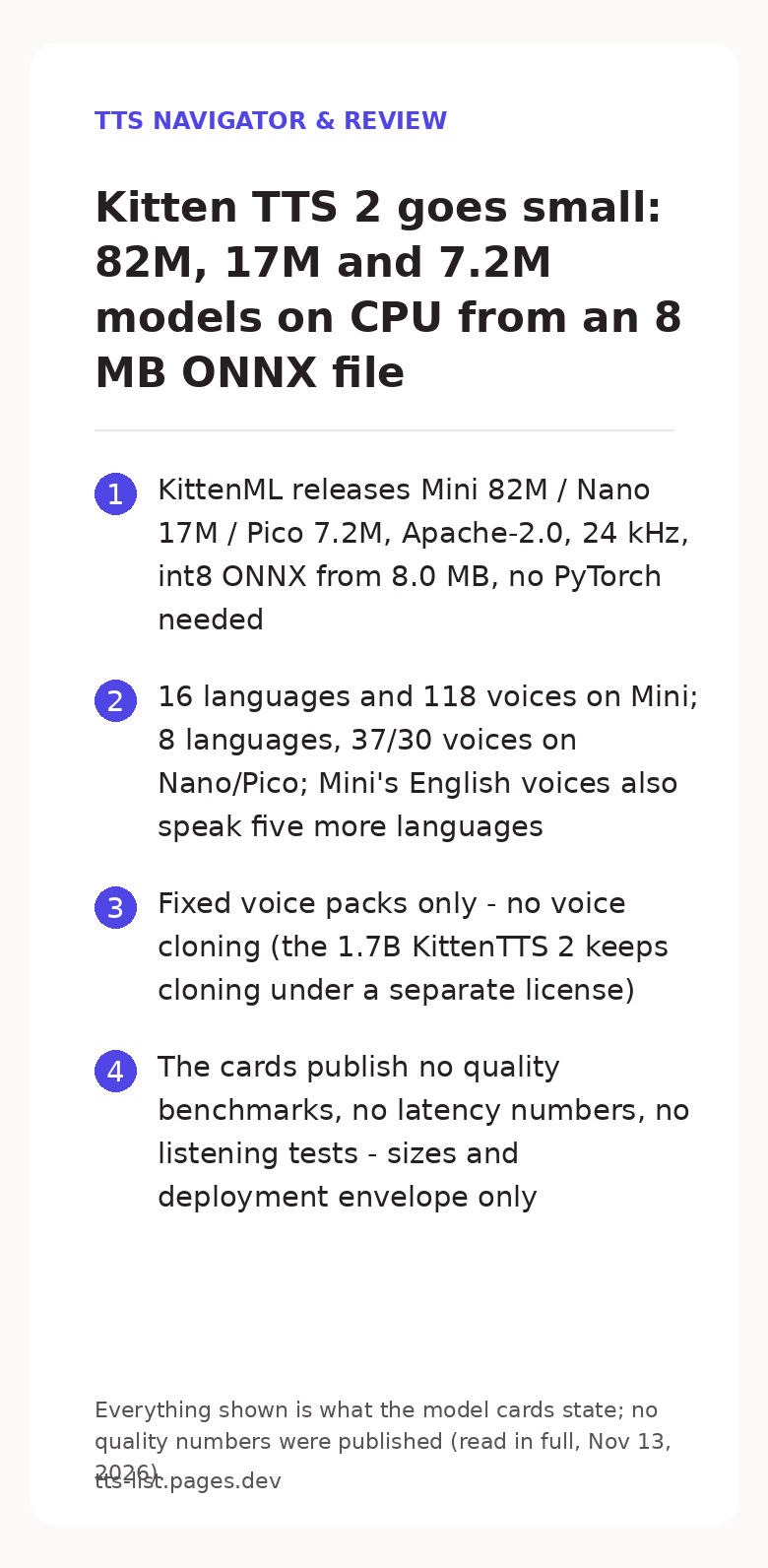
KittenML today released three small members of its Kitten TTS 2 family: Mini (82M parameters, 16 languages, 118 voices), Nano (17M parameters per language model, 8 languages, 37 voices) and Pico (7.2M per language model, 8 languages, 30 voices). All three synthesize 24 kHz audio, ship as int8 ONNX graphs that run on CPU with ONNX Runtime alone - 82.7 MB, 17.4 MB and 8.0 MB respectively - plus float32 PyTorch weights, and all three are Apache-2.0, including the voice packs and the bundled G2P files. The family context matters: the original KittenTTS 2, released September 30, is a 1.7B speech language model with in-context voice cloning from a 5-30 second reference, under a custom community license. The trio gives up cloning entirely - voices are fixed, named character packs - in exchange for size, CPU-only deployment and a permissive license.
What the cards specify
The runtime story is the point. pip install kittenml, pick a backend: onnx (default) runs the int8 graph with ONNX Runtime and no PyTorch install; torch loads the float32 weights on CPU or GPU. Only the files the selected backend needs are downloaded. Voices are first names with one-line descriptions ("Eleanor - somber historian", "Otis - rumbling blues musician"), addressable by name or description, with per-language voice packs stored as npz files. Mini covers English, German, Spanish, Italian, Portuguese, Russian, Hindi, Danish, Finnish, French, Japanese, Korean, Dutch, Swedish, Swahili and Turkish; Nano and Pico cover the first six of those plus Hindi and French. One cross-language wrinkle in Mini: its English voices also speak German, Spanish, Italian, Portuguese and Russian under the same voice name when you pass a language= argument - a single speaker identity across six languages, which is unusual at this size. Generation exposes a speed parameter; everything else is per-voice.
What the cards do not say
There are no benchmarks, no latency numbers, no listening tests and no training details on any of the three cards - no WER, no MOS, no real-time factors. The parameter phrasing differs between cards in a way worth quoting exactly: Mini is "82M parameters, 16 languages," while Nano and Pico are "17M / 7.2M parameters per language model," which reads as one small model per language bundled per repo. We did not run the models, so we cannot add numbers of our own; what can be said from the cards is the deployment envelope (CPU-only via ONNX Runtime, 8-83 MB on disk, 24 kHz output) and the licensing (Apache-2.0 end to end). The 1.7B KittenTTS 2 remains the family member with voice cloning; it carries a different, custom license.
Our analysis
The interesting move is the ladder shape. Most small-TTS releases ship one size; KittenML shipped three rungs at once, each with a clear deployment target - Pico at 8 MB is small enough to bundle inside a mobile app binary, Nano at 17 MB fits embedded Linux comfortably, Mini at 83 MB is the quality rung for desktop CPU apps. That mirrors where open TTS demand actually is: Kokoro-82M's adoption came from exactly this "good enough, tiny, Apache-2.0, runs anywhere" envelope, and KittenML is the same team that has been iterating in this niche since the kitten-tts nano/micro releases of 2025. The honest gaps a buyer should weigh: with zero published quality evidence, choosing a rung means listening yourself; fixed voice packs mean no cloning and no style control beyond speed; and multi-speaker-per-language coverage is thin outside English (four voices per language on Nano/Pico, and several Mini languages have only two or three). For screen-reader, toy, accessibility and offline-assistant use cases where an 8 MB Apache-2.0 artifact is the whole requirement, Pico alone makes this release worth a look.
Sources
- kitten-tts-2-mini model card (read in full, November 13, 2026)
- kitten-tts-2-nano model card (read in full)
- kitten-tts-2-pico model card (read in full)
- KittenTTS 2 (1.7B, voice cloning, separate license)