Inworld Realtime TTS-2 learns to reason: the model decides how to say your line - plus a faster, steadier refresh
Published October 30, 2026 · Built from Inworld's product update, read in full on October 30, 2026. Speed and consistency figures are Inworld's own comparisons; the Cekura numbers are an independent benchmark, labeled as such. We did not run the model.
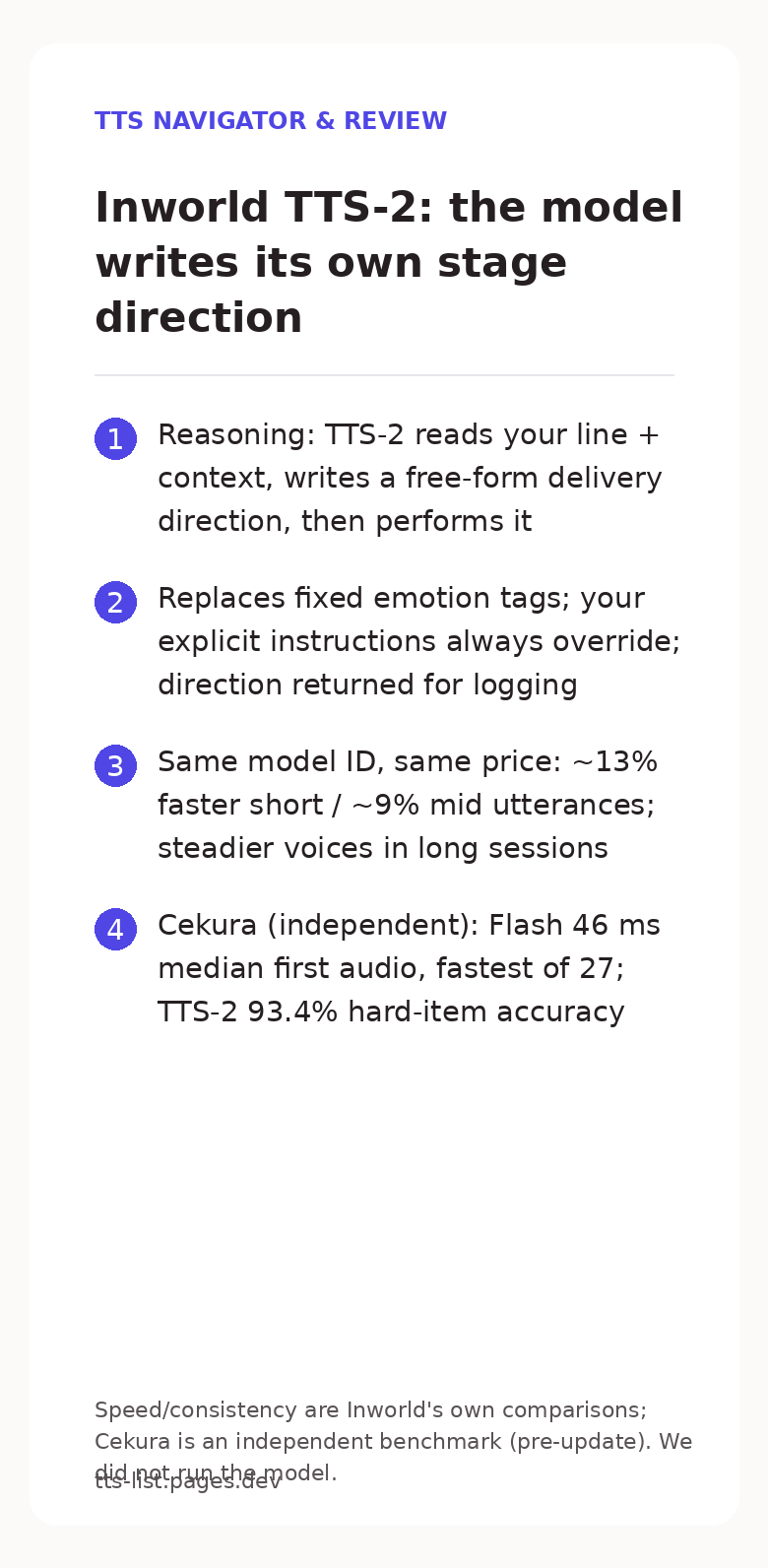
Inworld has shipped two updates to Realtime TTS-2 (October 28). The headline is Reasoning: the model reads your line plus a context you supply, writes itself a short delivery direction - "warm, delighted, speaking through a smile" - and then performs it. Inworld calls it the first speech model that decides how to say something before saying it. The second update is a model refresh behind the same model ID (inworld-tts-2) and the same price: faster generation and steadier voices over long sessions, no integration changes.
Reasoning: directions, not tags
- The problem: "I can't believe you did that." can be delight, hurt or disbelief. Without context a TTS model gives all three the same neutral read - and in a live app, nobody is there to mark the line up by hand.
- How it works: one request, three steps - you send text plus a
reasoningContext(never spoken); a language model inside the same TTS-2 request writes the delivery direction; TTS-2 performs it and returns the direction it chose in the response, so you can log it and adjust your context when a read is off. - Why not emotion tags: a tag is one label from a fixed list, identical in every scene, and your own LLM has to maintain the rules for picking it. Reasoning writes a free-form direction that sets emotion, tone and pacing together. Explicit instructions and inline tags you set yourself always override what Reasoning writes.
- Availability: opt-in (one field), live on TTS-2 synthesis, streaming and async requests at launch; WebSocket streaming, duplex (including the Realtime API) and batch are "coming soon."
The model refresh - vendor's own comparisons
- ~13% faster generation on short utterances, ~9% on mid-length, with more consistent speed across input lengths. Inworld's own honesty note: TTS is only one of five delay components (turn detection, LLM, network, playback) - measure the others separately.
- Steadier voices: better voice similarity in Stable mode, particularly for voices that have been hard to clone; less voice drift across long duplex sessions - companions and agents keep their identity deeper into a conversation.
- Completeness fixes: no more skipped words in long utterances; dropped final plosives (/p/, /t/, /k/) restored - word endings come through clearly. Creative mode gets more natural delivery with light built-in steering.
- Rollout is automatic by serving region behind the same model ID; Reasoning itself is opt-in.
The independent numbers (Cekura benchmark, labeled)
- Realtime TTS-2 Flash: 46 ms median, 73 ms p90 to first audible sound with the full text sent upfront - Cekura ranks it fastest of 27 models tested in the non-streaming category.
- Realtime TTS-2: 93.4% of difficult items read correctly - numbers and shorthand, codes and addresses, context-dependent words, medical terms.
- Method caveats: 104 agent sentences, three reads each, from one US East region; accuracy is estimated from speech-to-text transcripts, not human listening; and these results predate this update and do not include Reasoning.
Why it matters
- Prosody control is moving from markup to inference. Emotion tags made the app developer maintain a label vocabulary; Reasoning moves that judgment into the model, against the actual context. If it works in production, expect every TTS API to offer a "director" step within a year.
- The returned direction is the quietly important part. Getting the model's chosen direction back in the response makes prosody debuggable - you can see why a line came out flat and fix the context, not the audio.
- Same-ID refresh is a double-edged convenience. No integration changes also means your production voice changed without a version bump - teams with voice QA baselines should re-run them.
Source (read in full; link verified October 30, 2026)
- Realtime TTS-2 updates: reasoning, speed and consistency - Inworld AI (October 28, 2026) - all Reasoning mechanics, speed/consistency claims and the Cekura figures it cites.