Paper: ImageTTS takes FLUX.2 off the shelf - frozen image VAE and all - and makes it speak
Published October 29, 2026 · Built from arXiv:2610.34807, read in full on October 29, 2026. Every number below is the paper's own experiment - we say so each time it matters. We did not run the pipeline.
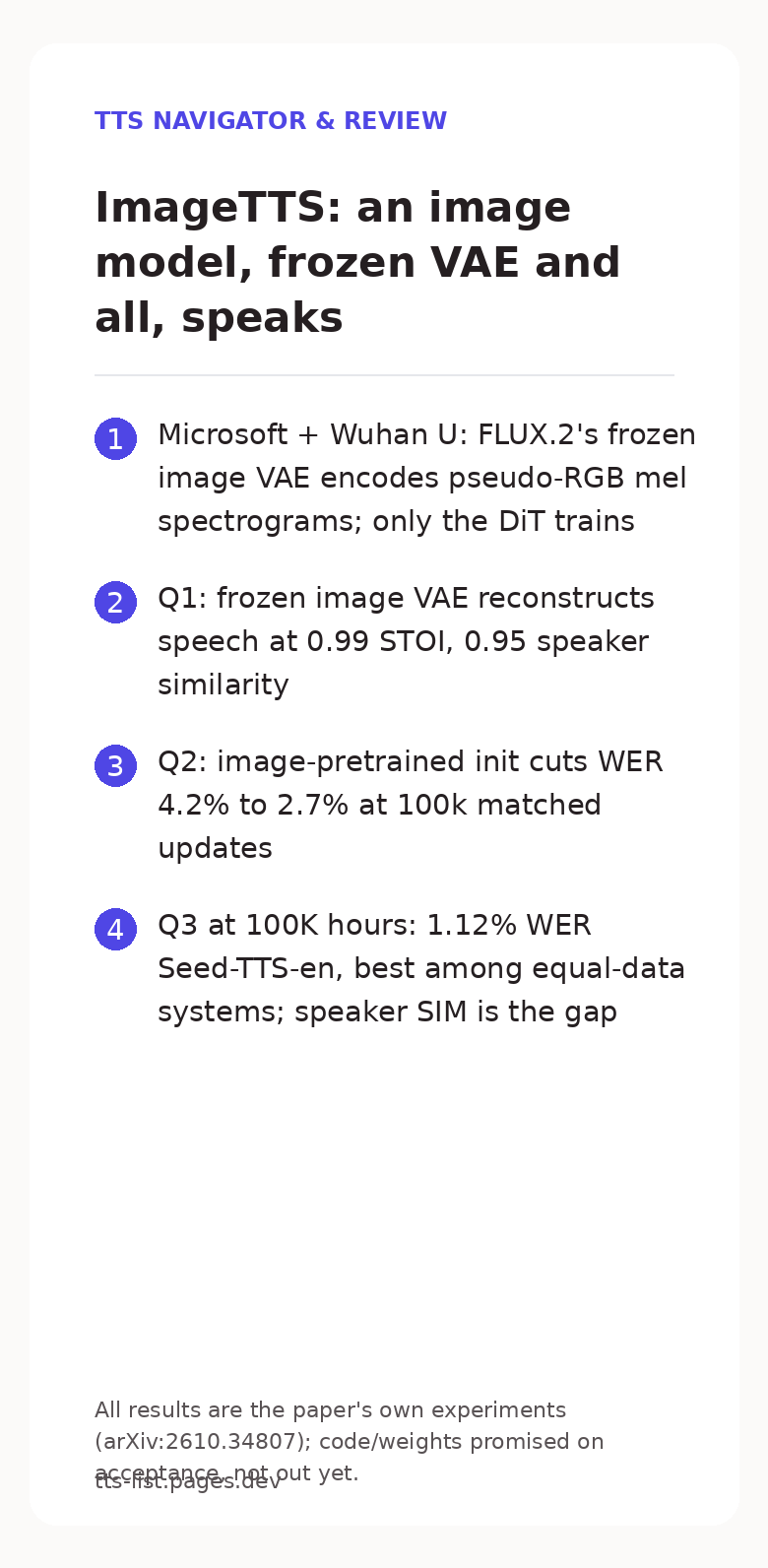
Speech models keep borrowing architectures from image generation - DiTs, flow matching, masked modeling. A new paper from Microsoft, Wuhan University and CUHK asks the harder question: can a text-to-image model supply not just the architecture but the learned internals - the latent space and the generative prior - for speech? ImageTTS answers by doing almost nothing: mel spectrograms are painted as pseudo-RGB images, encoded by FLUX.2's frozen image VAE, and only the pretrained DiT is fine-tuned with conditional flow matching. The paper is structured as three cleanly separated questions, which is what makes it worth reading.
Q1: can an image latent space represent speech? Yes, almost losslessly for content
Reconstruction through the frozen FLUX.2 VAE (no training at all) preserves 0.99 STOI intelligibility and 0.95 speaker similarity - versus 0.98 similarity for direct mel modeling through the same vocoder. An off-the-shelf visual codec turns out to be a serviceable speech codec. The 0.03 speaker-similarity gap matters later.
Q2: does image pretraining help the DiT? Yes, consistently
At 100k matched training updates on LibriTTS, image-pretrained initialization beats random initialization in both generation spaces the paper tests: WER 2.7% vs 4.2% in the image-VAE latent space, and 3.1% vs 4.2% for direct mel modeling. The ablation also separates the two transfers: modeling in the VAE latent yields better DNSMOS (3.78 vs 3.51), while direct mel keeps more speaker identity (SIM 0.80 vs 0.78). Representation transfer and prior transfer are different things, and both are real.
Q3: does it hold at scale? Mostly - with one named weakness
Scaled to about 100K hours of Emilia speech, ImageTTS-base reaches 1.12% WER on Seed-TTS test-en (MOS 4.08±0.18) and 1.68% CER on test-zh (MOS 4.01). Among systems trained on comparable public data - F5-TTS (95K hours: 1.17% WER, MOS 3.33) and MaskGCT (100K hours: 2.33%, MOS 3.95) - it has the lowest error rate and highest MOS on every setting. Against systems trained on vastly more private data, Qwen3-TTS (>5M hours, 0.96% WER) still leads, as you'd expect; the paper keeps those rows visibly separate rather than claiming the overall crown. The named weakness is speaker similarity, especially on Chinese (SIM 0.72 vs F5-TTS's 0.76 on test-zh) - and the paper attributes it directly to the frozen image VAE, citing that Q1 reconstruction gap. The proposed fix is future work: adapt the VAE to speech.
The instruct variant: data efficiency as a side result
ImageTTS-instruct continues training on CapSpeech pairs - transcript plus natural-language style description, both encoded by the same frozen Qwen3 text encoder the image pipeline ships with. With only 9K hours of instruction data (versus 33.6K for the CapTTS baselines), it posts the best scores among CapSpeech-trained models on nearly all metrics, reaching Style-ACC 0.66 - just behind VoxCPM2's 0.69, which sits outside that data budget. WER (8.8%) shows instruction following still costs content accuracy across the board.
Honest bookkeeping
- Zero-shot synthesis is formulated as reference-conditioned latent infilling; a dual classifier-free guidance sweep lands on (text 2.5, speech 1.8) - reported openly, not hidden in an appendix knob.
- Code and checkpoints are not out yet - promised "upon acceptance"; an anonymous demo page exists for audio samples. All results are the authors' experiments; not independently replicated.
- Ground-truth MOS on Seed-TTS-en is 4.17±0.19, so 4.08 still sits below natural speech.
Why it matters
- A second life for image models. If a frozen image VAE is a near-lossless speech codec and image pretraining transfers generative priors across modalities, every future image-model release is also a speech-model starting point - cheap adaptation instead of training from scratch.
- The bottleneck is precisely located. Speaker identity, not intelligibility, is what the visual latent loses - which tells the field exactly where to spend effort (adapt the VAE) rather than re-litigating whether transfer works.
- Experimental hygiene as the message. Three separated questions, matched-update comparisons, data-budget-aware baselines, and a limitation traced to its mechanism. Yesterday's persona paper did this for control interfaces; this one does it for representation transfer.
Source (read in full; link verified October 29, 2026)
- ImageTTS: Repurposing Pretrained Image Diffusion Transformers for Speech Synthesis - arXiv:2610.34807 (Pei, Liu, Deng, Wei, Liu, Yu, Huang) - all reconstruction, ablation, zero-shot and instruction-tuning numbers above.